Discover here some pictures of our Studio Flash shooting session we had during Franc’s Advanced Photography Workshop on Saturday November 1st. Here is the first part, action pause with Elisa and Diego.
By Franc Peret
For this Advanced Photography Class Workshop held in The Apartment (Yongfu lu, Shanghai), we had the chance to get 2 different topics.
You can discover some pictures here, done with a great pair of Copaeira dancers, Elisa and Diego from Italy, who are based in Shanghai.
In another post, you can check what we had done with our Model Isabelle during that same class.
1 – Acrobatic composition with Elisa and Diego, two Capoeira Teachers (http://capoeirashanghai.com).
Capoeira: Sometime girl almost hits boyThis could be a logoCapoeira: Sometime boy almost hits girl
Some more solo and duo figures
2 hands1 handKickingKicking 2Cropping
This class was a great success, Thanks to Elisa and Diego’s enthusiasm, energy and professionalism.
Franc
Special Thanks to Nico to give us the chance to discover such great talents.
Discover here some pictures of our Studio Flash shooting session we had during Franc’s Advanced Photography Workshop on Saturday November 1st. here is the second part. Modeling shots with Isabelle.
By Franc Peret
For this Advanced Photography Class Workshop held in The Apartment (Yongfu lu, Shanghai), we had the chance to get 2 different topics.
You can discover some pictures of our modeling shot here, done with Isabelle (a sweet lady from Quebec) and in another post you can see what we had done with Capoeira dancers.
It was a pure joy to work with Isabelle who get all the the quality we are looking for, from a model: natural attitude, patience, motivation, joy and sens of humor.
It is not that easy to stand in front a group of photographers, especially when few of them are quit strange (will not tell the name here!) and Isabelle adapted herself perfectly.
2 – Modeling session with Isabelle.
Spring in the darkIsabelle is a Femme fataleSpring on a SofaI guess I am the boss
This class was a great success, Thanks to Isabelle’s enthusiasm, energy and professionalism.
I do not advise my Essential Photography Class students to use the Manual setting in an uncontrolled environment, but sometimes I am personally forced to do so and I am explaining here how to handle such situation.
By Franc Peret
I am teaching to my Essential Photography Class students how to precisely and quickly control their camera in semi-automatic Aperture priority mode as it is the most efficient way to get it right, in real life photography.
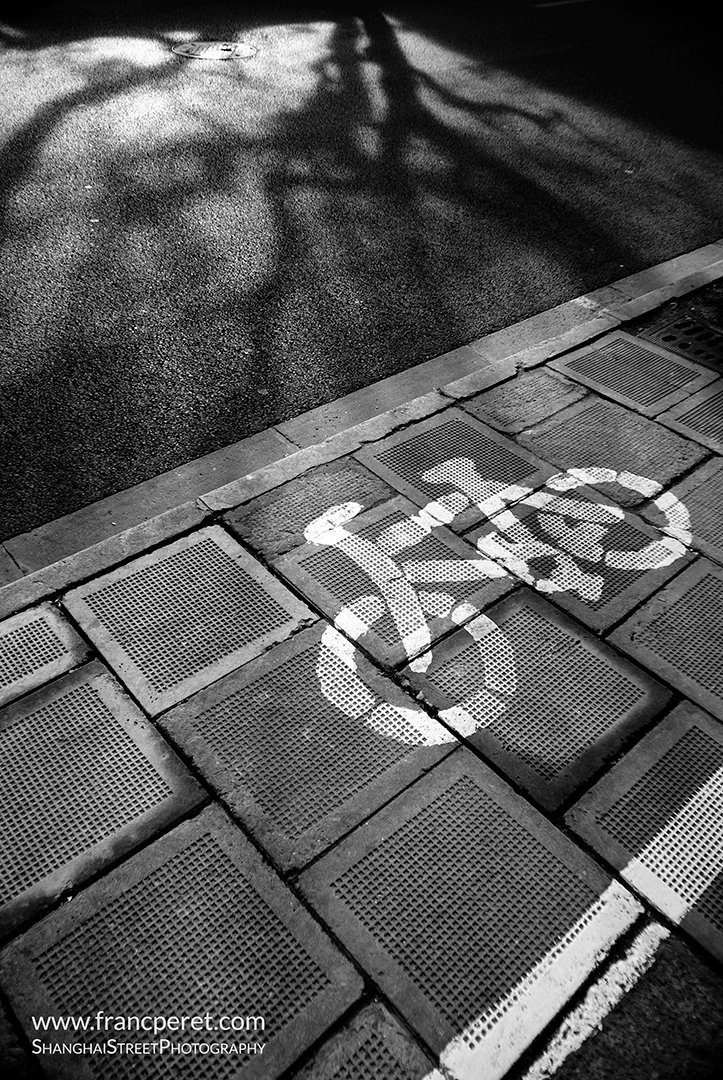
Nikon1 V1 and Cine Nikkor 10mm f1.8. With Sign and Shadows. Using a wide lens imposes to fill up the frame with interesting things (textures, Shape and Lines).Nikon1 V1 and Cine Nikkor 10mm f1.8. With Bicycle.
On my own, as I like to experiment a lot, I am often working with a strange combination of cameras and lenses linked by an adapter. And sometimes the 2 entities refuse to communicate with each other as they were not supposed to be connected.
Public Phone in the street. Soon to disappear… Nikon1 with 10mm f1.8 (equivalent to 27mm on a FX camera or 18mm on a DX)
Then, I am on my own, forced to use a full manual set up for both focus and exposure.
Last summer, I spent 2 months with such a strange combination. I adapted a collection of very old Cine-Nikkor C-mount lenses on my Nikon1 V1.
Therefore, for every shot, I had to guess the exposure and getting confirmation after the shot by checking the histogram to know if I were right or wrong.
One tip I am teaching to my students is this:
If you can see blue sky over your head and you are shooting someone under sunlight, the exposure value is matching (@ISO100 – f8 – 1/250s) or (@ISO100 – f5.6 – 1/500s) or any other combination at the same EV14.
For example, I might use (@ISO100 – f2 – 1/4000s) for portrait or for freezing high-speed action.
Having a base line to start with
EV14 is there in an average situation and in an average location.
In Australia Outback (no air pollution and lots of reflection from the sand), in The Alps, Himalaya, Tibet or Xinjiang high altitude (closer to the source of light) this value can be double (EV15) or even more.
That means the combination will be (@ISO100 – f8 – 1/500s)
In average situation, like in French Burgundy, I preset my camera to the EV14 value under a blue sky (@ISO100 – f5.6 – 1/500s) for a common subject.
If my subject is under the shadow, I know the EV is dropping at least by 2 stops so I will reduce my speed by 4 (@ISO100, f5.6, 1/125s) or open up my aperture by 2 stops (@ISO100 f2.8 1/500s) to compensate.
Taking care of parameters
My decision will depend on the fact I need or not speed to freeze motion or depth of field to get more things in focus.
This is a Quick and approximate decision without taking my eye out of the viewfinder. Shadow will be darker if the subject is not surrounded by reflective surfaces (such as a white wall).
And I will adapt my decision according to this parameter.
With the Nikon1 and my C-mount lenses, the Aperture ring is on the lens, and the shutter speed is controlled by a button next to my thumb.
Very handy.
Experience helps indoor
Now let’s imagine my subject is moving into a house with windows and white wall.
Outside is sunny and I know that the EV will be around 8 to 16 times slower (3 or 4 stops) indoor…
This is an approximation but if you are used to your environment, you should be able to guess quite accurately after few test shots. This will help you later on to get closer to the truth in few steps.
Most of the time, I got it right at first shot.
Variation will depend on reflection around (white wall or trees) the subject.
Working with human brain
Of course, during an overcast day, I have to do more test and try as I am having no reference anymore. Not every grey curtain or clouds in the sky deliver the same exposure on earth! It can be dramatically different from one day to another, one hour to another.
Step by step, knowing my environment, and having my eyes and brain used to communicate each other in this “guess what is the exposure here” game, I became more and more accurate in guessing the exposure of the place I were shooting my subject.
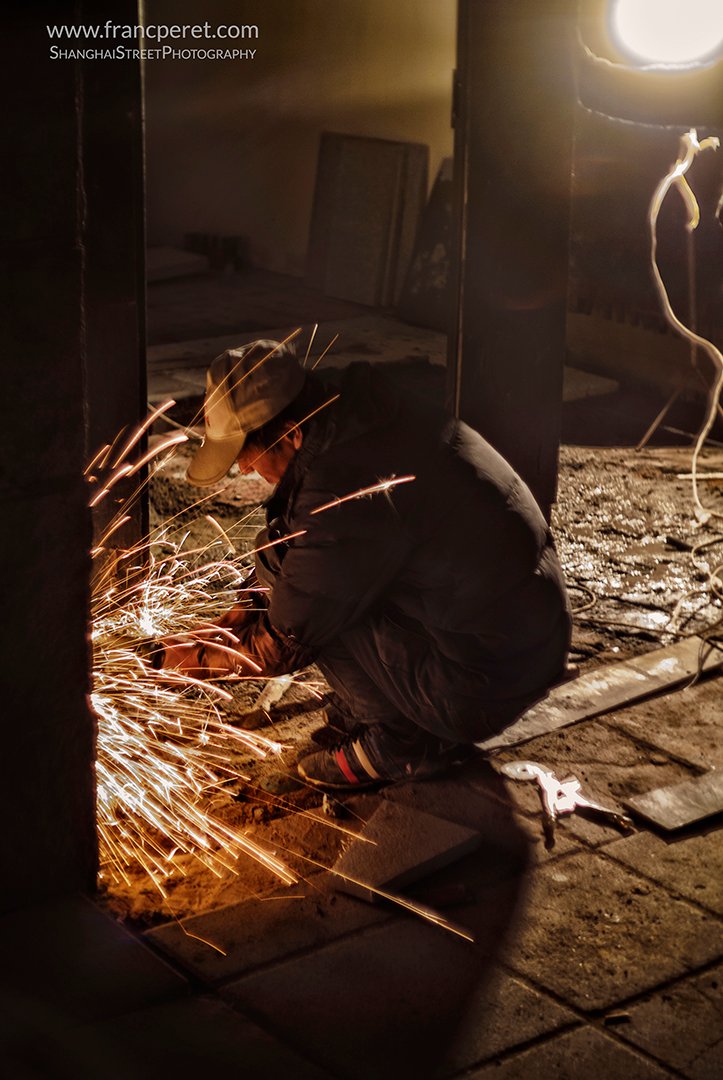
Nikon1 V1 @ ISO100, f0.95, 1/13s. I just stabilized myself with a tree, and waited my subject to be steady. My advice: Always immediately check the result you get to see if you really need to increase the ISO or not.Nikon1 V1 with an Angenieux 25mm f0.95 lens. Manual Focus and Manual exposure as this is a 30 years old lens without any “smart” contact with the camera body. I could increase the ISO a bit, but among the 10 shots I had done half of them are sharp enough so I had no reason to lose quality to raise the speed. Also, keeping a slow speed helped to get longer sparks.
Concerning focus set up, I was used to manual focus when I started my photography career back in 1986, so this didn’t bother me much since the viewfinder of the Nikon 1 is sharp enough for me to hit the focus right even using the f0.95 lens.
Finding the right balance
Manual focusing is like finding the right balance between too far and too close.
Actually, the best way to hit the right focus point is to turn the focus ring until you get your subject sharp in your view finder and then you just turn the focus a bit more until you lose the sharpness.
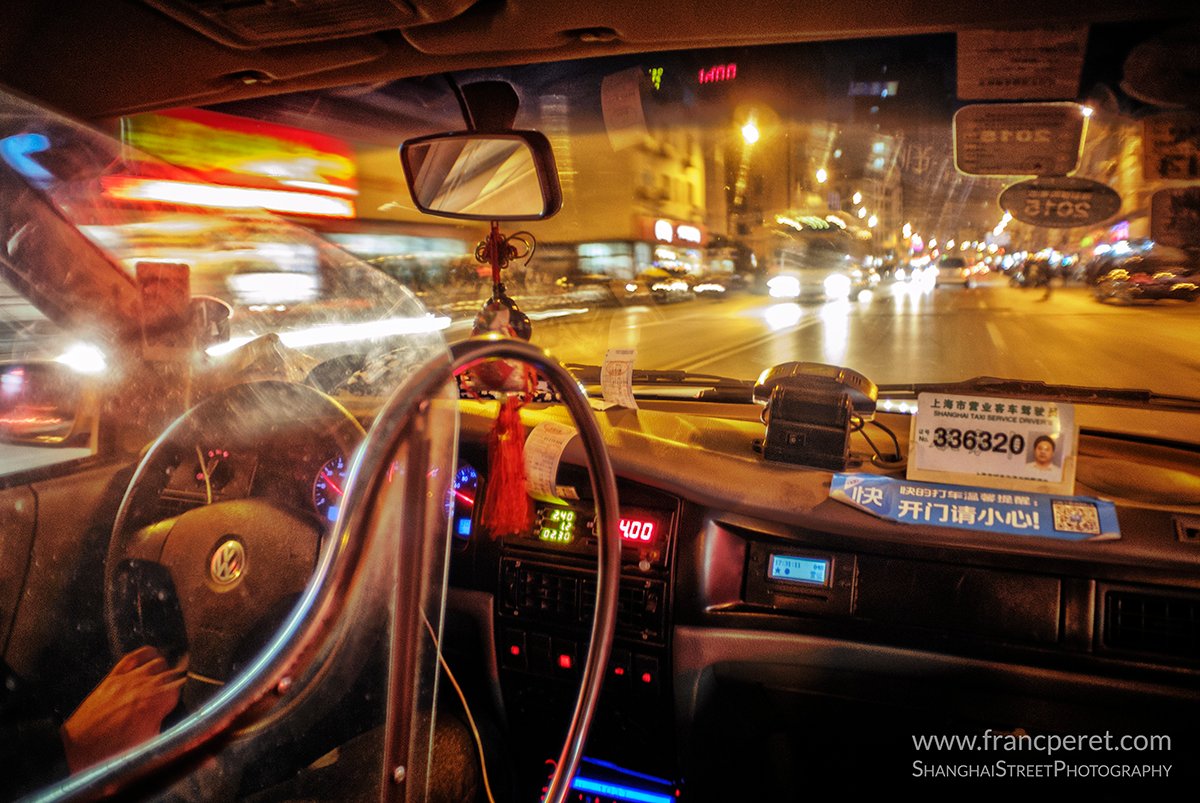
10mm f1.8 @ f2, Nikon1 @ ISO400, 1/10s
Then you turn your focus ring in the opposite direction until the subject appears perfectly sharp, again.
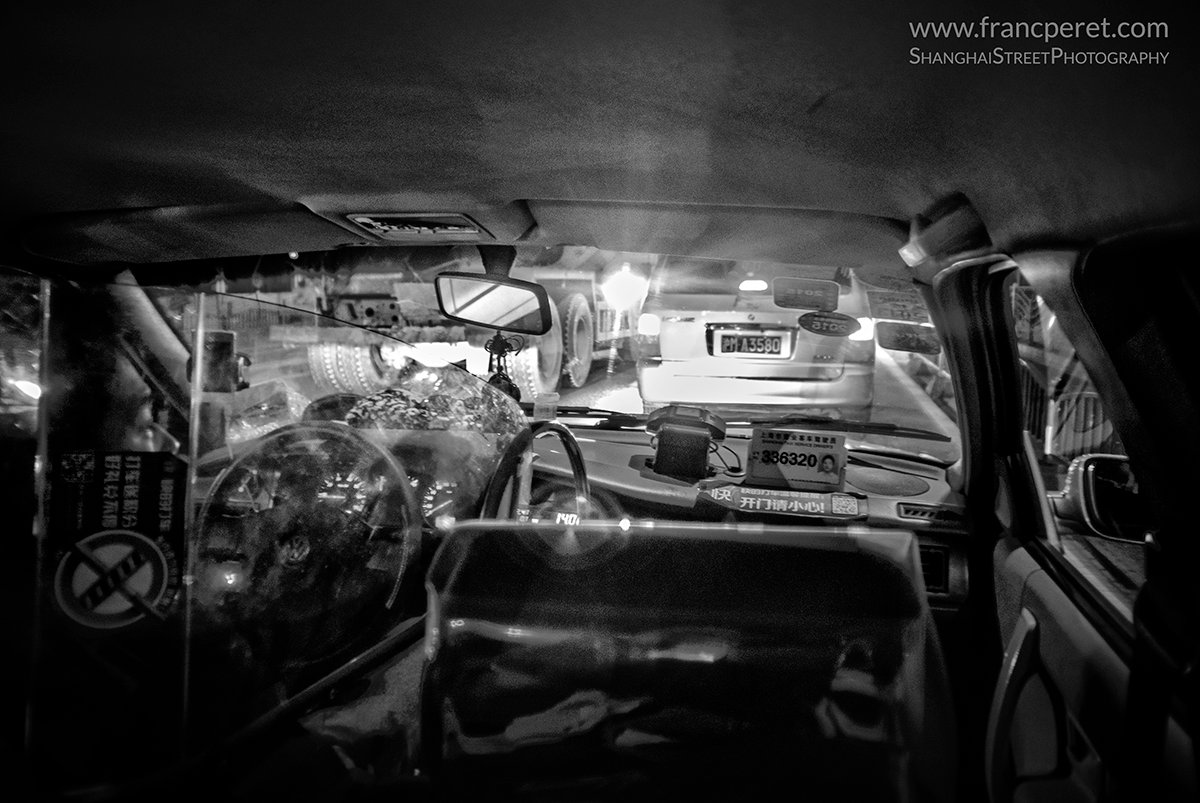
Cine-Nikkor 10mm f1.8. Shot done at ISO400, f1.8, 1/10s. Harder to shoot when the car is moving but still workable. Camera is still the Nikon1 V1. Manual Exposure, Manual focus, hand held.
To be more precise you can turn a bit more and see if it is better or worst, and then go backward again.
It is long to explain, but very quick to do
Overall, I was so seduced by the result (color, mood, character…) I got with the combination of the Nikon1 and my old lenses, that I left my GH4 and the Lumix lenses at home, despite the lack of any exposure and focus assistance from the Nikon1.
10mm f1.8 @f2. Advantage of small sensor camera is to get enough depth of field even wide open. Nikon1 V1 ISO100, 1/60s.10mm f1.8 @ f8 on Nikon1 @ ISO100. 1/160s
Of course, I would be very happy to get a firmware update or a hack to get the Nikon1 able to work on semi-auto Aperture priority with a dumb adapter.
That would make it even more enjoyable to use.
Just remember that in Photography, nothing is impossible and all is a matter of logic. And, if it is time-consuming and brain tiring to shoot fully manual, it is quite rewarding to be able to achieve the exact shots I had predicted without any assistance.
However, if I were using the exact same combination in the same location with a camera able to work in semi-auto Aperture priority, I might have many more interesting shots, especially of people and things on the move and I would be able to concentrate more on the composition and subject placement by freeing my brain from technical consideration dedicated to the exposure only.
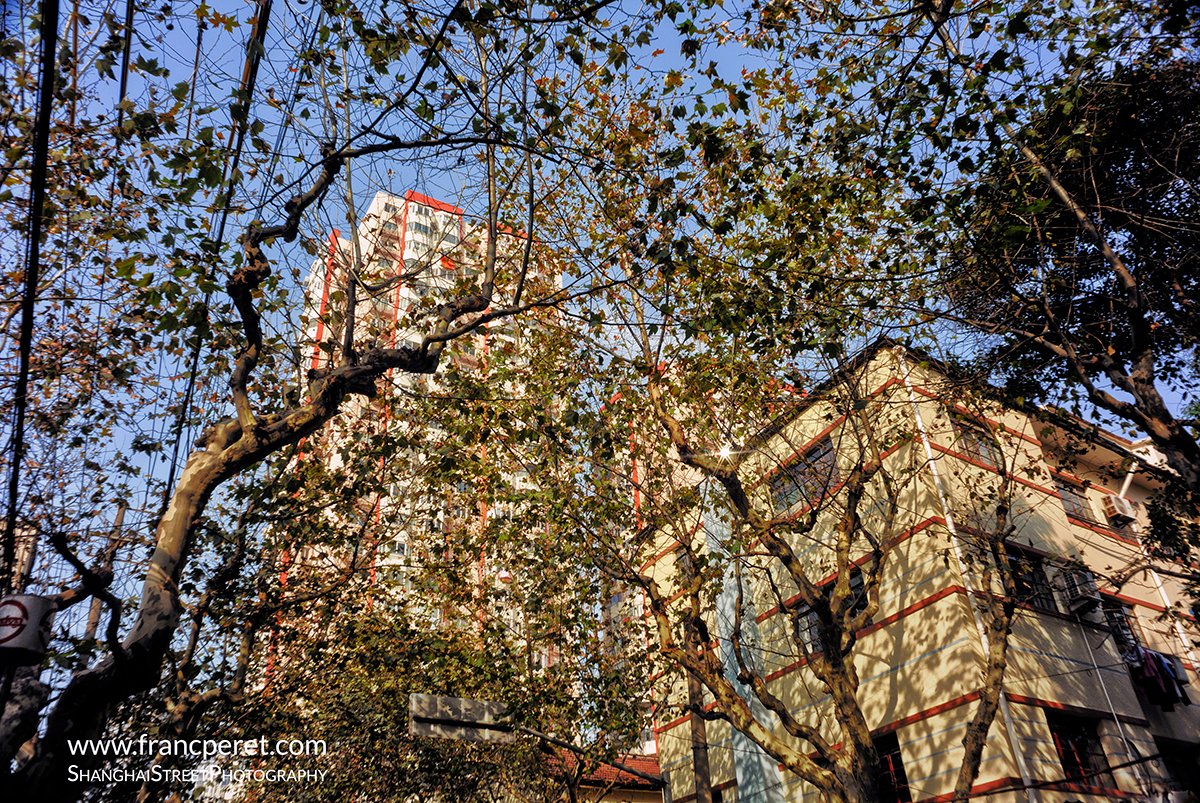
Autumn is a great season in Shanghai, thanks to the lasting blue sky and the numerous sycamore trees planted in the French concession.
By Franc Peret
To take benefit of the great lighting and the tawny color leaves falling on the ground or elsewhere, I went out with my Advanced workshop students for a 3 hours walk searching for interesting composition to memorize with our cameras.
Here are some of the shots I had done, working on structure, shape, colors, texture and humor…
Enjoy!
Franc
Black is best for reflection
Cars are everywhere nowadays, but nature is still taking over
When dust looks like marbleDust, leaves, spot of light and shadows
Decorum of the French concession
An open window for breaking down the symmetry and for catching colorful leavesFake flowers but real underwear.Leaves are ‘sitting’ anywhere, drying quietly under a filtered sun light..
People are also part of the decoration
When a leopard lady is wearing orange shoes, she sits on a Dulux painting pot.
High contrast lighting is cutting out the street in sharp shape and edges
From circle to oval.Crossing lines and shaping in 3D.Wheels in jail
Locked street cart collection for inspiration
Mixed disorder creates new order.Freed the tree!
When photography meets sculpture
One of my student standing there, his shadow reaching a leave and the magic just happened.Work and bicycle in progress.
Things always need to get fixed in Shanghai
3D game of light.Hope the knot is well done.Porsche Fan shooting a Porsche logo.Trees escaping from the fence.
Standing next to a traffic light to get traffic
Skating on Huai Hai Zhong lu.Waiting for a green light to roll again.
Photographer and target
Passing by a City sunsetLiam has 3D arms
Past and future
Connection relic, from the pre-wifi age.Monkey want to play too.
Connecting people in the street
Smiling firstPuffing second.
Riding and resting styles
Fashion in, fashion out.Riding a small bicycle barefoot is exhaustingStill some space in the taxi trunk for the baby?
Taking care of details
Make it Shine or at least less sticky.
Urban structures and monsters
Welding next to a monsterMetallic structure to fill up the sky.
My first Autumn 2014 Advanced Photography workshop was very successful. Topics was freezing water with speed, using flash or strong and constant light allowing high shutter speed.
Photos Franc Peret (Panasonic GH4)
I Wanted to share the set up, mood and some results from that first Franc’s Advanced Photography Workshop session I had done for this 2014 Spring Term.
To be able to record as many details as possible, a fast rate shooting camera is a plus, such as the Lumix GH4 able to sustain 12 frame per second
Like most of the different things students are discovering in this 10 weeks course, the set up of the action is as important as the camera setting. Photographer needs to be an orchestra conductor and not only a shooter hidden behind his/her camera.
Students are working as a group of 2 giving each others advises and alternatively handling the water choreography in front of their classmate camera.
The picture belongs to the person who set up the concept, the one who is creating the movement and the photographer who is framing and pushing the button.
As usual my students will get even more interesting pictures than mine, as I am too busy to take care of everything.
Liam and Alexandra concentrated on their mutual moment of creationThe set up of the action is as important of the camera setting in that type of photography work.
We had a great team of students: Alexandra, Dirk, Harald, Liam, Sarah, Eugenio, Regino and Jana. Ray was not there, but he will be back for the second workshop.
Stay tuned, as I am going to post all the things we are doing in class.
Dirk and Harald are working in natural light. It is possible to freeze movement without increasing the ISO in mid day with the sunshine coming into the room to light up the tank.The second way of freezing water is to use a flash in a darker environment. The short duration of the speed light compensate a slower shutter speed (1/250s in average)Harald and Dirk at workLiam working on his composition, ready to freeze a splash.
We set up a backdrop in the classroom with black and sparkling curtain.
3 camera shots in the same time.
1 x Panasonic GH1 on a slider
1 x Panasonic GH2 on a tripod
1 x Panasonic AF103 on a tripod or hand held
A wide collection of lens were adapted:
Voigtlander 25 f0.95, Nikon 50mmf1.2, Nikon 85 f1.4, Angenieux 25mm f0.95, Nikon 35mm f1.4…
Main subject
Dantes, the French singer who is singing in Chinese, composed and wrote the lyrics.
We specially had done this simple video to promote this song on the French market.
Equipment
Light set up was all tungsten with Fresnel 300W and 650W.
Final (live) Sound recording was done at the end of the video with the inboard microphone of the AF103.
I didn’t had time yet to write down English subtitle and description but it will come soon., Waiting for this, here is the original short movie in French.
By Franc Péret
Descrition in French:
Un visiteur se rend au domicile d’une personne pour répondre à l’une des annonces qu’il a publiée. Commence alors une histoire surréaliste, ou tous les personnages se comportent de manières inattendues, jouant un rôle improvisé qui s’affranchit de toute logique. Et si tout cela n’était qu’un jeu ?
Sous un air potache, ce film décrit d’une façon volontairement légère et décalée une tranche de vie où cohabitent tendresse innocente et “beaufitude” homophobe.
Dans ce monde imaginaire, la “beauf attitude” ne pervertit pas aussi facilement l’innocence des sentiments. Les blagues salaces et homophobes n’y changeront rien.
Finalement, ce monde fictif n’est-il pas moins absurde que le réel ?
Materiel utilisé :
Panasonic Lumix GH3 et GH1, Voigtlander 25mm f0.95, Nikon 50mm f1.2, Computar 75mm f1.4, SLR Magic 12mm f1.6, 100W kinoflo, LED panel, Soft bulb (125W).
Equipe technique : Franc et Sarah
Duree de tournage : 6 jours
This Music video is targeting Chinese market, my first attempt of Music video there with a camera I discovered few days before shooting.
By Franc Péret
I shot this 3min30s MTV in 2008 in Shanghai for Dantes, a french singer who is singing in both french and Chinese.
We did this shoot with a very low budget, a 3 to 4 people team.
I took this opportunity to try my newly bought Panasonic Lumix GH1, Hacked (to get higher bitrate). The running shot on board were done with the original 14-45 mm lens, which is stabilized. The other shots are done with Nikon lenses, ranking from 17mm to 300mm.
GH1 was never pushed more than ISO400, as it deliver better results being underexposed (at least 2 stops).
Night shooting even with the 300mm f4 lens (which turns as a 600mm field of view on this camera) were an amazing piece of pleasure! I did the studio shot in a classroom, where I am storing all my lighting for my photography and movie making class in Shanghai. You can check in my website: www.francperet.com/
In 1997, being in Beijing, I took advantage of my journalistic eye to catch some shots in sensitive areas, where people were kicked out from their traditional beloved houses for the good of modern profit.
Photos Franc Péret (Shot on slides, Fuji Provia100)
In 1997, I was in Mainland China for the first time and I was there with a mission.
As a western journalist able to understand Chinese (which was rare at that time), I was sent in Beijing a couple of weeks by a European Press group willing to develop a car magazine in mainland China.
Few cars in 1997 as people were mostly riding bicycle. Thanks to modernization, traffic jam and pollution level never cease to increase.Street names are not going to change, but the fancy lifting of the city is on its way.
I had two jobs in one: preparing a series of article on car reality (industry, regulation and drivers habit) and doing a market study regarding magazine creation, production and distribution in Mainland China.
Looking for magazines
Just for the anecdote, I discovered that magazine were sold in the street, not in bookstore chains and most of successful publication were available by subscription on a list in post office.
Chinese people have the logic of recycling from destruction. All bricks, tile, wood, doors and windows are carried away to villages in need of construction material.Horses are carrying away Beijing Architectural heritage.
For those who knows China a bit, no need to say that under table money was surely necessary to get a spot there.
Anyway, I took benefit of my first stay there to visit and shoot as much as I could. I can only show here my private work.
A student is drawing the street surrounding her school. Her work is a valuable memory now as this area totally disappeared.
I was amazed by the “out of time” feel of the old houses surrounding the forbidden city and fall in love for it. It was like historical movie background I had seen (such as Farewell my concubine).
Skyscrapers as goldmine
Don’t search for it now, they were all destroyed starting from 1995 to get replaced by office building and other gold mine dedicated to profit.
A timeless moment captured in the Forbidden CityFamous tourist spot without foreign tourists. They were very rare at that time.
When people are still speaking of Beijing as a culture center of China, it make me laugh with sorrow.
… to entertainment.From culture to…
Might be true for some individual, but certainly not for the architecture. Culture has no weight in front of business, despite 4000 years of history.
Gold is not pouring out of old stones. it does from real estate speculation.
More cranes in the sky than cars in the street during Beijing lifting.From left to right: Old houses, Destruction, new ugly buildings. For a better life says the propaganda.
Chinese pride is elsewhere, in what money can buy. This opportunism treats life like a prostitute.
No need educational background and culture enlightenment to get her and enjoy it. Money is All.
The ghost of Architectural Heritage
The few “old” houses you can find close to the forbidden city are all fake, made in 2007 from concrete and covered by tiles which look like bricks, for a clean preparation of the Olympic games. Another gold mine (not speaking about the medal here).
Home sweet home. It needed a nice clean up and refurbishing to go for another couple of centuries…
Back in 1997, I was invited by several people to visit their house, they lived in for several generation.
All the area surrounding the Forbidden City will be destroyed, step by step for opening the space to a lifeless concrete new reignA nice place to be for several generation of people located in Beijing center. The crane in the background announces a dark future for locals.
Before they got destroyed, they wanted to share their anger, as official were forcing them to get relocated in far suburb area.
A resident, soon to be kicked out from her historical house.
And worst of it, to avoid nostalgia from this population, they were splitting original neighbors in different suburb to not let them keep tight connection.
Global trouble
I had stop there my investigation as police got curious about me and I didn’t want to bring more trouble to those friendly local people, victim of a newly adopted capitalism. Such things are also happening in Western democracies, as bad.
Farewell traditional life…Crane, colorful flags and propaganda, some signs for a changing Beijing.
As far as huge corporate profit is concerned, individual people lifestyle and happiness has no value anywhere in the world.
So far, a great part of Beijing architectural heritage had been destroyed for the good of a globalized business model.
This fantastic genre story describes what could be a green revolution against humanity, triggered by the nature itself.
By Franc Péret
The film begins with a diversion, a fight between two men related to a debt to pay. A typical scenario concerned by human relationship, feel and thrill.
In the filmic vocabulary, we call this type of scene a “herring”, a false trail.
This offset from the rest of the movie scene expresses the fact that human being are always interested in the fate of men, and never concerned by the world they occupy and stains.
This very first part is there to emphasize the rest of the story, to create a gap between what we are usually concerned about and what we should really take care of.
We are like aunt in this world, but our conscious give us the feeling that we are important and we deserve interest. Our conscious is mainly oriented on ourselves and people around us.
Nature is just like a decorum we are free to occupy, use and destroy for the sake of human “evolution”, mostly oriented to profit. To point this out, the fight between the 2 men is about money.
This beginning is here to confuse the viewer, to take him out of the typical suspense film about man and his conflicts.
This film tries to evoke the idea that human problems are nothing compared to the multiple daily assaults suffered by nature, in complete indifference.
This movie contains different symbols:
1 – train, railway lines represent the high-speed progress of the human being, that nothing seems to stop. These lines are also the border between present humanity (the reign of humans) and the future of the “naturalness” (the reign of nature).
2 – The sky and clouds that pass: The time that passes and beyond us, eternity can also do without our presence.
3 – The Headless Man (the woodcutter 4×4 which we never see his face) is the most elementary of human brutality a prehistoric and no progress of society has been able to eradicate it by 4000 years of modern history.
4 – The main character is the conviction that we should all feel overlooked our lack of response to wrongdoing against nature which it is responsible, consenting witness (or ignoring) and accomplice.
5 – The degradation of rails by time. The failure of the mission? The inability to change bad human habits? The beginning of the reign of the “naturalness”.
Technically, this 8-minute film was made entirely in 6 days split in 2 years, shot by a team of two people: one director / cameraman and one assistant sound recordist, with the great help of few friends..