This story unveiled both magical and funny characters who seemed to start a day, like any other, in their living space, but in fact, all of the performance is part of a magical show.
By Franc Peret
This short Film was shot with my filmmaking students back in Fall 2014, but for multiple and unfortunate setbacks, I was able to finalize this editing in 2018 only.
It was tough, fun and exciting to accomplish this 3 minutes and 30 seconds pieces (written, prepared and shot) in about 15 hours shooting, parts of the 25 hours http://francperet.comclasses/film-courses/).
Shooting time lasts 3 afternoons, all in a very small 50 m2 flat I was living in at that time.
It was convenient for me to shoot there as all my equipment (lighting, rigs, cameras, and lenses) was stored there.
I saved lots of time in transportation and set up prior to the students’ arrival
Editing takes the longest part and is mainly done after the course.
5 students took part in the course and one of them, Charles Regaud, composed a specific soundtrack for it, tailor-made to the (almost) final edit.
Great memories indeed.
This is another Night shooting session in Shanghai, with 6 of my students in the same area as the previous Night Walk. However, each time, it is a different experience due to the personality of the participant, the mood of the moment and the direction we are taking. Another great session with great people.
By Franc Peret
Last but not least, I am often changing my gear.
This time, instead of the Nikon D750 I used for previous session, I picked my 2 smallest cameras: The Nikon 1 V1 (1 inch sensor) and my Panasonic GM5.
The participant to the class: Nathalie, Vivian, Veronique, Rebecca, Alex and Priscilla. Nikon1 V1 ISO200 1/15s and Cine Nikkor 25mm f/1.4 @ f/1.4.
I fixed a Cine Nikkor 25mm f/1.4 (full metal and full manual) on the Nikon and a Lumix 20mm f/1.7 on the GM5.
Getting the phone hanging in space was a way to capture the interesting metallic link holding it in front of the breaking cars in the background. Nikon1 V1 ISO200 1/30s and Cine Nikkor 25mm f/1.4 @ f/1.4.
SMALL SENSOR vs BIG SENSOR
The big advantage of this type of camera (smaller sensors with great lenses) at night is to provide much more depth of field even at maximum Aperture (f/1.4 and f/1.7 in that case).
Vivian working to achieve the same effect while struggling to keep her balance. Photography is a physical activity. Nikon1 V1 ISO200 1/8s and Cine Nikkor 25mm f/1.4 @ f/1.4.
Full frame camera are offering less noise, but to get enough things in focus, you can rarely use your lens fully open and being forced to close down the Aperture sometime, you need to increase the ISO to compensate.
To summarize, I would say that Full Frame camera at night are best used with subject at a longer distance, while cropped sensors works very well on close-up shots.
Somehow, APS-C (or DX) Sensors offer a great balance between the 2 options.
HUNTING REFLECTION
Alex collecting light on his face from Sony Showroom display. Nikon1 V1 ISO200 1/50s and Cine Nikkor 25mm f/1.4 @ f/1.4.
Here are some of shots I achieved that Night while walking in the heart of Shanghai, teaching to my students how to find a subject, compose their frame, set the camera according lighting condition and being as stable as possible to not need to increase the ISO.
Alex’s camera at rest. Nikon1 V1 ISO200 1/8s and Cine Nikkor 25mm f/1.4 @ f/1.4.
This is an easy task to achieve in Shanghai, as source of lights are coming from everywhere and our only duty is to fill up the frame with colors, reflective surfaces and bright spots.
Lonely Tour Eiffel in a store. Light source direction are unusual at night bringing some magic to anything. Panasonic GM5 ISO100 1/160s and 20mm f/1.7 @ f/2.5All black, white and red. Waiting to cross the street.Panasonic GM5 ISO200 1/6s and 20mm f/1.7 @ f/2
Most importantly, is to not try to reproduce the kind of shots you usually do daytime.
It would be meaningless as nighttime is offering such a different look and challenge.
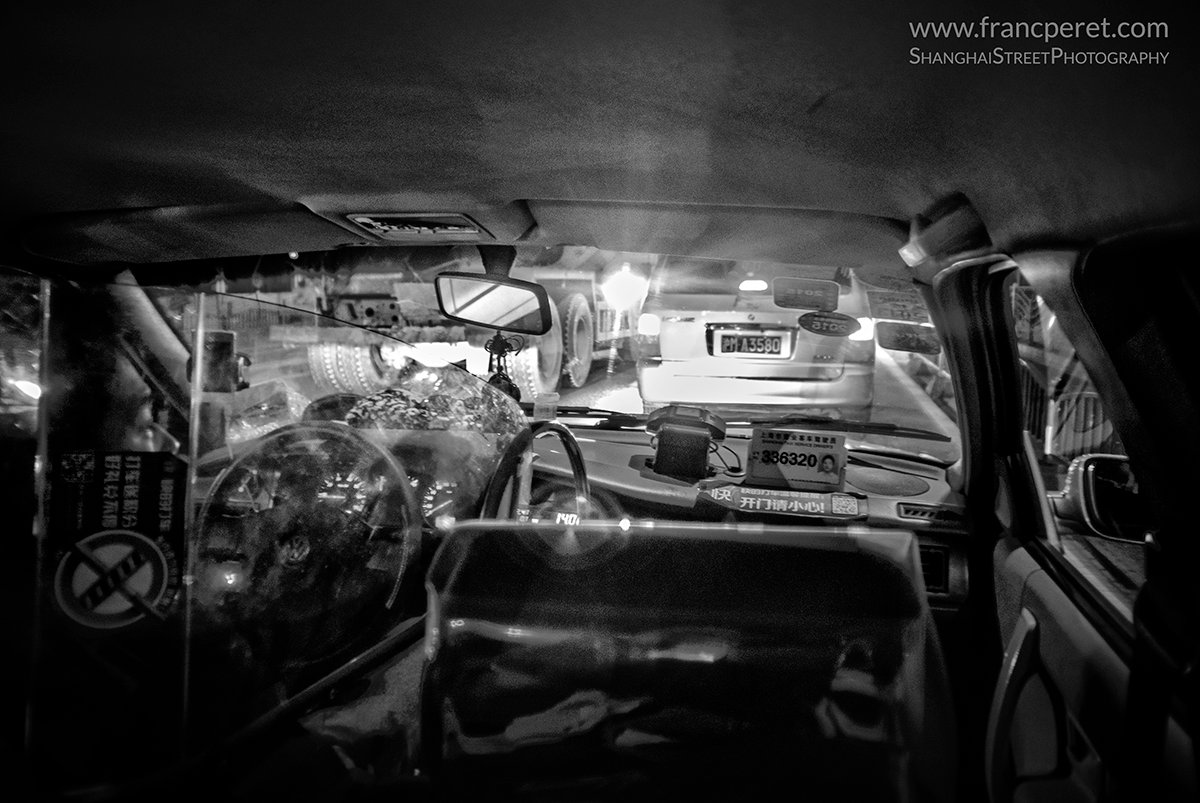
Yellow Bike build to last according the Brand name: “Yong jiou” (Use Longtime). Nikon1 V1 ISO100 1/6s and Cine Nikkor 25mm f/1.4 @ f/1.4No smoking. In the taxi bringing me to the meeting point. Nikon1 V1 ISO200 1/25s and Cine Nikkor 25mm f/1.4 @ f/1.4.
Best to be stable is to find something solid to hold your back, your shoulder or even your camera from the position you want to build up your composition.
Luminous landscape. Panasonic GM5 ISO200 1/15s and 20mm f/1.7 @ f/2.Nathalie framing a fire hydrant against the bright city landscape. Nikon1 V1 ISO200 1/15s and Cine Nikkor 25mm f/1.4 @ f/1.4
I usually advice wall, handrail, tree or ground.
Unfortunately, you are not always finding a friendly support for every subject.
Alex in a corner for a great color match. Panasonic GM5 ISO100 1/50s and 20mm f/1.7 @ f/2
In that case, the way you are positioning your body and holding your camera are going to matter even more to not get a blurry shot at low shutter speed.
AN HIDDEN WORLD
One of my favorite night shooting subject in such a developing city is background or details that could be used for the shooting of a 1950’s science fiction movie.
I am not sure you are going to understand this sentence, but lets check out the surrounding shots to get an idea of my feeling and inspiration.
Another inspiring Sci Fi background.Panasonic GM5 ISO200 1/10s and 20mm f/1.7 @ f/2A Science fiction set coming from the past. Panasonic GM5 ISO400 1/5s and 20mm f/1.7 @ f/1.8
In this kind of set or with those type of details I can imagine parts of an abandoned space ship or high tech factory.
Sometime people are telling me that I am having too much imagination…
Space Station. Panasonic GM5 ISO200 1/2s and 12mm f/1.6 @ f/4
I am very clear about that.
Imagination will be NEVER too much.
Back to reality (almost). Panasonic GM5 ISO200 1/25s and 20mm f/1.7 @ f/2
For me, imagination is the only way to never get bored of something I am doing since 1986: professional photography.
An individual space ship? Panasonic GM5 ISO400 1/10s and 20mm f/1.7 @ f/2
And after 15 years shooting film, digital photography helped me to cross all my previous boundaries, and Photoshop, Video, film making, editing are added value to the experience.
And as I often say to my students, I am learning something new about photography and film making, almost everyday.
It is an endless process.
My life will never be long enough to learn as much as I would like to…
If you liked this post, you can discover the previous night shooting session in Shanghai Here
Apolline (Ling Li, 灵莉, in Chinese) was delivered on June 3rd, after 36 hours of tough efforts from her mother (and my beloved wife) Sarah. First mensuration: 51cm long and 3.65 Kg. I am taking advantage of this great personal event to offer some tips about taking pictures of babies.
By Franc Peret
Having a baby is the start of an emotional journey which is going to last until her adult life (at least).
Another earlier shot, less than 3 hours after birth. In China, a tag is attached to the body with the name of the mother and the sex of the baby. Majority of Chinese parents prefer boy than girl and some of them would not hesitate to switch a baby to get their wish fulfilled. Light was getting lower already, but my subject is not moving. I increased the ISO to be able to close down a bit the Aperture to be sure that the complete frame will be sharp. Panasonic GH4 ISO400 1/40s, 25mm f1.4 @ f2.One of my very first shot in the hospital, a couple of hours after Apolline birth in Shanghai. Artificial Light was real bad, but that does not matter in such circumstances, capturing immediate magic moments are more important than aesthetics improvement sometime. Panasonic GH4 ISO200 1/80s, 25mm f1.4 @ f1.8.
Most of the time, my students are having difficulties to take good pictures if they are too much in love with their subject, which is often the case with kids (hopefully!).
When emotions get on the way
With a camera in hand, they can hardly see their beloved ones with cold blood aesthetics and critical eyes for concentrating on key elements, which are somehow needed to achieve a successful composition and therefore a better shot.
A second “finger holding” picture with a different angle and much more light. Notice that on those 2 shots I am using a diagonal composition to fill up my frame with interesting information and to render a more dynamic feel: her finger grabbing seems to be in action, like it just happened. Panasonic GH4 ISO200 1/320s and 25mm f1.4 @ f2.8.First day with Apolline, I was amazed by her hands, especially compared to surrounded Chineses babies in the same room. Her fingers are so thin and so long. To give an idea of their size, I let her holding one of my finger and I focused on it to attract the attention of the viewer. Panasonic GH4 ISO200 1/60s and 25mm f1.4 @ f2.
Double personality
Due to my long professional career, I am used to split my personality in two as soon as I am grabbing a camera for shooting.
Massage time on Apolline’s little foot. While my right hand was busy, I succeeded to stabilize my camera with my left hand, setting up manually the focus on the nearest limit of the lens and just moving physically toward my subject until the foot gets in focus. I used a very bright lens to render that dreamy comfy look from the blanket and surrounding element. Panasonic GH4 ISO200 1/100s + Metabones Speed Booster + Nikon AIS 55mm f1.2 @ f1.2.A foot print was taken from our new born baby for Hospital record, I focused on the blue ink which is still visible. Important here was to press the shutter at the right timing, when feet were statics, to get the shot in low light and low ISO. Panasonic GH4 ISO200 1/250s and 25mm f1.4 @ f1.6.
As everyone else, I am using my heart for emotion and inspiration, but whatever happens, I am able to keep my brain concentrated on technical decision as soon as there is a view-finder between me and the scene.
Different Case Study
For example, in usual life, seeing blood flooding make me badly sick, but as a photographer, watching bloody scene through my lenses does not affect me at all.
Here, the composition challenge was to get both my hand and her feet in the shot and the rest of her body out of focus in the background. I turned the bed to soften a bit the contrast by getting the windows (main source of light) closer to my right shoulder. Here, depth of field was less important as only the foot is the main subject. Nikon1 V1 ISO200 1/50s with Angenieux 25mm f0.95 @ f2.I am addicted to my daughter’s feet which are quit slender for a 2 weeks old, half Chinese, baby girl. I position the bed to get that strong contrast lighting from the nearby window to help me to separate her feet and my hand by creating a shadow between the 2. I tried to be as symmetrical as possible to attract the attention on both subjects texture, shape and size. I Closed down the Aperture to get enough depth of field and more details (by reaching a sweet spot of my lens) to perfectly render the skin texture of both hand and foot. Nikon1 V1 ISO100 1/40s and Angenieux 25mm f0.95 @ f2.8.
In such shooting circumstances, I am only thinking of getting the best shots possible out of the scene, even the guy in front of me is bleeding like hell, as you can see here, in my 1994 Taiwan Qi Gung report.
Actually, I felt sick the first time I watched my pictures!
Sweet headline
To come back to my headline sweeter topic, shooting baby (especially yours) need that double personality split capacity and I am sure any of my student or reader can earn it.
Wake up time. This is a difficult moment. Baby is moving randomly and it is best to pull back to get some headroom and “footroom”. In this shot, I didn’t anticipate enough the amplitude of her movement and her right foot is cropped a bit. I still like this picture because the blurry parts (legs are both out of focus and moving) translate the body tension accompanying the moaning session. My advice: Just get what you absolutely need in focus and do not mind the blurriness elsewhere as soon as it serves your intention (more dynamic and lively shot). Nikon D750 ISO 560 1/125s and AF-S 85mm f1.4D @ f2Sleeping time, nothing is moving, there is no excuse to get a blurry or grainy pictures, in those ideal conditions. I positioned the bed (a chair actually) next to a window to get the smooth light (overcast polluted day is perfect for that) falling on my baby. I can work quietly, stabilizing my camera and shooting at base ISO for best quality. I used a very bright lens and focused on her face. Panasonic GH4 ISO200 1/200s and 42.5mm f1.2 @ f1.2
To help them and you on that, I am delivering some simple tips related to baby shooting, something I am experimenting since 3 weeks at the time I am writing this article.
Auto portrait in the bathroom. First of all, light on as many (and good) lights as possible to get a better quality shot. Remember: Photography is painting with light! Second, position the focus point on something significant (such as a face), hold the camera firmly (and the baby too!) and try to keep it straight, horizontal and stable. Try to look friendly or smart and shoot. Nikon D750 ISO400 1/80s and 50mm f1.8 @ f2.8. I increased the ISO a bit to be able to close down the Aperture (to get more DOF) as I am using a Full Frame camera and as my face and baby’s face are not positioned at the exact same distance. Being stable enough to hold the camera and to not move, 1/80s was sufficient.Cleaning time. Mama is taking care of her baby girl who is moving a lot, except her head (one of the heaviest part of her body). Therefore, I was able to keep a reasonable ISO value as a lower shutter speed was sufficient to get both a sharp face while keeping hands movement blurry, to describe Apolline’s excitement. I focused on her eyes precisely as I am quit close with a fully open Aperture (less Depth of field overall). Panasonic GH4 ISO400 1/40s and 25mm f1.4 @ f1.4/.
TIPS FOR PASSPORT PICTURE
First thing first, I needed to shoot a passport picture to be sure to get it on time for a planed trip back to France during summer break.
Mission impossible?
This is not an easy task when baby is only 1 week old and can hardly:
My one week old daughter’s picture for her passport. Shot with a Panasonic GH4 ISO200 1/60s and 28mm f2.8 @ f4 (for more details and depth of field) under natural light (window and white wall).
– Stay awake with eyes opened under good lighting.
– Sit down
– Hold her head by herself.
5 steps for success
All of this sounds like Mission impossible, but I succeed to manage it following those steps:
1 – Stand next to a window to collect as much light as possible.
If weather is sunny, get a transparent curtain closed to soften the light.
Do not try to shoot it at night or under artificial lighting, the image has many chances to be grainy or blurry. Do not use flash! It is dangerous for baby’s eyes and can damage them, especially if you set a direct flash straight on her face.
2 – Mount a ‘portrait” lens on your camera: a 25mm or longer on a M43 camera, a 50 mm or longer on an APS-C (DX) camera or 85 mm or longer on a FX camera.
3 – In Aperture mode, set up your ISO and Aperture in advance, according your lighting situation, to reach a fast enough shutter speed (about 1/125s).
4 – Get your baby well dressed, in a good mood and fully wake up (daytime after feeding him/her).
5 – Someone has to hold her/him as straight as possible, facing the camera, with one hidden hand behind the neck for keeping him/her still.
One bad habit is to always shoot close up shots and to avoid too much the environment, as the changing facial expression of the little one is so attractive. Panasonic GH4 ISO400 1/60s and 25mm f1.4 @ f1.4.With a bit of discipline, you can try to force yourself to pull back and to include informative out of focus foreground and a wider background around your main And cute subject. Panasonic GH4 ISO400 1/100s and 25mm f1.4 @ f1.4.
Later on, I am going to add some more ideas and advises into this page, while adding more pictures.
Already, you are having plenty of tips by reading all posted picture’s captions.
Hope all of this will be useful…
Some technical remarks
I am using 3 different types of cameras with different size sensor. This matters a lot in term of Depth of field and field of view. I am used to switch and I am used to consider my lens choice and my Aperture settings accordingly.
Surprise! Nikon D750 ISO400 1/160s and AFS 85mm f1.4D @ f1.4.Do not hesitate to shoot a lot and often, as soon as you get a balanced composition, a good enough lighting and the right exposure. Facial expression is changing so quickly that every shot will be different. It was real hard to make a choice among so many cute facial expression. Nikon D750 ISO400 1/160s and AFS 85mm f1.4D @ f1.4.
To keep it simple (even it is not perfectly accurate), Nikon D750 (FX) Sensor’s Size = 2 x Panasonic GH4 Sensor’s Size (M43) and Nikon D750 (FX) Sensor’s Size = 2.7 x Nikon 1 V1 Sensor’s Size (CX).
Or Little Glamorous Asian Princess… Nikon D750 ISO400 1/160s and AFS 85mm f1.4D @ f1.4.Funny face… Nikon D750 ISO400 1/160s and AFS 85mm f1.4D @ f1.4.
In term of field of view:
A 25mm lens on a GH4 is equivalent to a 50mm lens on a Nikon D750.
A 25mm lens on a Nikon1 V1 is equivalent to a 68mm lens on a Nikon D750.
In term of Depth of field rendition:
a f1.4 Aperture on a GH4 is equivalent to a f2.8 Aperture on a Nikon D750
a f0.95 Aperture on a Nikon1 is equivalent to a f2.8 Aperture on a Nikon D750
I do not advise my Essential Photography Class students to use the Manual setting in an uncontrolled environment, but sometimes I am personally forced to do so and I am explaining here how to handle such situation.
By Franc Peret
I am teaching to my Essential Photography Class students how to precisely and quickly control their camera in semi-automatic Aperture priority mode as it is the most efficient way to get it right, in real life photography.
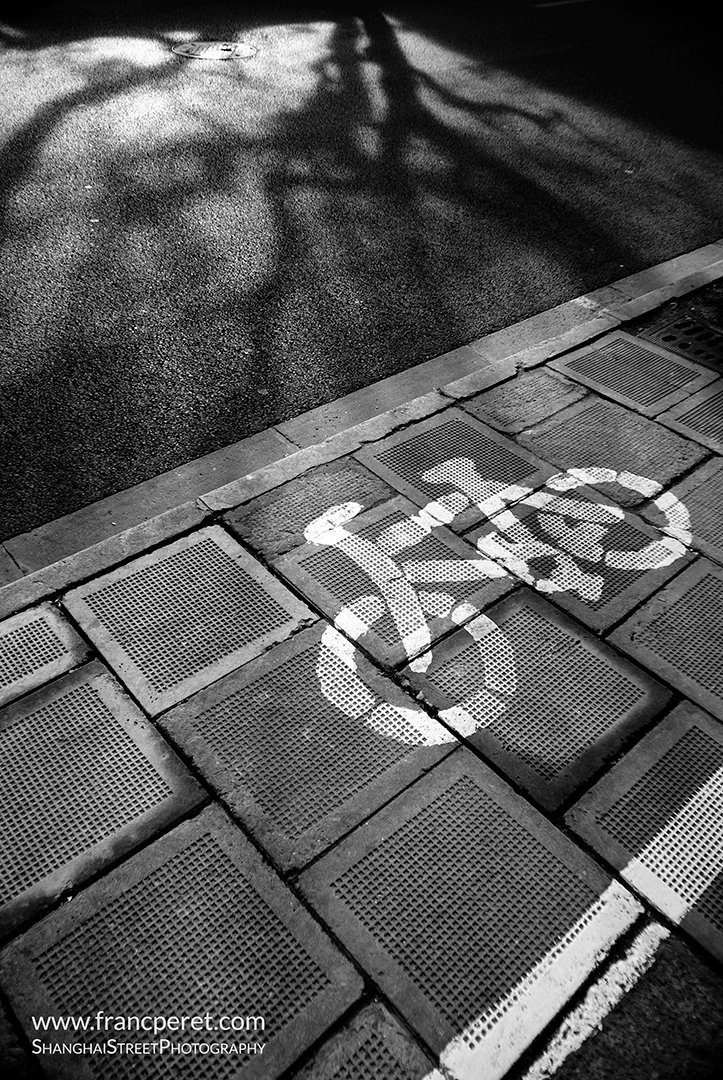
Nikon1 V1 and Cine Nikkor 10mm f1.8. With Sign and Shadows. Using a wide lens imposes to fill up the frame with interesting things (textures, Shape and Lines).Nikon1 V1 and Cine Nikkor 10mm f1.8. With Bicycle.
On my own, as I like to experiment a lot, I am often working with a strange combination of cameras and lenses linked by an adapter. And sometimes the 2 entities refuse to communicate with each other as they were not supposed to be connected.
Public Phone in the street. Soon to disappear… Nikon1 with 10mm f1.8 (equivalent to 27mm on a FX camera or 18mm on a DX)
Then, I am on my own, forced to use a full manual set up for both focus and exposure.
Last summer, I spent 2 months with such a strange combination. I adapted a collection of very old Cine-Nikkor C-mount lenses on my Nikon1 V1.
Therefore, for every shot, I had to guess the exposure and getting confirmation after the shot by checking the histogram to know if I were right or wrong.
One tip I am teaching to my students is this:
If you can see blue sky over your head and you are shooting someone under sunlight, the exposure value is matching (@ISO100 – f8 – 1/250s) or (@ISO100 – f5.6 – 1/500s) or any other combination at the same EV14.
For example, I might use (@ISO100 – f2 – 1/4000s) for portrait or for freezing high-speed action.
Having a base line to start with
EV14 is there in an average situation and in an average location.
In Australia Outback (no air pollution and lots of reflection from the sand), in The Alps, Himalaya, Tibet or Xinjiang high altitude (closer to the source of light) this value can be double (EV15) or even more.
That means the combination will be (@ISO100 – f8 – 1/500s)
In average situation, like in French Burgundy, I preset my camera to the EV14 value under a blue sky (@ISO100 – f5.6 – 1/500s) for a common subject.
If my subject is under the shadow, I know the EV is dropping at least by 2 stops so I will reduce my speed by 4 (@ISO100, f5.6, 1/125s) or open up my aperture by 2 stops (@ISO100 f2.8 1/500s) to compensate.
Taking care of parameters
My decision will depend on the fact I need or not speed to freeze motion or depth of field to get more things in focus.
This is a Quick and approximate decision without taking my eye out of the viewfinder. Shadow will be darker if the subject is not surrounded by reflective surfaces (such as a white wall).
And I will adapt my decision according to this parameter.
With the Nikon1 and my C-mount lenses, the Aperture ring is on the lens, and the shutter speed is controlled by a button next to my thumb.
Very handy.
Experience helps indoor
Now let’s imagine my subject is moving into a house with windows and white wall.
Outside is sunny and I know that the EV will be around 8 to 16 times slower (3 or 4 stops) indoor…
This is an approximation but if you are used to your environment, you should be able to guess quite accurately after few test shots. This will help you later on to get closer to the truth in few steps.
Most of the time, I got it right at first shot.
Variation will depend on reflection around (white wall or trees) the subject.
Working with human brain
Of course, during an overcast day, I have to do more test and try as I am having no reference anymore. Not every grey curtain or clouds in the sky deliver the same exposure on earth! It can be dramatically different from one day to another, one hour to another.
Step by step, knowing my environment, and having my eyes and brain used to communicate each other in this “guess what is the exposure here” game, I became more and more accurate in guessing the exposure of the place I were shooting my subject.
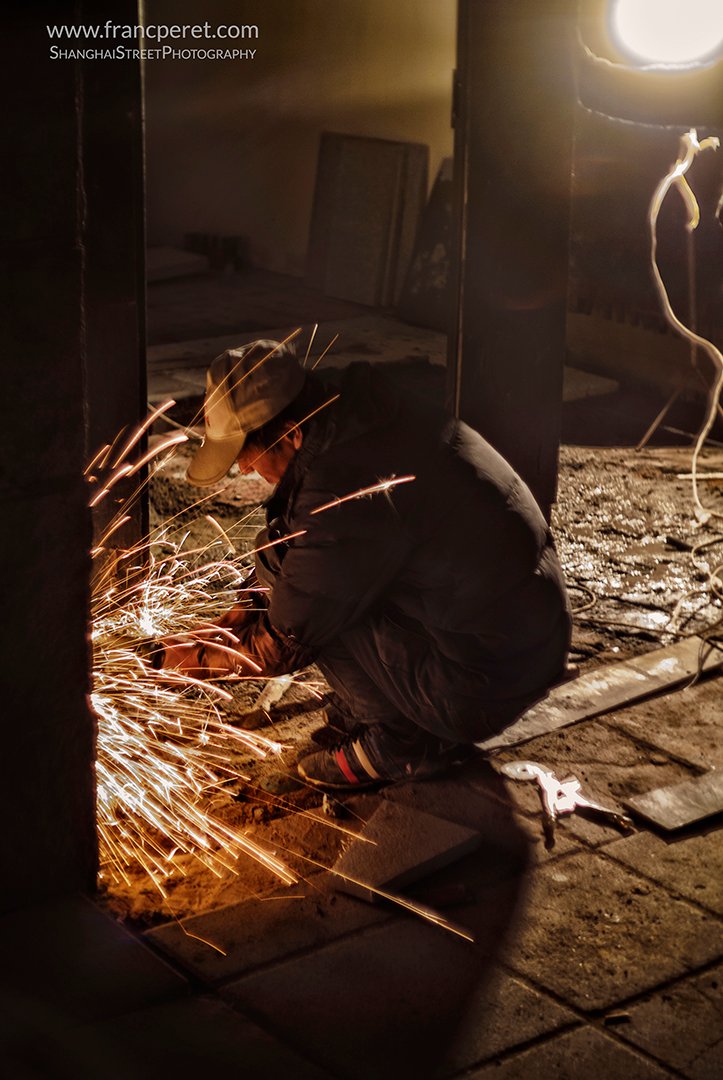
Nikon1 V1 @ ISO100, f0.95, 1/13s. I just stabilized myself with a tree, and waited my subject to be steady. My advice: Always immediately check the result you get to see if you really need to increase the ISO or not.Nikon1 V1 with an Angenieux 25mm f0.95 lens. Manual Focus and Manual exposure as this is a 30 years old lens without any “smart” contact with the camera body. I could increase the ISO a bit, but among the 10 shots I had done half of them are sharp enough so I had no reason to lose quality to raise the speed. Also, keeping a slow speed helped to get longer sparks.
Concerning focus set up, I was used to manual focus when I started my photography career back in 1986, so this didn’t bother me much since the viewfinder of the Nikon 1 is sharp enough for me to hit the focus right even using the f0.95 lens.
Finding the right balance
Manual focusing is like finding the right balance between too far and too close.
Actually, the best way to hit the right focus point is to turn the focus ring until you get your subject sharp in your view finder and then you just turn the focus a bit more until you lose the sharpness.
10mm f1.8 @ f2, Nikon1 @ ISO400, 1/10s
Then you turn your focus ring in the opposite direction until the subject appears perfectly sharp, again.
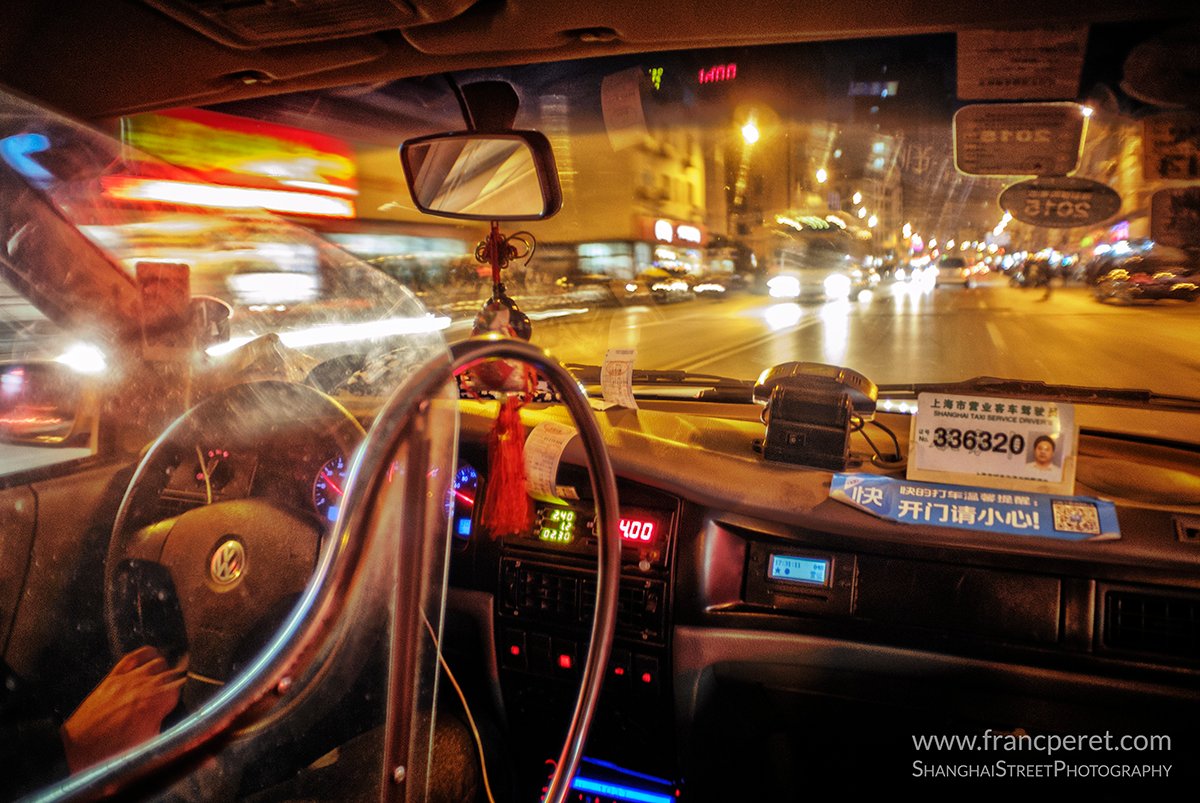
Cine-Nikkor 10mm f1.8. Shot done at ISO400, f1.8, 1/10s. Harder to shoot when the car is moving but still workable. Camera is still the Nikon1 V1. Manual Exposure, Manual focus, hand held.
To be more precise you can turn a bit more and see if it is better or worst, and then go backward again.
It is long to explain, but very quick to do
Overall, I was so seduced by the result (color, mood, character…) I got with the combination of the Nikon1 and my old lenses, that I left my GH4 and the Lumix lenses at home, despite the lack of any exposure and focus assistance from the Nikon1.
10mm f1.8 @f2. Advantage of small sensor camera is to get enough depth of field even wide open. Nikon1 V1 ISO100, 1/60s.10mm f1.8 @ f8 on Nikon1 @ ISO100. 1/160s
Of course, I would be very happy to get a firmware update or a hack to get the Nikon1 able to work on semi-auto Aperture priority with a dumb adapter.
That would make it even more enjoyable to use.
Just remember that in Photography, nothing is impossible and all is a matter of logic. And, if it is time-consuming and brain tiring to shoot fully manual, it is quite rewarding to be able to achieve the exact shots I had predicted without any assistance.
However, if I were using the exact same combination in the same location with a camera able to work in semi-auto Aperture priority, I might have many more interesting shots, especially of people and things on the move and I would be able to concentrate more on the composition and subject placement by freeing my brain from technical consideration dedicated to the exposure only.
In 2013, I bought a Nikon1 V1 new for very cheap, and as soon as I tried my collection of old C-mount Cine Lenses with it, I felt in love for the combination. Since then, for my personal work, I am using the Nikon1 more than any of my other cameras (Nikon D800 and Panasonic GH4), despite the fact I am forced to shoot everything in full manual mode.
Don’t search for it in a store, the Nikon1 V1 is not sold new anymore. Nowadays the third version, Nikon1 V3 is on the shelves but I have no idea how good it is.
I am going in this post to present my lenses and to show some of the shot I had done with them attached to the Nikon1 V1, last summer, back to France.
My Favorite Chinese tourist. Nikon1 V1 and Angenieux 25mm f0.95.800 years old bridge, Ahun, Creuse, France. Nikon1 V1 and Cine-Nikkor 6.5mm f1.8Auxerre, Burgundy, France. nikon1 V1 and Cine-Nikkor 6.5mm f1.8
In term of sale, the Nikon1 V1 had a very difficult start due to a very high price tag (in 2011) for what it was offering compared to a well established strong competition (M43 Olympus and Panasonic Lumix).
Barbel-wire. Nikon1 and Cine-Nikkor 50mm f1.8Wheat fields in sunset. Nikon1 V1 and Cine-Nikkor 50mm f1.8
Some reviewer on the net criticized its lack of external control (for exposure compensation, ISO or White Balance for example), others judged its sensor too small (1 inch) to be attractive with not enough pixels (10 millions) to impress.
At its original high price, it was difficult to understand what was the idea behind this camera.
The Tamron 25mm f1.6 is not a Cine Lens, but is is so light (40g) and so small that I often leave it attached to my Nikon1 V1.
Logically, after such a bashing, this camera sold badly, and therefore it got highly discounted when the new model came out (V2).
And this gave me the opportunity to give it a try for very cheap, less than 200 USD (1/3 of the original price).
Sunset Flower. Nikon1 V1 and Cine-Nikkor 50mm f1.8Haidresser in Auxerre (Burgundy, France). Nikon1 and Cine-Nikkor 6.5mm f1.8
My first motivation was its CX format sensor, equivalent to 16mm film camera, which is smaller than my M43 camera (Panasonic GH) and I thought it might be a perfect match for my C-mount lenses which were vignetting too much on my Lumix.
Ready for a vintage ride. Nikon1 V1 and Cine-Nikkor 50mm f1.8Honda Benly 50cc in the field. Nikon1 V1 and Cine-Nikkor 50mm f1.8
At first, what I liked the most about The Nikon1 V1 is its efficient simplicity.
The Joy of Nikon1 V1
Its viewfinder is clear and sharp (sharp enough to be able to manually focus).
Its long lasting battery (a day of shooting) is the same model I am using in my professional camera (Nikon D800).
Its menu is short and logical and its body fits perfectly in my hand with a nice high quality feel.
Globally, it has been a joy to use since day 1.
Landscape from my favorite village in Burgundy. Nikon1 V1 and Cine-Nikkor 6.5mm f1.8Sunset on Apple. Nikon1 V1 and Angenieux 25mm f0.95
Holding this camera is a delight.
Also, its Sensor is very special, delivering great vivid and natural (accurate) colors which remind me my film time. And 10 millions pixel are enough for me who is not going to print big anyway.
The shot is a bit blurry as Piggy was begging for food, but I like it this lively way. Nikon1 V1 and Angenieux 25mm f0.95.Door and Windows closed down. Nikon1 V1 and Cine-Nikkor 50mm f1.8
Another film analogy is the ISO limitation, I never push the Nikon1 V1 sensitivity higher than ISO400, as noise starts to be on the way. Actually it is a pleasing type of noise which also looks like film grain… In my film time, I was 90% of the time shooting with ISO100 slides.
Candle and Stain-glasses in Monpazier, Perigord, France. Nikon1 V1 and Cine-Nikkor 6.5mm f1.8Chairs in Church in Monpazier, Perigord, France. Nikon1 V1 and Angenieux 25mm f0.95
And I am working the same way with the Nikon1, using bright lenses, my Cine Nikkor series and some other high quality old lenses matching the 1 inch Sensor size (which is similar to 16mm movie camera). The fastest aperture of my set of lenses is ranking from f1.8 to f0.95!
The magic of C-mount Cine Lenses
Second hand C-mount lenses were often used on old type of cameras such 16mm for film and documentaries, TV News video camera, and surveillance cameras.
kenny is a young guy who own a (small) collection of old French cars. Nikon1 V1 and Cine-Nikkor 13mm f1.8.My favorite French actor, who performs in 3 of my movies: Revol’verte, L’annonce and La Deuche de l’enfer. Nikon1 V1 and Cine-Nikkor 13mm f1.8.
14 years ago, I had the idea to shoot a short film with on board video-surveillance camera (no Go pro at that time) and I started to buy high quality C-mount lenses to get the best image possible, especially at night. I bought bunch of them on Ebay for very cheap prices as nobody were using it anymore.
Once, I had a box full of lenses for less than 80 USD and some are worth a lot more nowadays.
Auxerre city and Yonne river, Burgundy, France. I am spending most of my summers in this quiet area. Nikon1 V1 and Cine-Nikkor 13mm f1.8.Purple at dusk. nikon1 V1 and Cine-Nikkor 50mm f1.8
Among my collection, I get some jewels, such as a series of Cine-Nikkor Lenses which were used on 16mm film camera. They are very rare, but I succeed to get almost a complete collection, ranking from 6.5mm f1.8 to 50mm f1.8 (which means 17.5mm f1.8 to 135mm f1.8). Compare to full frame camera the cropping factor if the Nikon1 is x2.7.
A shutter block. Nikon1 V1 and Tamron 25mm f1.6Robinet = Tap. Nikon1 v1 and Cine-Nikkor 50mm f1.8
Those lenses reach professional standard with a sturdy build and a very practical design for film making: For example, they all have the same length to ease the placement of accessories around them (filter holder with matte box, follow focus…).
Monpazier, Perigord, France. Nikon1 V1 and Tamron 25mm f1.6Brick Frame, Burgundy, France. Nikon1 V1 and Angenieux 25mm f0.95My favorite Chinese tourist in Burgundy. Nikon1 and Cine-Nikkor 50mm f1.8
Despite little bit of dust, oil and wear inside the glass (they all need a serious cleaning), the optical quality is great with a very sharp center even wide open and most of the frame getting sharp when the aperture is closed down.
The Full Manual challenge
They have lots of character, a greenish tint to them which is easily corrected in post. They are a match (in term of color and optical rendition), which is important for cinematographer concerned by continuity.
My hometown forest, 25km away from Paris. Nikon1 V1 Cine-Nikkor 6.5mm f1.8Velib (public rental bike) in Boulogne, France. Nikon1 V1 and Angenieux 25mm f0.95.
I love those lenses and the result I get out of it, despite the great difficulty to use it on my Nikon1 V1 as there absolutely no assistance from the camera in term of manual focus (no peaking, no green light in viewfinder) and exposure.
Here is the traditional place where I am buying my fresh milk daily. Nikon V1 Cine-Nikkor 6.5mm f1.8
Everything is completely manual and for 2 months of daily use, I had to guess the exposure and check it out after the shot on the histogram. I am quit good now to guess the needed exposure in many different situation.
Sunflower at dusk. Nikon1 V1 and Angenieux 25mm f0.95Getting mess in order and colors. Nikon1 V1 and Cine-Nikkor 50mm f1.8
This complex process remind me my early works in photography back to 1986.
Beside my Cine-Nikkor, I am having also a glorious Angenieux 25mm f0.95 and a tiny Tamron 25mm f1.6.
I am going to start with this lens for presentation.
Chinese Shadow in Auxerre, Burgundy, France. Nikon1 V1 and Cine-Nikkor 6.5mm f1.8Sunset in Burgundy. Nikon1 V1 and Cine-Nikkor 50mm f1.8Paris Suburb forest. Would love to get a place like this next to Shanghai… Nikon1 V1 and Cine-Nikkor 6.5mm f1.8
To see more pictures, check my album posted there Flickr
Lenses Presentation
Tamron 25mm f1.6
The Tamron has a “Ninja Star” kind of Aperture blades design. The lens is very sharp but has some vignetting coming in the way at certain Apertures. I got it for 8 USD.Without the adapter, Tamron 25mm f1.6, Cmount, 40g, minimum focus distance: 0.25m
Angenieux 25mm f0.95
Angenieux 25mm f0.95 weights 160g and its minimum focal distance is 18 inches.Angenieux 25mm f0.95: A rare lens which has a double personality, fully open (Fuzzy) or closed down a stop (Sharp). I got it for 80 USD 10 years ago.
Nikon Cine-Nikkor 50mm f1.8
The Cine-Nikkor 50mm f1.8, weight 170g and use an eight blades aperture with a typical curved shape which sometime appears in the out of focus area.Cine-Nikkor 50mm f1.8, The sharpest of the lot, but minimum focus distance is not close enough: 1m. I got it for 100 USD.
Nikon Cine-Nikkor 25mm f1.4
The Cine-Nikkor 25mm f1.4 presents a classical hexagonal Aperture, but shape still has the same curved signature than the others Nikon lenses here.Cine-Nikkor 25mm f1.4, the brightest of Cine-Nikkor series, but not the best one. I would only use it for continuity purpose (to get same character then the others) in a short movie shoot. I got it for 80 USD.
Nikon Cine-Nikkor 13mm f1.8
Different characteristic than the other Cine-Nikkor for the 13mm with 6 blades for an aperture which looks like a star.The Cine-Nikkor 13mm f1.8 wieght 150g with a minimum focus distance of 0.4m. It is a very sharp lens, but has trouble with vignetting at any aperture. I got it for 100 USD.
Nikon Cine-Nikkor 6.5mm f1.8
The Cine-Nikkor Lens 6.5mm f1.8 is the widest and the most expensive (very rare) one. This lens is far to be flawless, but I love its character. I got it for 300 USD.The Cine-Nikkor Lens 6.5mm f1.8 presents an hexagonal aperture shape.The Cine-Nikkor Lens 6.5mm f1.8 is one of the most impressive lens of the series due to its size and its very wide field of view without much distortion.
To see more pictures about this topic, check my album posted there Flickr