Tag Archives: D750

MIGRATION

Spring is here, white stork going back home. Picture Shot with Panasonic G85 + Lumix 100-300 mm f/4-f/5.6 lens.
By Franc Peret

Living in Burgundy in France for a while after so many years in China, getting back to nature and wildlife environment is a blessing.
I am always carrying a camera with me to record whatever happens in the countryside.
I am used to driving on a very small road and I spotted an area where migrating birds were used to take a rest.

Full Frame was not the best tool for this shot

That day I was carrying my Nikon D750 and an old 80-200 mm f/2.8 zoom, but the reach was not long enough and anytime I tried to get closer to the bird, they were flying away, in the wrong direction from my point of view.
At home, I am having a 300 mm Nikon lens, but according to my initial shots, I knew it would not be long enough.

M43 for wildlife

The next day, I came back with my Panasonic G85 and my longest lens.
Panasonic or Olympus are M43 type camera and with their smaller sensor (compare to APS-C or Full Frame) actually “crop” the lens internally by 2 compare to Full frame.
Thus, a 100 – 300 mm M43 zoom lens delivers an image which is equivalent to a 200 – 600 mm FF zoom lens.
This is a big advantage for wildlife photography as you can be 2 times further away from your subject + the lens is at least 2 times lighter (less tiring without monopod) than its Full Frame equivalent.
Another advantage is the fact that @ f/4, an M43 sensor delivers the equivalent depth of field @ f/8 on an FF sensor.

Therefore, I am using a lighter (also much cheaper, and surprisingly good) lens, with a long reach and plenty of depth of field.

Last but not least, my Panasonic G85 combines both stabilizations on the sensor and the lens to allow the use of slower shutter speed.
This is a great feature if you are shooting something steady.
However, here, as the birds are flapping, I have to shoot at around 1/500s – 1/1000s shutter speed.

Here are my settings:

– Aperture priority mode
– Continuous focus
– ISO 100: I should put ISO 200 (which the base ISO on this camera) but I was shooting something steady just before this one and I had no time to switch.

Spotting the stork
Spotting the stork

Higher ISO would give me a little bit more speed or allow me to close down a bit more the Aperture for more sharpness and less motion blur.
– Aperture f/5.6: Zoom was at 276 mm and its max aperture at this range is f/5. It is very important on such a zoom lens to never zoom in completely as image get less sharp at the longer end of the zoom.
Also better to never work at its max Aperture. Closing a little bit will always deliver a sharper image.
– Resulting Shutter speed: 1/640s. 1/1000s would have been better and ISO200 would have help on this.
Still, that speed was ok. Actually bigger the bird, less shutter speed you need as they are flapping at a slower frequency than smaller birds.
– Exposure correction: +0.7.
Another great feature of the M43 camera is their electronic viewfinder with histogram constantly visible in it.
Thus, on this Panasonic G85, I can immediately correct under or overexposure by turning a wheel under my thumb without pressing any button. This is immediate and very useful when “magic finger” is not possible (like in this case).
As I am shooting against the sky, close to the source fo light, I had to force my camera to shoot a brighter image to not get the bird as a silhouette.
– Post processing: Some people like (and promote the idea) to correct this kind of exposure compensation in post processing (by pushing brightness in shadows), but M43 sensors have their limit (weakness) and this is one of them.
Correcting too much in post create lots of noise.

As I am “old school” I am used to set my camera at the exact right exposure while shooting as with slides, they were no way to correct mistakes later on.

Hope this was informative!

Former photo journalist, Film maker and ELC Shanghai Photography teacher, Franc Peret is teaching Essential Photography Classes, Advanced Photography Workshop and Film Making Classes in Shanghai, for the last 13 years.
If you wish to contact Franc, just drop an email to francperet@hotmail.com

Living the flood

Same topic, three ways of shooting it. Pictures, settings, and choices explained.

By Franc Peret

I am not sure my little one, Apolline, will keep those moments in her inner memories, but pictures should help…

All shot with Nikon D750 and Nikon 24-70 mm f/2.8

Shouting Apolline
Shouting Apolline

1 – Shouting Apolline (against heavy clouds ready to pour):
– Zoom lens position 38 mm = Semi-wide shot to integrate the subject in her environment but keeping the possibility to get a shallower depth of field (wider the lens more depth of field you get).
– ISO 100 = Best quality and no need to increase as light are great.
– Aperture: f/2.8 = Treated as a portrait to get a shallow depth of field,
– Resulting Shutter speed (as I am working on Aperture priority mode) = 1/1250s

Feet in Water
Feet in Water

2 – Feet in the water (cut out the rest of the world)
– Zoom lens position 24 mm = Wide shot to integrate the subject in her environment.
– ISO 100 = Best quality and no need to increase as light are great.
– Aperture: f/5.6 = Treated as a landscape shot to get a deep depth of field, as my girl is too small and too far away to be dealt as a portrait. And the location is more important here to tell the story: wet and isolated, cut out from the rest of the world.
– Resulting Shutter speed (as I am working on Aperture priority mode) = 1/350s (I could set up at f/8 but as I never know if Apolline is going to move, I preferred to play it safe. At f/8 shutter speed would be around 1/160s, sufficient if she is keeping steady.)

Under the sun
Under the sun

3 – Under the sun (between rain)
– Zoom lens position 29 mm = Wide shot to integrate the subject in her environment.
– ISO 100 = Best quality and no need to increase as light are great.
– Aperture: f/2.8 = Treated as a portrait to get a shallow depth of field,
– Resulting Shutter speed (as I am working on Aperture priority mode) = 1/1600s (faster than the first shot as there is more light from the sun).

Former photo journalist, Film maker and ELC Shanghai Photography teacher, Franc Peret is teaching Essential Photography Classes, Advanced Photography Workshop and Film Making Classes in Shanghai, for the last 13 years.
If you wish to contact Franc, just drop an email to francperet@hotmail.com

The 3 Steps of Photography

I am used to divide my Essential Photography course in three steps. First, providing essential technical knowledge. Second, explaining essential composition rules. Last but not least, developing student’s conceptual mind. Here is how it works.
By Franc Peret

Taking successful pictures is both a simple task and a complicated one.
Simple, because the process involved is almost always the same and quit easy to explain and remember, step by step:
1 – Set the right exposure
2 – Focus on the subject.
3 – Be ready to grab the right moment (positioning or facial expression for example)
4 – Concentrate on your personal creative decision in term of framing, assembling elements (composition), and depth of field.

"Yammi"  (Lumix G85 ISO 100 1/100s + 14-140 mm f/3.5-5.6 @ 17 mm f/4.5) Being patient and steady while waiting for the right moment to shoot help to become discreet and out of focus of the subject, even you are next to her.
“Yammi” (Lumix G85 ISO 100 1/100s + 14-140 mm f/3.5-5.6 @ 17 mm f/4.5) Being patient and steady while waiting for the right moment to shoot help to become discreet and out of sight of the subject, even you are next to her.
Once the essential set up of the camera is done right, most important is to not miss the right moment! Lumix G85  ISO 400 1/40s  + 25mm f/1.4 @ f/1.4
“Ice on lips” (Lumix G85 ISO 400 1/40s + 25mm f/1.4 @ f/1.4) Once the essential set up of the camera is done right, most important is to not miss the moment!

Not that simple

The fact that you often have to solve those 4 steps in less than a second is the complicated part of photography.
Getting the picture right, as often as possible, is possible with training…
More you are going to shoot, better the chance to make the right decision on time.

"Reflective street"  (Lumix G85 ISO 100 1/80s -0.7 + 14-140 mm f/3.5-5.6 @ 14 mm f/8) Searching for interesting lighting  and reflective surface is a good start to get out of routine.
“Reflective street” (Lumix G85 ISO 100 1/80s -0.7 + 14-140 mm f/3.5-5.6 @ 14 mm f/8) Searching for interesting lighting and reflective surface is a good start to get out of routine.
"Square everywhere" (Nikon D750 ISO 800 1/180s + 24-120 mm f/4 @ 120 mm f/4.8) Step by step you should switch from funny street snapshot to more personal subject and sophisticated composition
“Square everywhere” (Nikon D750 ISO 800 1/180s + 24-120 mm f/4 @ 120 mm f/4.8) Step by step you should switch from funny street snapshot to more personal subject and sophisticated composition

Developing a vision

Once you are used to get good results, you have to challenge yourself a little more to add meanings, drama, sparks or personality to your shots.
How to get this?
While pressing the shutter button, you should already get a clear concept in mind, a vision or a directive line to be able to bring together a meaningful series of shots to tell a complete story (journalistic approach) or to express a specific mood (“artistic” approach).

"Quiet Butterfly" (Lumix G85 ISO 200 1/400s + 14-140 mm f/3.5-5.6 @ 140 mm f/5.6) ... While others needs quicker reaction before they are gone...
“Quiet Butterfly” (Lumix G85 ISO 200 1/400s + 14-140 mm f/3.5-5.6 @ 140 mm f/5.6) … While others needs quicker reaction before they are gone…
"Lion Cloud". (Nikon D750 ISO 100 1/80s +28 mm f/3.5 @ f/8) Some subjects allow several minutes to be detected and shot... Nikon D750 ISO 100 1/80s +28 mm f/3.5 @ f/8
“Lion Cloud”. (Nikon D750 ISO 100 1/80s +28 mm f/3.5 @ f/8) Some subjects allow several minutes to be detected and shot…

Fine tuning
This conceptual mind will also, later on, help you to process your image on computer in the right direction , the one you had initially chosen.

"Followed by her shadow" (Lumix G85 ISO 100 1/200s + 14-140 mm f/3.5-5.6 @ 14 mm f/6.7) Under such a hard source of light, he choice was obvious here, composing the shot with the subject and her shadow for a more 3D visual.
“Followed by her shadow” (Lumix G85 ISO 100 1/200s + 14-140 mm f/3.5-5.6 @ 14 mm f/6.7) Under such a hard source of light, he choice was obvious here, composing the shot with the subject and her shadow for a more 3D visual.
"Like a mirror" (Lumix G85 ISO 100 1/200s + 14-140 mm f/3.5-5.6 @ 30 mm f/5.6) My little girl is already a little lady, looking at herself in any reflective surface. I was ready for this one!
“Like a mirror” (Lumix G85 ISO 100 1/200s + 14-140 mm f/3.5-5.6 @ 30 mm f/5.6) My little girl is already a little lady, looking at herself in any reflective surface. I was ready for this one!

Some camera brand (such as Olympus or Fujifilm), with great color science, are better than others to delivery very satisfying results out of the box (jpg file), but most of the time, you will be able to improve the result by working on raw files.
All depends on the final use of the picture, such as quick share on social network (jpg are enough) or print for exhibition (better to go raw).

"Electric Birds 2" (Lumix G85 ISO 200 1/1320s + 14-140 mm f/3.5-5.6 @ 14 mm f/6.7). This approach brings in more imagination but also challenge the original concept behind any creative choice,
“Electric Birds 2” (Lumix G85 ISO 200 1/1320s + 14-140 mm f/3.5-5.6 @ 14 mm f/6.7). This approach brings in more options and feed imagination but also challenge the original concept behind any creative choice. It is important to never go “too far” and the limit is a personal choice.
"Electric Birds" (Lumix G85 ISO 200 1/160s + 14-140 mm f/3.5-5.6 @ 102 mm f/6.3). The exact same subject can be shot with so many different point of view and post treatment. This approach brings in more imagination but also challenge the original concept behind any creative choice,
“Electric Birds” (Lumix G85 ISO 200 1/160s + 14-140 mm f/3.5-5.6 @ 102 mm f/6.3). The exact same subject can be shot with so many different point of view and post treatment, such as vintage look or dramatic B&W.

No faking here!

" Electric Birds 3" (Lumix G85 ISO 200 1/400s + 14-140 mm f/3.5-5.6 @ 140 mm f/6.3) Later in the day, when the sky is all blue and the source of light is not behind the subject anymore, best is to keep it in color.
“Electric Birds 3” (Lumix G85 ISO 200 1/400s + 14-140 mm f/3.5-5.6 @ 140 mm f/6.3) Later in the day, when the sky is all blue and the source of light is not behind the subject anymore, best is to keep it in color.

The aim of Post production (“Photoshoping”) is indispensable to extract the optimum “juice” out of your work:
To get back the details you had seen with your eyes that seems gone on the jpg, to reproduce the right colors, to emphasize some parts of the shot or to improve the visibility of important elements by fine tuning the exposure of your raw image.

Post processing extra value

Of course, processing on computer is time consuming, and a potential painful experience for novices, but it is a very useful way to progress and to keep progressing forever.
Processing the image is a way to think of and judge what you had done with each subject, to discover some mistakes or imprecision, some stuff you should had done better or different to get a better result or more options out of the box.

"Cat rest" (Lumix G85 ISO 200 1/1500s + 14-140 mm f/3.5-5.6 @ 177 mm f/6.3) When, the light is great and an interesting subject is there waiting for you to shoot, there is not much things to think about prior to press the trigger.
“Cat rest” (Lumix G85 ISO 200 1/1500s + 14-140 mm f/3.5-5.6 @ 177 mm f/6.3) When, the light is great and an interesting subject is there waiting for you to shoot, there is not much things to think about prior to press the trigger.

Lasting passion

It also helps to emphasize a conceptual approach of photography, the best way to never get bored of it.
I am shooting for a living since 1986 and I am still not tired of it.

"Pollen Hunt" (Lumix GM5 ISO200 1/1600s + 150mm f/2.8 @ f/4) Lens choice matters more on some specific subject needing both speed and short minimal focus distance.
“Pollen Hunt” (Lumix GM5 ISO200 1/1600s + 150mm f/2.8 @ f/4) Lens choice matters on some specific subject needing both speed and short minimal focus distance.
"From the Past" (Lumix G85 ISO 100 1/800s + 14-140 mm f/3.5-5.6 @ 140 mm f/8) Longer lenses compress the perspective, extract details from the environment and keep lines straights.
“From the Past” (Lumix G85 ISO 100 1/800s + 14-140 mm f/3.5-5.6 @ 140 mm f/8) Longer lenses compress the perspective, extract details from the environment and keep lines straights.

More I know about photography, more I am excited about it, as I can measure the progress I still have to do to reach fulfillment.

Visual Samples

To illustrate my words, find here a series of personal shots (no job assignment here) with detailed captions on the three parts: essential settings, composition choices and conceptualization.

" Too young for her first ride" (Lumix G85 ISO 200 1/1000s + 14-140 mm f/3.5-5.6 @ 21 mm f/5.6) For most of the lively shots of kids, it is important to quickly find a point of view with the less disturbing background to keep viewer attention to the main action.
” Too young for her first ride” (Lumix G85 ISO 200 1/1000s + 14-140 mm f/3.5-5.6 @ 21 mm f/5.6) For most of the lively shots of kids, it is important to quickly find a point of view with the less disturbing background to keep viewer attention to the main action.
“Blue Crown″ (Lumix G85 ISO 200 1/640s + 14-140 mm f/3.5-5.6 @ 24 mm f/5.6) Color combination is a basic of composition to associate a subject to an interesting background.
“Blue Crown″ (Lumix G85 ISO 200 1/1640s + 14-140 mm f/3.5-5.6 @ 24 mm f/5.6) Color combination is a basic of composition to associate a subject to an interesting background.

I hope that all of this will be useful to my readers.
If you are having questions or if you are in need of explanation, do not hesitate to drop me an email!

Former photo journalist, Film maker and ELC Shanghai Photography teacher, Franc Peret is teaching Essential Photography Classes, Advanced Photography Workshop and Film Making Classes in Shanghai, for the last 11 years.
If you wish to contact Franc, just drop an email to francperet@hotmail.com

Once the essential set up of the camera is done right, most important is to not miss the right moment! Lumix G85  ISO 400 1/40s  + 25mm f/1.4 @ f/1.4
“Ice on lips” (Lumix G85 ISO 400 1/40s + 25mm f/1.4 @ f/1.4) Once the essential set up of the camera is done right, most important is to not miss the moment!
"Lion Cloud". (Nikon D750 ISO 100 1/80s +28 mm f/3.5 @ f/8) Some subjects allow several minutes to be detected and shot... Nikon D750 ISO 100 1/80s +28 mm f/3.5 @ f/8
“Lion Cloud”. (Nikon D750 ISO 100 1/80s +28 mm f/3.5 @ f/8) Some subjects allow several minutes to be detected and shot…
"Followed by her shadow" (Lumix G85 ISO 100 1/200s + 14-140 mm f/3.5-5.6 @ 14 mm f/6.7) Under such a hard source of light, he choice was obvious here, composing the shot with the subject and her shadow for a more 3D visual.
“Followed by her shadow” (Lumix G85 ISO 100 1/200s + 14-140 mm f/3.5-5.6 @ 14 mm f/6.7) Under such a hard source of light, he choice was obvious here, composing the shot with the subject and her shadow for a more 3D visual.
"Electric Birds 2" (Lumix G85 ISO 200 1/1320s + 14-140 mm f/3.5-5.6 @ 14 mm f/6.7). This approach brings in more imagination but also challenge the original concept behind any creative choice,
“Electric Birds 2” (Lumix G85 ISO 200 1/1320s + 14-140 mm f/3.5-5.6 @ 14 mm f/6.7). This approach brings in more options and feed imagination but also challenge the original concept behind any creative choice. It is important to never go “too far” and the limit is a personal choice.
"Electric Birds" (Lumix G85 ISO 200 1/160s + 14-140 mm f/3.5-5.6 @ 102 mm f/6.3). The exact same subject can be shot with so many different point of view and post treatment. This approach brings in more imagination but also challenge the original concept behind any creative choice,
“Electric Birds” (Lumix G85 ISO 200 1/160s + 14-140 mm f/3.5-5.6 @ 102 mm f/6.3). The exact same subject can be shot with so many different point of view and post treatment, such as vintage look or dramatic B&W.
"From the Past" (Lumix G85 ISO 100 1/800s + 14-140 mm f/3.5-5.6 @ 140 mm f/8) Longer lenses compress the perspective, extract details from the environment and keep lines straights.
“From the Past” (Lumix G85 ISO 100 1/800s + 14-140 mm f/3.5-5.6 @ 140 mm f/8) Longer lenses compress the perspective, extract details from the environment and keep lines straights.
"Reflective street"  (Lumix G85 ISO 100 1/80s -0.7 + 14-140 mm f/3.5-5.6 @ 14 mm f/8) Searching for interesting lighting  and reflective surface is a good start to get out of routine.
“Reflective street” (Lumix G85 ISO 100 1/80s -0.7 + 14-140 mm f/3.5-5.6 @ 14 mm f/8) Searching for interesting lighting and reflective surface is a good start to get out of routine.

Shanghai by Night (Handheld)

Since I am living in Asian big cities, I deeply enjoy shooting at night as there is so much going on with so many light sources, potential silhouette and reflective surfaces. Best of all, it is always a pleasure to share my knowledge and experience about such a very specific topic with some of my favorite students.
By Franc Peret

Here is what I achieved while running this Fall 2015 Night shooting class in the heart of Shanghai.
This is the first of a series of night shooting with and without tripod.
You can discover the second hand held night walk session here.

In search of interesting reflective surfaces and bright dots in background
In search of interesting reflective surfaces and bright dots in background. Nikon D750 ISO100 1/20s 50mm f/1.8 @ f/1.8
Audi bright lines.
Audi bright lines. Nikon D750 ISO200 1/6s 50mm f/1.8 @ f/2

I worked with a Nikon D750 and three cheap and bright lenses: Nikon AF-S 50mm f/1.8G, Nikon AF-S 35mm DX f/1.8G and Sigma 28mm f/1.8.

Wide night world in marble.
Wide night world in marble. Nikon D750 ISO100 1/20s 50mm f/1.8 @ f/1.8

Surprisingly, the 35mm DX (designed for crop sensor camera, such as Nikon D7200) is working very well on my Full Frame camera.

Abstract car's breaking light on aluminium panel
Abstract car’s light on aluminium panel. Nikon D750 ISO100 1/6s 50mm f/1.8 @ f/2.8
Double Rey and his Sony A7.
Double Rey and his Sony A7. Nikon D750 ISO100 1/8s 50mm f/1.8 @ f/1.8

Set on some Aperture and focusing closer, a strong vignetting appears, but I am avoiding this quit easily. It is a great little lens, sharp and light.

Dream Team of students with (from left to right) Rey, Natacha, Charlie, Isabelle, Monja, Klaus, Gwen, Liam and Jana
Dream Team of students with (from left to right) Rey, Natacha, Charlie, Isabelle, Monja, Klaus, Gwen, Liam and Jana. Nikon D750 ISO800 1/20s 35mm f/2 @ f/2.2

To Compare, I brought along an old prime lens: Nikon AF-D 35mm f/2 which is still a good performer as you can see on the group shots.

An emergency shot done just before the parked car with the red lights is going away. Hard to be quick, to compose and to be stable. Nikon D750 ISO200 1/10s 35mm f/2 @ f/2

The 28mm f/1.8 Sigma is an old Manual focus lens that I bought second hand more than 10 years ago in Japan for less than 300 RMB (50 USD). It is bright, light and a joy to use.

Kerstin at work: stability and concentration
Kerstin at work: stability and concentration. Nikon D750 ISO400 1/8s 35mm f/2 @ f/2

For many years, Nikon Camera are having a great and helpful feature for focusing, especially at night with a fully open bright lens.

Orange and Blue
Orange and Blue. Nikon D750 ISO400 1/5s 35mm f/2 @ f/2.2
Red and Blue
Red and Blue. Nikon D750 ISO400 1/15s 35mm f/2 @ f/2.5

A green dot is lighting up in the left corner of the view finder, as soon as any lens fixed on the camera is getting in focus. It is very accurate and a time saver sometime.

Wood Men in Suits. Red and Blue. Nikon D750 ISO200 1/15s 35mm f/2 @ f/4

TO come back to the night shooting Class, our group didn’t have to cover a long distance as there is so many things to see, with trained eyes, in what supposed to be darkness.

Game of Lines, Silhouette, Light and Shadow. Nikon D750 ISO200 1/4s Sigma 28mm f/1.8 @ f/2.8

3 hours class between 6:30 to 9:30 pm were sufficient to collect hundred of shots.
Here is a short selection of that inspiriting time.

Sakura Hotel, a difficult High Contrast Scene that would deserve a tripod and a HDR treatment with a series of bracketed shots. Nikon D750 ISO400 1/20s Sigma 28mm f/1.8 @ f/2.0

When my Students start to find aesthetic interest in garbage can, I know that my teaching was efficient and meaningful to them. I am having a joke about this in my essential photography program.

When my Students start to find aesthetic interest in garbage can, I know that my teaching was efficient and meaningful to them. Klaus at work with his Fujifilm Camera. Nikon D750 ISO400 1/10s 50mm f/1.8 @ f/2.0

I am teaching that the most dangerous topics for photographer and kids and pets (especially kitty).
In the world, the biggest calendar sell are still cats.
Nothing can beat cats in term of visual attraction to most middle age house wife who are buying those calendars.

Handling the Handle bar. Nikon D750 ISO100 1/6s 50mm f/1.8 @ f/2.0
Painted words and side light. Nikon D750 ISO100 1/6s 50mm f/1.8 @ f/2.0

Problem with pets and kids is that they are attractive on their own. Show a picture of a little kid or a baby cat and viewers are going to love your pictures.

Handling the Handle bar, version 2. Nikon D750 ISO100 1/10s 50mm f/1.8 @ f/2.0
Handrail. Nikon D750 ISO100 1/30s 50mm f/1.8 @ f/1.8

Frustration comes on the fact that, viewer do not specifically like your picture, they like the subject instead.
And here comes the garbage can parabola.

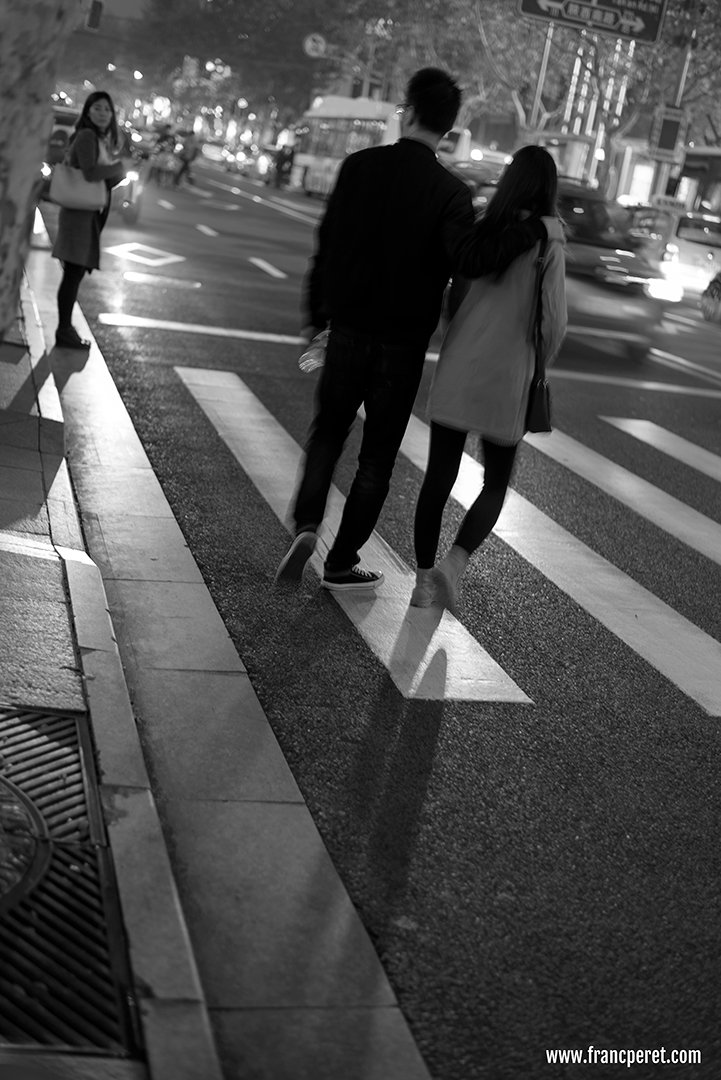
Zebra and couple. Nikon D750 ISO100 1/10s 50mm f/1.8 @ f/1.8
Zebra II. Nikon D750 ISO100 1/10s 50mm f/1.8 @ f/1.8
Zebra. Nikon D750 ISO100 1/10s 50mm f/1.8 @ f/1.8

I am teaching to my students that if they are able to bring positive emotion to viewers while showing them their garbage can picture, they would have achieve something genuinely good as photographer…

Success will not belong to the subject itself, but to the photographer only.
And night shooting, with all its magic, is the best place to give it a try…

If you liked this post, you can discover the second hand held night session in Shanghai here.

Former photo journalist, Film maker and ELC Shanghai Photography teacher, Franc Peret is teaching Essential Photography Classes, Advanced Photography Workshop and Film Making Classes in Shanghai, for the last 10 years.