
Apolline and her mother for a moment suspended in the air // Apolline et sa mère pour un instant suspendus dans les airs.
Par Franc Peret

Le bonheur c’est simple comme un tour de balançoire.
Apolline and her mother for a moment suspended in the air // Apolline et sa mère pour un instant suspendus dans les airs.
Par Franc Peret
WORKING ON COMPOSITION
The frozen tap
TRAVAIL DE COMPOSITION
Le robinet gelé
Franc Peret


I am working on the publication of my first book of photographs, built around my 2 years of photographic reporting on social movements in France. Here is an overview, even if nothing is final and far from it!
Franc Peret
Je travaille à la publication de mon premier livre de photographies, construit autour de mes 2 années de reportage photographique sur les mouvements sociaux en France. En voici un aperçu, même si rien n’est définitif, loin de là !


History is on its way in France, with its yellow vest insurrection and I couldn’t let it go without being part of it as a visual witness, due to my photo and video journalist background
By Franc Peret
I left home at 5:30 am took a train and spent my day in Paris, searching for snapshots in the heat of the yellow vest insurrection.

Subway stations being shut down, I walked for hours from “Paris-Bercy” to “Place de l’Étoile” through “Bastille” (about 11 kms due to many major streets blocked by police).


I saw policemen disguised as protesters, I got 6 safety body search prior to reach “Champs Élysées”.
Police kept my protective goggle and my light gas mask to be sure I will be suffering during their coming assault.
I followed a growing marching group to destination.


They were coming from all parts of France, with no leaders and no political party for telling people where to go and what to do.

Most of them reacted against the official message from our government: “Don’t go to Paris, it will be too dangerous and our forces will be tough on illegal protesters (they consider us all as illegal anyway)”.


Reaching “Champs Élysées”, men in uniform let us in, but never let us out until mid afternoon.


Waiting for the rest of the crowd, we exchanged jokes and opinion with very friendly Gendarme (kind of police belonging to Army corp) locking the way to the “Place de l’Étoile”.

Later on, they protected us against some very aggressive policemen in combat gear.

Locked in a trap, we swallowed tear gas for hours.


Once I threw up and cried a lot.

I became blind and lost my way, until a baton pushed me away in the right direction. I was in the most dangerous location; among men in gear.


Few minutes later, I got shot by a flash ball in my right leg.


Luckily, it bounced on somebody else before hitting me.
The old lady was bleeding, and I just got a bruise.

Protesting nurse, doctors and firemen in strike took care of people in pain like us.


My leg was steep and I had great difficulties to reach back my train station, hobbling for 2 hours, on the irregular pavement of the Seine river bank.

Back in the train, i realized that I didn’t sit for a single second during the last 10 hours.


I was not fully satisfied with my pictures and video, as my lack of protection, experience and updated information plus my protective instinct kept me away from the hottest event.

Thus I went back once again to Paris the following Saturday, with a better understanding of the situation but a worst lighting situation due to a winter style overcast day…
THE END
Information:
– All pictures were shot with Panasonic Lumix GH5 + 12-35 mm f/2.8 + 35-100 mm f/2.8 + Voigtlander 25 mm f/0.95.
– Wide format pictures and panoramic views were extracted from my 4K video footage.
Former photo journalist, Film maker and ELC Shanghai Photography teacher, Franc Peret is teaching Essential Photography Classes, Advanced Photography Workshop and Film Making Classes in Shanghai, for the last 13 years.
If you wish to contact Franc, just drop an email to francperet@hotmail.com


Same topic, three ways of shooting it. Pictures, settings, and choices explained.
By Franc Peret
I am not sure my little one, Apolline, will keep those moments in her inner memories, but pictures should help…
All shot with Nikon D750 and Nikon 24-70 mm f/2.8

1 – Shouting Apolline (against heavy clouds ready to pour):
– Zoom lens position 38 mm = Semi-wide shot to integrate the subject in her environment but keeping the possibility to get a shallower depth of field (wider the lens more depth of field you get).
– ISO 100 = Best quality and no need to increase as light are great.
– Aperture: f/2.8 = Treated as a portrait to get a shallow depth of field,
– Resulting Shutter speed (as I am working on Aperture priority mode) = 1/1250s

2 – Feet in the water (cut out the rest of the world)
– Zoom lens position 24 mm = Wide shot to integrate the subject in her environment.
– ISO 100 = Best quality and no need to increase as light are great.
– Aperture: f/5.6 = Treated as a landscape shot to get a deep depth of field, as my girl is too small and too far away to be dealt as a portrait. And the location is more important here to tell the story: wet and isolated, cut out from the rest of the world.
– Resulting Shutter speed (as I am working on Aperture priority mode) = 1/350s (I could set up at f/8 but as I never know if Apolline is going to move, I preferred to play it safe. At f/8 shutter speed would be around 1/160s, sufficient if she is keeping steady.)

3 – Under the sun (between rain)
– Zoom lens position 29 mm = Wide shot to integrate the subject in her environment.
– ISO 100 = Best quality and no need to increase as light are great.
– Aperture: f/2.8 = Treated as a portrait to get a shallow depth of field,
– Resulting Shutter speed (as I am working on Aperture priority mode) = 1/1600s (faster than the first shot as there is more light from the sun).
Former photo journalist, Film maker and ELC Shanghai Photography teacher, Franc Peret is teaching Essential Photography Classes, Advanced Photography Workshop and Film Making Classes in Shanghai, for the last 13 years.
If you wish to contact Franc, just drop an email to francperet@hotmail.com
Which course to choose? Advanced or Essential class?
I am often receiving this question when time comes to enroll to one of my photography program. Here is the answer.
Franc Peret
I am offering 2 different Photography courses: Advanced and Essential and despite the detailed description on my website, it can be difficult to choose.
Essential vs Advanced
To make it simple, the Essential Class is what it is: “Essential”.
Everything you should know, think about and do, to get better pictures, a higher success rate (to capture the moment) and very pleasing result (technically and artistically).
Everyone should consider Essential
This class is the best value for money as everything you are learning there will be immediately useful in any kind of situation you can meet daily in the street, during an event or a trip. It covers essential photography in portrait, landscape, sports, macro, night shooting… analyzing the difficulties in those practice and offering a very efficient and practical “what to do” case by case solution.
It is a down to earth class adapted to both complete beginners and people with experience who knows things here or there but who cannot yet connect everything in a logical understanding and order.
Experimental and conceptual
The Advanced class is something very different.
This program is a series of workshops for you to discover how far you can go with your camera.
Also, more important, this experience will help you to understand that what is happening (what you organize and set) in front of the lens is finally much more important than the camera itself.
Pushing Boundaries
Somehow it teach you how to become a director/art director/orchestra conductor handling an overall project and not simply a photographer trying to grab a picture.
It is more oriented toward personal creativity, using the camera in many unusual ways: very higher shutter speed, very long pose, shooting several shot from same position, post processing for special effects and so on.
Take it all!
Somehow, to get a complete overview about photography, you should take both lessons, but I would say, the essential class is the most useful one if you are a street photographer type of person, somebody who like to shoot people in documentary style, bringing back travel or family pictures, shoot landscape or products…
If you are more into design, painting, graphic work and virtual world, the advanced class will match as soon as you know how and why to set up your camera or choose a lens.
I hope all of this will be helpful ot pick up the right class for you, but if anything is not clear yet, do not hesitate to contact me!
Former photo journalist, Film maker and ELC Shanghai Photography teacher, Franc Peret is teaching Essential Photography Classes, Advanced Photography Workshop and Film Making Classes in Shanghai, for the last 11 years.
If you wish to contact Franc, just drop an email to francperet@hotmail.com
Tweaking images had always been part of photography, long before the existence of digital file and Photoshop type of software. There is nothing wrong about it, as soon as you exactly know what you are doing. Thus, you need a clear vision of your concept from model, background, accessories, lighting and shooting style.
By Franc Peret
Experimenting with cameras, lenses, point of view, composition, flash, lighting, natural light, structure, model or actors always feed my interest in film making and photography.
Last but not least, post processing is the ultimate touch I can add to finalize my original concept.
I am using my 2 favorite software to do so: Photoshop (for pictures and video) and Premiere (for video).


I am working with no more than 10% of their capabilities, but they already allow me to to get closer to my initial ideas, to push even further my interpretation or to create an unexpected result.
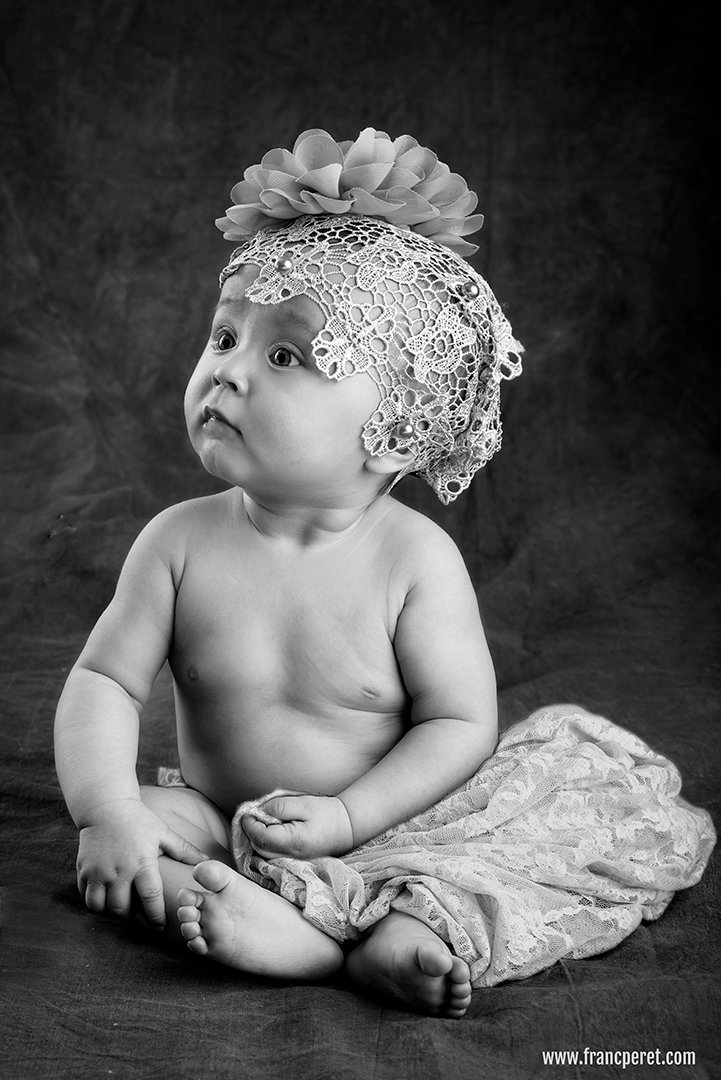

Most Important before using a post processing software is to get a concept in mind.
For this series of vintage shot of my little one, I had an idea in mind and this drives most of my choices: background, clothe and accessories, point of view, lens choice and lighting.
Lighting is a bit specific as shooting a little kid is not the same as shooting an adult. You have to be prepared to get her face turning around and therefore to light up the scene from both direction to get a pleasing result wherever the little model is looking.
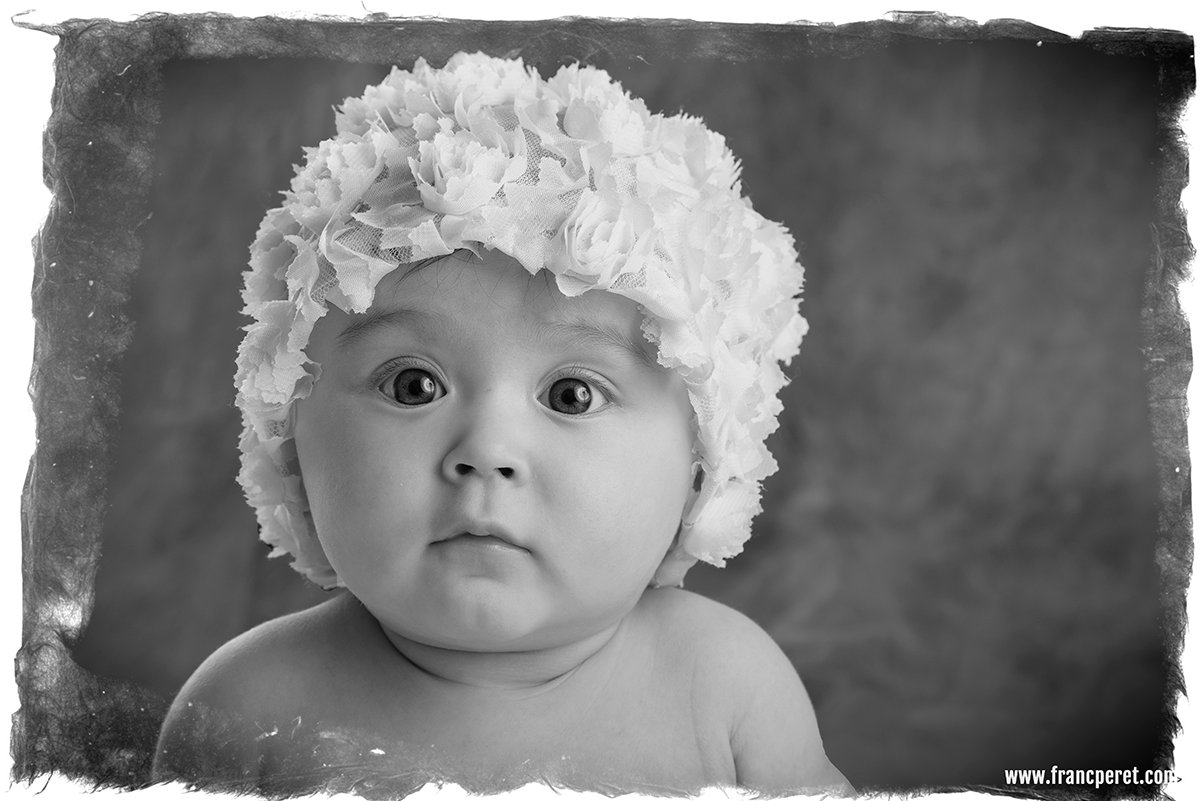

Key light and fill light should not exceed a 1:2 contrast ratio with the kick light in the same range to detach her silhouette from the background without burning the reflected highlight on her skin.
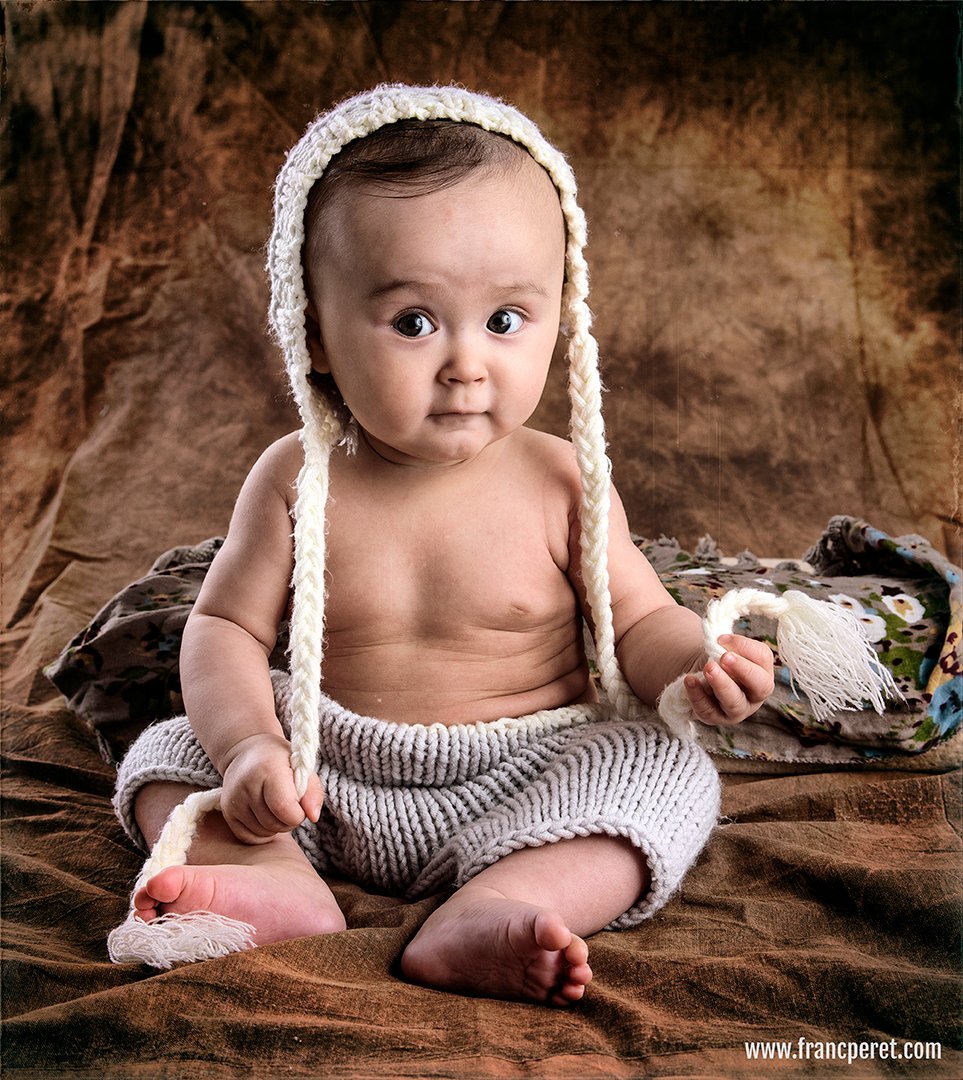

To achieve such a smooth light set up, I used 3 flashes:
The key light was bouncing inside a huge soft umbrella which behave like a 1.5 meter wide beauty dish (positioned on her left side, next to my right shoulder).
The fill light (which was also used to light up the background) was bouncing in the opposite corner of the room (facing her high, on her right side, over my shoulder).
The kick light was bouncing against the white wall behind her (high, on the right side of her back).
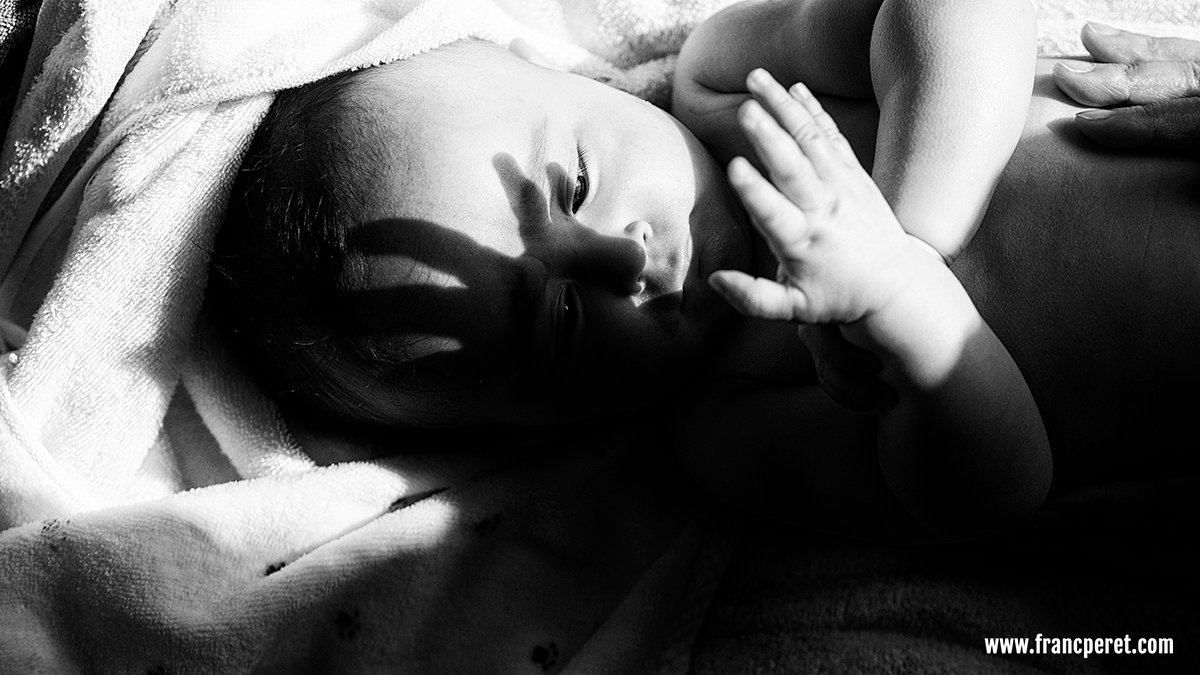
Final touch, she was surrounded by white reflector panel to not get colored shadow form the wood furniture around.
I forgot to say that this set up was done in my bedroom and not a studio and my bedroom is quit small…
For that “studio session”, I used my Nikon D750 (ISO100) and a great old zoom lens (AF-S f/3.5-f/4.5 28-105mm D) set at f/8.
With such a cute model and good pictures to start with, it was very inspiring to play around with different photo treatment in post processing, to achieve the vintage look I was after.


From start to end, I had something in my mind and I just made it come alive by adjusting every steps of the process in the same direction.
FP
Former photo journalist, Film maker and ELC Shanghai Photography teacher, Franc Peret is teaching Essential Photography Classes, Advanced Photography Workshop and Film Making Classes in Shanghai, for the last 11 years.
If you wish to contact Franc, just drop an email to francperet@hotmail.com
Just a quick word to wish to all my past, actual and future students a Happy New Year 2016!
Being the lucky father of a little star, I am very busy at home! And 2016 is going to be Apolline year…
Thanks to Richard Williams for his assistance on the “home made” studio shoot (actually all set in my tiny bedroom)…
Shot with 2 studio flashes, 1 huge umbrella (behaving like a 1.5 meter wide beauty disk) a backdrop and a Nikon D750 + an old great zoom Nikkor AF 28-105 mm f/3.5-f/4.5D set at f/8.
Franc Peret is a professional Photographer teaching Essential Photography Classes, Advanced Photography Workshop and Film Making Classes in Shanghai
It is quit funny, as important decisions are changing my life every 10 years. Here are some of my key steps in 1985, 1995, 2005 and 2015.
By Franc Peret
– In 1985, I decided to work all year to prepare a car and motorcycle race I wanted to participate in: Atlas Rally in Morocco.
It costs me about 6 months salary in investment, and I was in search of sponsors.
To seduce potential partner, I got the idea to ask to different magazine if they would accept to publish an article from my experience, being a complete rookie in such races, one of the youngest participant.
Yannick Picard, who was a chief editor of Moto Magazine, a cooperative type of publication (which means open minded and ready to take risk) was the only one to accept to give me a chance.
And I will never thank him enough for this, as without him, I would never had a chance to find my way.

Yannick filled up my hand with a load of Fuji roll of slide film, wishing me good luck.
From there, my only aim was to finish the race, whatever happen, as I needed material (pix and stories to tell) to get published.
Here are my pictures from my participation to Atlas Rally in Morocco (Photos from Friends and Maindru).


In the bag around my hip, I was carrying a shockproof compact film camera (offered by another great guy, a photographer) to record my experience of the week long (5600Km) off road race, I absolutely needed to finish.
And I made it, despite several crashes and many problems, I was able to write and illustrate a 6 pages story which will become my first article published in a professional magazine.
Thanks to this race I became a photojournalist shortly after, starting with Moto Magazine as Yannick appreciated my very first article.
He needed someone able to write article about off-road racing and I was at the right place at the right time for this.
And it launches my career of photo journalist for good, learning my craft and improving both my writing and my pictures step by step for the 10 years to come.

– In 1995 I quit France to set up in Taiwan and this was the start of my life in Asia and a career in Film making and Lifestyle Photography, which last until now.


I started there as a still photographer for movie, but quickly learned the film-making craft being an Assistant director and finally a cameraman

I was hired by Leon Dai, a Taiwanese director to shoot his first feature film: “Summers”


– In 2005, I decided to set up in China and I added a new activity to my arsenal by becoming a photography and film making teacher…

What will happen in 2015? Another big change for sure and I already know the answer as you can see with this picture taken recently.

Franc Peret is a professional Photographer teaching Essential Photography Classes, Advanced Photography Workshop and Film Making Classes in Shanghai
It was both very challenging and a great chance to start my career as Sport photographer, especially in the film area (without any possibilities to immediately check the result).
By Franc Peret
Challenging because shooting moving things (especially fast ones) is one of the most difficult technical thing in photography as you have to solve several problems in the meantime.
The most obvious are getting the right focus point (while following movement), anticipating shutter speed to get the right effect (Freezing impact or tracing motion with blurred background) and getting the right exposure as it might change along your tracking.

One more thing, which is often unknown if you are not used to action shot, is “tempo”: which means pressing the shutter button as the exact right time, when the action reach its climax or when the subject is perfectly positioned in your frame on the right focus point (in case of predictive focus) without overlapping with disturbing things in the background.

As far as I am concerned, the fact I was a racer before becoming a photographer did help me greatly on this.
When you are involved in Motorsport, so many things are happening at the same time, your brain needs to process very quickly and action is seen almost in slow motion.

All of this seems complicated a long to explain, but the reaction of the photographer has to be instantaneous.
Somehow, a sport photographer has to be as fast as competitor themselves, adrenaline is part of the game as well to record the shot on the right tempo.

As far as I am concerned, the fact I was a racer before becoming a photographer did help me greatly on this.
When you are involved in Motorsport, so many things are happening at the same time, your brain needs to process very quickly and action is seen almost in slow motion.
Since I was 19 years old, adrenaline was my drug, while racing Side Car Cross for 3 Seasons. I choose this sport because,as a student, I couldn’t afford a racing bike and to follow up on a season on my own.

And being the “Monkey” in the side car, I was part of an extreme thrilling experience without having to worry about cost.
My investment was purely physical and I often invested more than I got, despite my long and intensive physical training before each race.

I was exhausted, hurt and sometime wounded, but this was one of the most exciting part of my existence and a very good start to not be scared by anything (except boredom) later on, for the rest of my Adult life.
All those shots of me racing between 1983 and 1985 were taken by two of my best friends of that time (Lionel Prieur and Jean-Louis Toribio).
Franc Peret is a professional Photographer teaching Essential Photography Classes, Advanced Photography Workshop and Film Making Classes in Shanghai


