Tag Archives: Nikon

SEEING LIGHT

For beginners, a good photography starts with a good subject. While progressing, the quality of light becomes a priority over subject, as any of them can deliver a great result as soon a moody lighting is falling on it.
Franc Peret

In my Essential Photography Classes, I very quickly emphasize the importance of light to my students who solely focus on camera settings and the subject itself.

Commercial photo shoot involves lots of lighting to get the best result out of the subject.
Commercial photo shoot are done in studio to get the best result out of the subject.
TV commercial lighting set up involves much more equipment, time and budget than the shooting part
TV commercial lighting set up involves much more equipment, time and budget than the shooting part.

I am always repeating this back to basic motto: “without good light, there is no good picture”
The word “Photography” literally (from its Greek origin) means: “painting with light”.

Working with light means also working with shadow and everything in between. Nikon D750 ISO100 1/60s with 24-120 mm f/4 @ 90 mm f/11.
My little one looking at the main door bathed by soft natural light. Lumix GM5 ISO200 1/160s with 45 mm f/1.8 @ f/1.8
My little one looking at the main door bathed by soft natural light shaping her face with a bright line. Lumix GM5 ISO200 1/160s with 45 mm f/1.8 @ f/1.8

It is the reason why, big budget advertisement, movies and important visual production are spending most of the money on lighting equipment, specialist and crew.
It is also the reason why studio shooting are making a difference compare to natural light session (for portrait, products and fashion).

Reflective tools under sunlight. Nikon D750 ISO100 1/1000s with 24 mm f/2 @ f/2
Graphical Shanghai airport. Nikon D90 ISO 200 1/60s with 18-140 mmf/3.5-5.6 @  18 mm f/8
Graphical Shanghai airport. Nikon D90 ISO 200 1/60s with 18-140 mmf/3.5-5.6 @ 18 mm f/8

Also, memorable landscape photography are always shot at the best time of the year and the best hours of the day.

ISOgraphy

Of course, with newer camera able to shoot at very high ISO (higher than ISO 6400), this original idea seems outdated.

Meeting new friends. Lumix GM5 ISO1250 1/30s with 25 mm f/1.4 @ f/1.4
Marc the gardener in winter light. Lumix GM5 ISO400 1/15s with 25 mm f/1.4 @ f/1.4

And some geeks are spending their time to challenge their vision and their equipment capacity by shooting subjects in “no light” situation such as a jumping black dog in a tunnel at night.

Apolline, her mother and a stray cat. Lumix GM5 ISO100 1/640s with 25 mm f/1.4 @ f/2
Summer in France. Lumix GM5 ISO100 1/160s with 20 mm f/1.7 @ f/4

With this search of camera efficiency in low light, subject is not important anymore, only pixel peeping and noise hunting on screen seems to bring satisfaction.

Cinemascope framing for this outdoor portrait: During a sunny day, keeping the subject face under shadow deliver a softer and more pleasing look. Nikon D750 ISO100 1/640s with 85 mm f/1.4 @ f/1.4

However, this kind of practice is not related to photography anymore and I am calling it “ISOgraphy”.

Light is all you need

Therefore, whatever camera you are using, a better lighting will always bring the best improvement in your photography.

An old bed frame became a art piece in my garage, before It goes away in a garbage truck. Nikon D750 ISO140  1/160s with 24-120 mm f/4 @ 92 mm f/5
An old bed frame became a art piece in my garage, before It goes away in a garbage truck. Nikon D750 ISO140 1/160s with 24-120 mm f/4 @ 92 mm f/5
A plastic bottle on a table in my home.Thanks to the light, anything can become attractive. Lumix G85 ISO 200 (to preseve details) 1/8s (G85 has a great internal stabilizer) with 100-300 mm f/4-5.6 @ 125mm f/9 (to get enough depth of field)
A plastic bottle on a table in my home.Thanks to the light, anything can become attractive.
Lumix G85 ISO 200 (to preseve details) 1/8s (G85 has a great internal stabilizer) with 100-300 mm f/4-5.6 @ 125mm f/9 (to get enough depth of field)

I am so used to search for light (or building up lighting for film making and studio work) that my emotional response to any subject (even my little daughter) is linked to the quality of light falling on them.

My little one is cute, and even cuter under great lighting, her eyes turned to the sky. Nikon D750 ISO100 1/320s with 90 mm f/2.8 @ f/2.8
My little one is cute, and even cuter under great lighting, her eyes turned to the sky.
Nikon D750 ISO100 1/320s with 90 mm f/2.8 @ f/2.8

Somehow, anything under good lighting is a subject to me and my feeling and creativity is building up the shot.

Quality of light?

When I am speaking about lighting, there is sometime a misunderstanding among my students.
While I am considering quality, they are considering brightness only.

Blowing dandelion seeds... Mid day under blue sky is not offering the best lighting, better to avoid strong shadows on face by choosing your point of view according the sun position. Nikon D5500 ISO100 1/3200s with 50 mm f/1.8 @ f/2
Blowing dandelion seeds… Mid day under blue sky is not offering the best lighting, better to avoid strong shadows on face by choosing your point of view according sun’s position. Nikon D5500 ISO100 1/3200s with 50 mm f/1.8 @ f/2

A good quality of light is shaping the subject (3D feel), bringing a mood (hard or soft), displaying vivid or pastel colors, offering a strong B&W type of contrast or a smooth transition between bright and dark area.

Vintage Suitcase in market. Direct sunlight emphasize colors. details and texture. Nikon D750 ISO200 1/125s with 24-120 mm f/4 @ f/11
On action shot, best is to wait for your subject to cross the light you had detected. Nikon D5500 ISO400 1/1000s with 18-140 mm f/5.6 @ 140 mm f/5.6

As soon as you are starting to be sensitive to light, it is a never ending experience as it is spreading such a wide panel of beauty and there is nothing more enjoyable in life than to see beauty everyday.

Hard light with sharp shadows under winter sunlight. Nikon D750 ISO100 1/3200s with 85 mm f/1.4 @ f/1.8

No need to be trained to find good lighting, it can be anywhere, anytime (for close up shots) and you just need to open your eyes and to concentrate on the way light is falling on things and people around you.
And whatever is bath under a great light will become your subject…

Former photo journalist, Film maker and ELC Shanghai Photography teacher, Franc Peret is teaching Essential Photography Classes, Advanced Photography Workshop and Film Making Classes in Shanghai, for the last 11 years.
If you wish to contact Franc, just drop an email to francperet@hotmail.com

When you are used to see a landscape, it changes drastically according the sky scenario. ISO100 1/2000s with 18-140 mm f/3.5-5.6 @ 18 mm f/5.6
When you are used to see a landscape, it changes drastically according the sky scenario. Nikon D5500 ISO100 1/2000s with 18-140 mm f/3.5-5.6 @ 18 mm f/5.6
Even in a darker area, you need different sources of light  for shaping the scenery. Lumix GM5 ISO400 1/25s with 20 mm f/1.7 @  f/2.8
Even in a darker area, you need different sources of light for shaping the scenery. Lumix GM5 ISO400 1/25s with 20 mm f/1.7 @ f/2.8

Friends Holding branches

Winter is the perfect season to shoot trees against the sky, as a graphical and structural silhouette. You just need to find the right subject and the right setting.
By Franc Peret

This picture was shot in Burgundy, at the end of the day with a Sony A7M2 + adapter + 25 years old Nikon AIS 20 mm f/2.8 (Manual focus).
As usual in outdoor shots, I set my camera in Aperture priority mode and pointed it toward the subject without any exposure compensation (+/- @ 0).

Note:
Often I am having questions about sunset shot settings…
Answer: Just point and shoot and deal with the foreground as a silhouette.

1 – COMPOSITION
The idea was to fill up the frame with the branches net complexity and pattern of those trees while getting the sun partially hidden behind one of them. I adjusted my position accordingly to be at the right distance to get the complete scene and avoiding disturbing elements.

2 – CAMERA SET UP
– ISO 100:
Best quality and facing the sun with the right exposure of the sky, shutter speed is always fast enough.

– Aperture: f/8.
I a closing the aperture a lot, even I do not need that much depth of field for 3 reasons: 1 – interesting trees are on the same line (same distance from me). 2 – I am using a very wide lens and wider the lens, deeper is the depth of field by default. 3 – I am far from the trees (about 20 meters) and focusing away already deliver more depth of field. Somehow, at f/4 I would have enough DOF.
However, I closed down much more my aperture to get the best sharpness possible on the complete frame (corner to corner) out of my lens and this happens around f/8 or f/11 (for that generation of lenses).
More modern lenses are able to deliver full-frame sharpness earlier, but diffraction tends to come earlier too.
Never take the risk, shot this type of picture with a different aperture (f/5.6 – f/8 – f/11.) if you are not sure of the best one on the field.

– Related shutter speed: 1/160s.
As soon as there is no wind and you are stable, 1/30s would have been enough if the sun was lower because nothing is moving and I am using a wide lens (which tends less transmitting my potential move to the picture).

Former photo journalist, Film maker and ELC Shanghai Photography teacher, Franc Peret is teaching Essential Photography Classes, Advanced Photography Workshop and Film Making Classes in Shanghai, for the last 13 years.
If you wish to contact Franc, just drop an email to francperet@hotmail.com

Living the flood

Same topic, three ways of shooting it. Pictures, settings, and choices explained.

By Franc Peret

I am not sure my little one, Apolline, will keep those moments in her inner memories, but pictures should help…

All shot with Nikon D750 and Nikon 24-70 mm f/2.8

Shouting Apolline
Shouting Apolline

1 – Shouting Apolline (against heavy clouds ready to pour):
– Zoom lens position 38 mm = Semi-wide shot to integrate the subject in her environment but keeping the possibility to get a shallower depth of field (wider the lens more depth of field you get).
– ISO 100 = Best quality and no need to increase as light are great.
– Aperture: f/2.8 = Treated as a portrait to get a shallow depth of field,
– Resulting Shutter speed (as I am working on Aperture priority mode) = 1/1250s

Feet in Water
Feet in Water

2 – Feet in the water (cut out the rest of the world)
– Zoom lens position 24 mm = Wide shot to integrate the subject in her environment.
– ISO 100 = Best quality and no need to increase as light are great.
– Aperture: f/5.6 = Treated as a landscape shot to get a deep depth of field, as my girl is too small and too far away to be dealt as a portrait. And the location is more important here to tell the story: wet and isolated, cut out from the rest of the world.
– Resulting Shutter speed (as I am working on Aperture priority mode) = 1/350s (I could set up at f/8 but as I never know if Apolline is going to move, I preferred to play it safe. At f/8 shutter speed would be around 1/160s, sufficient if she is keeping steady.)

Under the sun
Under the sun

3 – Under the sun (between rain)
– Zoom lens position 29 mm = Wide shot to integrate the subject in her environment.
– ISO 100 = Best quality and no need to increase as light are great.
– Aperture: f/2.8 = Treated as a portrait to get a shallow depth of field,
– Resulting Shutter speed (as I am working on Aperture priority mode) = 1/1600s (faster than the first shot as there is more light from the sun).

Former photo journalist, Film maker and ELC Shanghai Photography teacher, Franc Peret is teaching Essential Photography Classes, Advanced Photography Workshop and Film Making Classes in Shanghai, for the last 13 years.
If you wish to contact Franc, just drop an email to francperet@hotmail.com

The 3 Steps of Photography

I am used to divide my Essential Photography course in three steps. First, providing essential technical knowledge. Second, explaining essential composition rules. Last but not least, developing student’s conceptual mind. Here is how it works.
By Franc Peret

Taking successful pictures is both a simple task and a complicated one.
Simple, because the process involved is almost always the same and quit easy to explain and remember, step by step:
1 – Set the right exposure
2 – Focus on the subject.
3 – Be ready to grab the right moment (positioning or facial expression for example)
4 – Concentrate on your personal creative decision in term of framing, assembling elements (composition), and depth of field.

"Yammi"  (Lumix G85 ISO 100 1/100s + 14-140 mm f/3.5-5.6 @ 17 mm f/4.5) Being patient and steady while waiting for the right moment to shoot help to become discreet and out of focus of the subject, even you are next to her.
“Yammi” (Lumix G85 ISO 100 1/100s + 14-140 mm f/3.5-5.6 @ 17 mm f/4.5) Being patient and steady while waiting for the right moment to shoot help to become discreet and out of sight of the subject, even you are next to her.
Once the essential set up of the camera is done right, most important is to not miss the right moment! Lumix G85  ISO 400 1/40s  + 25mm f/1.4 @ f/1.4
“Ice on lips” (Lumix G85 ISO 400 1/40s + 25mm f/1.4 @ f/1.4) Once the essential set up of the camera is done right, most important is to not miss the moment!

Not that simple

The fact that you often have to solve those 4 steps in less than a second is the complicated part of photography.
Getting the picture right, as often as possible, is possible with training…
More you are going to shoot, better the chance to make the right decision on time.

"Reflective street"  (Lumix G85 ISO 100 1/80s -0.7 + 14-140 mm f/3.5-5.6 @ 14 mm f/8) Searching for interesting lighting  and reflective surface is a good start to get out of routine.
“Reflective street” (Lumix G85 ISO 100 1/80s -0.7 + 14-140 mm f/3.5-5.6 @ 14 mm f/8) Searching for interesting lighting and reflective surface is a good start to get out of routine.
"Square everywhere" (Nikon D750 ISO 800 1/180s + 24-120 mm f/4 @ 120 mm f/4.8) Step by step you should switch from funny street snapshot to more personal subject and sophisticated composition
“Square everywhere” (Nikon D750 ISO 800 1/180s + 24-120 mm f/4 @ 120 mm f/4.8) Step by step you should switch from funny street snapshot to more personal subject and sophisticated composition

Developing a vision

Once you are used to get good results, you have to challenge yourself a little more to add meanings, drama, sparks or personality to your shots.
How to get this?
While pressing the shutter button, you should already get a clear concept in mind, a vision or a directive line to be able to bring together a meaningful series of shots to tell a complete story (journalistic approach) or to express a specific mood (“artistic” approach).

"Quiet Butterfly" (Lumix G85 ISO 200 1/400s + 14-140 mm f/3.5-5.6 @ 140 mm f/5.6) ... While others needs quicker reaction before they are gone...
“Quiet Butterfly” (Lumix G85 ISO 200 1/400s + 14-140 mm f/3.5-5.6 @ 140 mm f/5.6) … While others needs quicker reaction before they are gone…
"Lion Cloud". (Nikon D750 ISO 100 1/80s +28 mm f/3.5 @ f/8) Some subjects allow several minutes to be detected and shot... Nikon D750 ISO 100 1/80s +28 mm f/3.5 @ f/8
“Lion Cloud”. (Nikon D750 ISO 100 1/80s +28 mm f/3.5 @ f/8) Some subjects allow several minutes to be detected and shot…

Fine tuning
This conceptual mind will also, later on, help you to process your image on computer in the right direction , the one you had initially chosen.

"Followed by her shadow" (Lumix G85 ISO 100 1/200s + 14-140 mm f/3.5-5.6 @ 14 mm f/6.7) Under such a hard source of light, he choice was obvious here, composing the shot with the subject and her shadow for a more 3D visual.
“Followed by her shadow” (Lumix G85 ISO 100 1/200s + 14-140 mm f/3.5-5.6 @ 14 mm f/6.7) Under such a hard source of light, he choice was obvious here, composing the shot with the subject and her shadow for a more 3D visual.
"Like a mirror" (Lumix G85 ISO 100 1/200s + 14-140 mm f/3.5-5.6 @ 30 mm f/5.6) My little girl is already a little lady, looking at herself in any reflective surface. I was ready for this one!
“Like a mirror” (Lumix G85 ISO 100 1/200s + 14-140 mm f/3.5-5.6 @ 30 mm f/5.6) My little girl is already a little lady, looking at herself in any reflective surface. I was ready for this one!

Some camera brand (such as Olympus or Fujifilm), with great color science, are better than others to delivery very satisfying results out of the box (jpg file), but most of the time, you will be able to improve the result by working on raw files.
All depends on the final use of the picture, such as quick share on social network (jpg are enough) or print for exhibition (better to go raw).

"Electric Birds 2" (Lumix G85 ISO 200 1/1320s + 14-140 mm f/3.5-5.6 @ 14 mm f/6.7). This approach brings in more imagination but also challenge the original concept behind any creative choice,
“Electric Birds 2” (Lumix G85 ISO 200 1/1320s + 14-140 mm f/3.5-5.6 @ 14 mm f/6.7). This approach brings in more options and feed imagination but also challenge the original concept behind any creative choice. It is important to never go “too far” and the limit is a personal choice.
"Electric Birds" (Lumix G85 ISO 200 1/160s + 14-140 mm f/3.5-5.6 @ 102 mm f/6.3). The exact same subject can be shot with so many different point of view and post treatment. This approach brings in more imagination but also challenge the original concept behind any creative choice,
“Electric Birds” (Lumix G85 ISO 200 1/160s + 14-140 mm f/3.5-5.6 @ 102 mm f/6.3). The exact same subject can be shot with so many different point of view and post treatment, such as vintage look or dramatic B&W.

No faking here!

" Electric Birds 3" (Lumix G85 ISO 200 1/400s + 14-140 mm f/3.5-5.6 @ 140 mm f/6.3) Later in the day, when the sky is all blue and the source of light is not behind the subject anymore, best is to keep it in color.
“Electric Birds 3” (Lumix G85 ISO 200 1/400s + 14-140 mm f/3.5-5.6 @ 140 mm f/6.3) Later in the day, when the sky is all blue and the source of light is not behind the subject anymore, best is to keep it in color.

The aim of Post production (“Photoshoping”) is indispensable to extract the optimum “juice” out of your work:
To get back the details you had seen with your eyes that seems gone on the jpg, to reproduce the right colors, to emphasize some parts of the shot or to improve the visibility of important elements by fine tuning the exposure of your raw image.

Post processing extra value

Of course, processing on computer is time consuming, and a potential painful experience for novices, but it is a very useful way to progress and to keep progressing forever.
Processing the image is a way to think of and judge what you had done with each subject, to discover some mistakes or imprecision, some stuff you should had done better or different to get a better result or more options out of the box.

"Cat rest" (Lumix G85 ISO 200 1/1500s + 14-140 mm f/3.5-5.6 @ 177 mm f/6.3) When, the light is great and an interesting subject is there waiting for you to shoot, there is not much things to think about prior to press the trigger.
“Cat rest” (Lumix G85 ISO 200 1/1500s + 14-140 mm f/3.5-5.6 @ 177 mm f/6.3) When, the light is great and an interesting subject is there waiting for you to shoot, there is not much things to think about prior to press the trigger.

Lasting passion

It also helps to emphasize a conceptual approach of photography, the best way to never get bored of it.
I am shooting for a living since 1986 and I am still not tired of it.

"Pollen Hunt" (Lumix GM5 ISO200 1/1600s + 150mm f/2.8 @ f/4) Lens choice matters more on some specific subject needing both speed and short minimal focus distance.
“Pollen Hunt” (Lumix GM5 ISO200 1/1600s + 150mm f/2.8 @ f/4) Lens choice matters on some specific subject needing both speed and short minimal focus distance.
"From the Past" (Lumix G85 ISO 100 1/800s + 14-140 mm f/3.5-5.6 @ 140 mm f/8) Longer lenses compress the perspective, extract details from the environment and keep lines straights.
“From the Past” (Lumix G85 ISO 100 1/800s + 14-140 mm f/3.5-5.6 @ 140 mm f/8) Longer lenses compress the perspective, extract details from the environment and keep lines straights.

More I know about photography, more I am excited about it, as I can measure the progress I still have to do to reach fulfillment.

Visual Samples

To illustrate my words, find here a series of personal shots (no job assignment here) with detailed captions on the three parts: essential settings, composition choices and conceptualization.

" Too young for her first ride" (Lumix G85 ISO 200 1/1000s + 14-140 mm f/3.5-5.6 @ 21 mm f/5.6) For most of the lively shots of kids, it is important to quickly find a point of view with the less disturbing background to keep viewer attention to the main action.
” Too young for her first ride” (Lumix G85 ISO 200 1/1000s + 14-140 mm f/3.5-5.6 @ 21 mm f/5.6) For most of the lively shots of kids, it is important to quickly find a point of view with the less disturbing background to keep viewer attention to the main action.
“Blue Crown″ (Lumix G85 ISO 200 1/640s + 14-140 mm f/3.5-5.6 @ 24 mm f/5.6) Color combination is a basic of composition to associate a subject to an interesting background.
“Blue Crown″ (Lumix G85 ISO 200 1/1640s + 14-140 mm f/3.5-5.6 @ 24 mm f/5.6) Color combination is a basic of composition to associate a subject to an interesting background.

I hope that all of this will be useful to my readers.
If you are having questions or if you are in need of explanation, do not hesitate to drop me an email!

Former photo journalist, Film maker and ELC Shanghai Photography teacher, Franc Peret is teaching Essential Photography Classes, Advanced Photography Workshop and Film Making Classes in Shanghai, for the last 11 years.
If you wish to contact Franc, just drop an email to francperet@hotmail.com

Once the essential set up of the camera is done right, most important is to not miss the right moment! Lumix G85  ISO 400 1/40s  + 25mm f/1.4 @ f/1.4
“Ice on lips” (Lumix G85 ISO 400 1/40s + 25mm f/1.4 @ f/1.4) Once the essential set up of the camera is done right, most important is to not miss the moment!
"Lion Cloud". (Nikon D750 ISO 100 1/80s +28 mm f/3.5 @ f/8) Some subjects allow several minutes to be detected and shot... Nikon D750 ISO 100 1/80s +28 mm f/3.5 @ f/8
“Lion Cloud”. (Nikon D750 ISO 100 1/80s +28 mm f/3.5 @ f/8) Some subjects allow several minutes to be detected and shot…
"Followed by her shadow" (Lumix G85 ISO 100 1/200s + 14-140 mm f/3.5-5.6 @ 14 mm f/6.7) Under such a hard source of light, he choice was obvious here, composing the shot with the subject and her shadow for a more 3D visual.
“Followed by her shadow” (Lumix G85 ISO 100 1/200s + 14-140 mm f/3.5-5.6 @ 14 mm f/6.7) Under such a hard source of light, he choice was obvious here, composing the shot with the subject and her shadow for a more 3D visual.
"Electric Birds 2" (Lumix G85 ISO 200 1/1320s + 14-140 mm f/3.5-5.6 @ 14 mm f/6.7). This approach brings in more imagination but also challenge the original concept behind any creative choice,
“Electric Birds 2” (Lumix G85 ISO 200 1/1320s + 14-140 mm f/3.5-5.6 @ 14 mm f/6.7). This approach brings in more options and feed imagination but also challenge the original concept behind any creative choice. It is important to never go “too far” and the limit is a personal choice.
"Electric Birds" (Lumix G85 ISO 200 1/160s + 14-140 mm f/3.5-5.6 @ 102 mm f/6.3). The exact same subject can be shot with so many different point of view and post treatment. This approach brings in more imagination but also challenge the original concept behind any creative choice,
“Electric Birds” (Lumix G85 ISO 200 1/160s + 14-140 mm f/3.5-5.6 @ 102 mm f/6.3). The exact same subject can be shot with so many different point of view and post treatment, such as vintage look or dramatic B&W.
"From the Past" (Lumix G85 ISO 100 1/800s + 14-140 mm f/3.5-5.6 @ 140 mm f/8) Longer lenses compress the perspective, extract details from the environment and keep lines straights.
“From the Past” (Lumix G85 ISO 100 1/800s + 14-140 mm f/3.5-5.6 @ 140 mm f/8) Longer lenses compress the perspective, extract details from the environment and keep lines straights.
"Reflective street"  (Lumix G85 ISO 100 1/80s -0.7 + 14-140 mm f/3.5-5.6 @ 14 mm f/8) Searching for interesting lighting  and reflective surface is a good start to get out of routine.
“Reflective street” (Lumix G85 ISO 100 1/80s -0.7 + 14-140 mm f/3.5-5.6 @ 14 mm f/8) Searching for interesting lighting and reflective surface is a good start to get out of routine.

Achieving a vintage feel

Tweaking images had always been part of photography, long before the existence of digital file and Photoshop type of software. There is nothing wrong about it, as soon as you exactly know what you are doing. Thus, you need a clear vision of your concept from model, background, accessories, lighting and shooting style.
By Franc Peret

Experimenting with cameras, lenses, point of view, composition, flash, lighting, natural light, structure, model or actors always feed my interest in film making and photography.
Last but not least, post processing is the ultimate touch I can add to finalize my original concept.
I am using my 2 favorite software to do so: Photoshop (for pictures and video) and Premiere (for video).

And the tough version with more details and preservation of the background details.
Two identical shot with 2 different post treatment: the smooth one with glow.

I am working with no more than 10% of their capabilities, but they already allow me to to get closer to my initial ideas, to push even further my interpretation or to create an unexpected result.

Timing is the main difficulty for shooting a kid, as she is always looking for discovery.
Sometime, a cute attitude occur for a very short time. Better to get flashes quick to recharge.
Sometime, a cute attitude occurs for a very short time. Better to get flashes quick to recharge.

Most Important before using a post processing software is to get a concept in mind.

For this series of vintage shot of my little one, I had an idea in mind and this drives most of my choices: background, clothe and accessories, point of view, lens choice and lighting.

Lighting is a bit specific as shooting a little kid is not the same as shooting an adult. You have to be prepared to get her face turning around and therefore to light up the scene from both direction to get a pleasing result wherever the little model is looking.

Difficulties in post processing is options. They are endless and sometime a break is welcome to leave the creative process for a while to come back with a fresh mind.
Difficulties in post processing is options. They are endless and sometime a break is welcome to leave the creative process for a while and to come back few hours later with a fresher mind a more critic eyes.
The first treatment is softer with a frame to get a "coming from the past" feel, while this one is having more details and higher contrast. Hard to decide which one is working the best...
The first treatment is softer with a frame to get a “coming from the past” feel, while this one is having more details and higher contrast. Hard to decide which one is working the best…

Key light and fill light should not exceed a 1:2 contrast ratio with the kick light in the same range to detach her silhouette from the background without burning the reflected highlight on her skin.

Sometime, I prefer to keep the color version all depends on the composition and the facial expression.
Sometime, I prefer to keep the color version, all depends on the composition and the facial expression.
Black and White is logically associated to the concept of vintage, but colors matter a lot as a starting point as they do not translate in the same shade of grey compare to the skin.

To achieve such a smooth light set up, I used 3 flashes:
The key light was bouncing inside a huge soft umbrella which behave like a 1.5 meter wide beauty dish (positioned on her left side, next to my right shoulder).
The fill light (which was also used to light up the background) was bouncing in the opposite corner of the room (facing her high, on her right side, over my shoulder).
The kick light was bouncing against the white wall behind her (high, on the right side of her back).

The sun is usually my best friend to shoot Apolline discovering her new world.
The sun is usually my best friend to shoot Apolline discovering her new world. Panasonic GM5 1/2500s ISO100 and OLYMPUS 45mm f/1.8 @ f/1.8
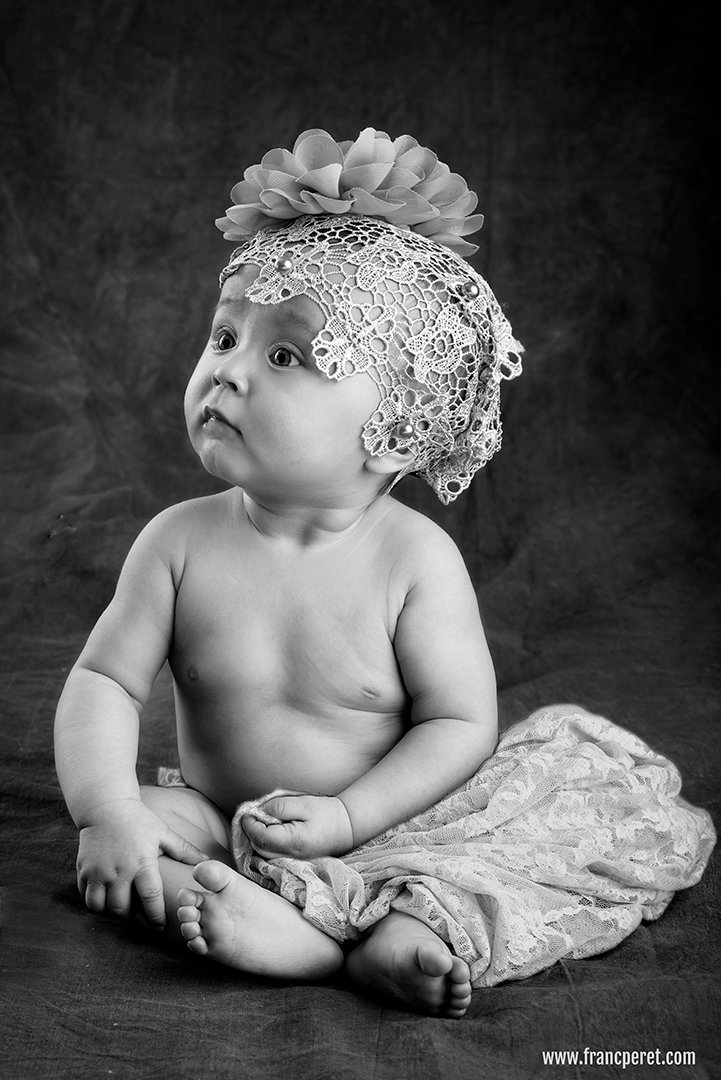
To tell the truth, I am much more used to shoot pictures of my little one in natural light, on the fly, when magic happens. I had to force myself a bit to start that "studio series", but I finally liked the experience very much.
To tell the truth, I much more used to shoot pictures of my little one in natural light, on the fly, when magic happens. I had to force myself a bit to start that “studio series”, but I finally enjoyed the experience very much and I will redo it again. Panasonic GM5 1/800s ISO100 and OLYMPUS 45mm f/1.8 @ f/2.2

Final touch, she was surrounded by white reflector panel to not get colored shadow form the wood furniture around.
I forgot to say that this set up was done in my bedroom and not a studio and my bedroom is quit small…

For that “studio session”, I used my Nikon D750 (ISO100) and a great old zoom lens (AF-S f/3.5-f/4.5 28-105mm D) set at f/8.

With such a cute model and good pictures to start with, it was very inspiring to play around with different photo treatment in post processing, to achieve the vintage look I was after.

A little girl is just an amazing subject to shoot with so many different expression waiting to be recorded
A little girl is just an amazing subject to shoot with so many different expression waiting to be recorded. Panasonic GM5 1/500s ISO100, LEICA DG NOCTICRON 42.5mm f/1.2 @ f/1.2
After shooting that studio session, I got used to treat my image different ways according the facial expression, my mood and type of lighting falling on her.
After shooting that studio session, I got used to treat my image different ways according the facial expression, my mood and type of lighting falling on her. Panasonic GM5 1/320s ISO100, LEICA DG NOCTICRON 42.5mm f/1.2 @ f/1.2

From start to end, I had something in my mind and I just made it come alive by adjusting every steps of the process in the same direction.

FP

Former photo journalist, Film maker and ELC Shanghai Photography teacher, Franc Peret is teaching Essential Photography Classes, Advanced Photography Workshop and Film Making Classes in Shanghai, for the last 11 years.
If you wish to contact Franc, just drop an email to francperet@hotmail.com

My First Pix of the Year

Here is my first shot of the year, in the bathroom mirror, while holding my no-cooperative little one with one hand and shooting with the other, using my newly purchased “vintage” digital camera.
By Franc Peret

For this shot, I am using a Nikon D90, a 2008 technology camra, bought new for 1800 RMB (= 275 USD) + a Nikkor 35mm f/2D (a vintage lens too) and a Yongnuo YN568EX Flash (Cheap and great Chinese Brand).

Why did I buy such an “outdated” camera? More about this in another post, later on…

SET UP EXPLAINED:
– Manual Mode = The only mode I can use to get my camera working with my flash at high synchro speed.
– Autofocus = AF single, multi point selection. This was the most efficient way to get in focus as our heads are in the foreground and, holding the camera that way, I am not able to perfectly set the more precise single focus point on one of our face.
– ISO200 = Base ISO for the D90, best possible quality picture with contrast, color depth and dynamic range.
– f/5.6 = to get enough Depth of field as we are close to the mirror and Apolline is moving back and forth so that she is never on the same plan as me. I could close down a bit more to be safer, but my flash batteries were not freshly charged and bouncing the flash is more demanding in term of power use and recycling time. I wanted to be able to shoot more frequently and at f/5.6 the flash was recycling much faster than at f/8.
– 1/500s (no need to be that fast, but I wanted to test the high speed synchro capability of he Yongnuo flash with the D90 and it works great!).
– Result: Soft light and no motion blur. At that set of value, 100% lighting is coming from the bounced flash directed straight to the ceiling which became the main source of light reflected by the surrounding white wall (and sink!) and the mirror itself.
– Black and White treatment: I felt that it worked very well to give more importance to the camera, as much as Apolline and myself in that shot. It is a matter of visual balance to communicate my feeling: My mind is split in 2 opposite directions that are, sometime, getting along very well:
My daughter VS Photography (and film making!)…

FP

Former photo journalist, Film maker and ELC Shanghai Photography teacher, Franc Peret is teaching Essential Photography Classes, Advanced Photography Workshop and Film Making Classes in Shanghai, for the last 11 years.
If you wish to contact Franc, just drop an email to francperet@hotmail.com

New Year Wishes?

This Colorful chalk on blackboard exhibit in Shanghai street looks like Some wishes for 2016 by a local street artist.
By Franc Peret

A real art piece as it is invaluable, nobody can buy it and it is going to be erased within a month…
Actually, those who are living in China know about those black boards present everywhere in traditional areas. Someone from the local community is writing and drawing on it for all their neighbors to remember the basic rules of good social behaviors as well as some advises related to education, health and safety.

It looks dated, in term of communication tool, but it is quit efficient and it should be considered as a real street art form.

FP

Former photo journalist, Film maker and ELC Shanghai Photography teacher, Franc Peret is teaching Essential Photography Classes, Advanced Photography Workshop and Film Making Classes in Shanghai, for the last 11 years.
If you wish to contact Franc, just drop an email to francperet@hotmail.com

New Year 2016

Just a quick word to wish to all my past, actual and future students a Happy New Year 2016!

Being the lucky father of a little star, I am very busy at home! And 2016 is going to be Apolline year…

Thanks to Richard Williams for his assistance on the “home made” studio shoot (actually all set in my tiny bedroom)…
Shot with 2 studio flashes, 1 huge umbrella (behaving like a 1.5 meter wide beauty disk) a backdrop and a Nikon D750 + an old great zoom Nikkor AF 28-105 mm f/3.5-f/4.5D set at f/8.

Franc Peret is a professional Photographer teaching Essential Photography Classes, Advanced Photography Workshop and Film Making Classes in Shanghai

Shanghai by Night II (Handheld)

This is another Night shooting session in Shanghai, with 6 of my students in the same area as the previous Night Walk. However, each time, it is a different experience due to the personality of the participant, the mood of the moment and the direction we are taking. Another great session with great people.
By Franc Peret

Last but not least, I am often changing my gear.
This time, instead of the Nikon D750 I used for previous session, I picked my 2 smallest cameras: The Nikon 1 V1 (1 inch sensor) and my Panasonic GM5.

The participant to the class: Nathalie, Vivian, Veronique, Rebecca, Alex and Priscilla.
The participant to the class: Nathalie, Vivian, Veronique, Rebecca, Alex and Priscilla. Nikon1 V1 ISO200 1/15s and Cine Nikkor 25mm f/1.4 @ f/1.4.

I fixed a Cine Nikkor 25mm f/1.4 (full metal and full manual) on the Nikon and a Lumix 20mm f/1.7 on the GM5.

Getting the phone hanging was a way to capture the interesting metallic link holding it in front of the breaking cars in the background.
Getting the phone hanging in space was a way to capture the interesting metallic link holding it in front of the breaking cars in the background. Nikon1 V1 ISO200 1/30s and Cine Nikkor 25mm f/1.4 @ f/1.4.

SMALL SENSOR vs BIG SENSOR

The big advantage of this type of camera (smaller sensors with great lenses) at night is to provide much more depth of field even at maximum Aperture (f/1.4 and f/1.7 in that case).

Vivian working to achieve the same effect while struggling to keep her balance.  Photography is a physical activity. anNikon1 V1 ISO200 1/8s and Cine Nikkor 25mm f/1.4 @ f/1.4.
Vivian working to achieve the same effect while struggling to keep her balance. Photography is a physical activity. Nikon1 V1 ISO200 1/8s and Cine Nikkor 25mm f/1.4 @ f/1.4.

Full frame camera are offering less noise, but to get enough things in focus, you can rarely use your lens fully open and being forced to close down the Aperture sometime, you need to increase the ISO to compensate.

To summarize, I would say that Full Frame camera at night are best used with subject at a longer distance, while cropped sensors works very well on close-up shots.
Somehow, APS-C (or DX) Sensors offer a great balance between the 2 options.

HUNTING REFLECTION

Alex collecting light on his face from Sony Showroom  display.  Nikon1 V1 ISO200 1/50s and Cine Nikkor 25mm f/1.4 @ f/1.4.
Alex collecting light on his face from Sony Showroom display. Nikon1 V1 ISO200 1/50s and Cine Nikkor 25mm f/1.4 @ f/1.4.

Here are some of shots I achieved that Night while walking in the heart of Shanghai, teaching to my students how to find a subject, compose their frame, set the camera according lighting condition and being as stable as possible to not need to increase the ISO.

Alex's camera at rest.
Alex’s camera at rest. Nikon1 V1 ISO200 1/8s and Cine Nikkor 25mm f/1.4 @ f/1.4.

This is an easy task to achieve in Shanghai, as source of lights are coming from everywhere and our only duty is to fill up the frame with colors, reflective surfaces and bright spots.

Lonely Tour Eiffel in a store. Light source direction are unusual at night bringing some magic to anything.
Lonely Tour Eiffel in a store. Light source direction are unusual at night bringing some magic to anything. Panasonic GM5 ISO100 1/160s and 20mm f/1.7 @ f/2.5
All black, white and red. Waiting to cross the street.
All black, white and red. Waiting to cross the street.Panasonic GM5 ISO200 1/6s and 20mm f/1.7 @ f/2

Most importantly, is to not try to reproduce the kind of shots you usually do daytime.
It would be meaningless as nighttime is offering such a different look and challenge.

Yellow Bike build to last according the Brand name: "Yong jiou" (Use Longtime). Nikon1 V1 ISO100 1/6s and Cine Nikkor 25mm f/1.4 @ f/1.4
Yellow Bike build to last according the Brand name: “Yong jiou” (Use Longtime). Nikon1 V1 ISO100 1/6s and Cine Nikkor 25mm f/1.4 @ f/1.4
No smoking. In the taxi bringing me to the meeting point. Nikon1 V1 ISO200 1/25s and Cine Nikkor 25mm f/1.4 @ f/1.4
No smoking. In the taxi bringing me to the meeting point. Nikon1 V1 ISO200 1/25s and Cine Nikkor 25mm f/1.4 @ f/1.4.

Best to be stable is to find something solid to hold your back, your shoulder or even your camera from the position you want to build up your composition.

Luminous landscape. Panasonic GM5 ISO200 1/15s and 20mm f/1.7 @ f/2.
Nathalie framing a fire hydrant against the bright city landscape. Nikon1 V1 ISO200 1/15s and Cine Nikkor 25mm f/1.4 @ f/1.4

I usually advice wall, handrail, tree or ground.
Unfortunately, you are not always finding a friendly support for every subject.

Alex in a corner for a great color match.
Alex in a corner for a great color match. Panasonic GM5 ISO100 1/50s and 20mm f/1.7 @ f/2

In that case, the way you are positioning your body and holding your camera are going to matter even more to not get a blurry shot at low shutter speed.

AN HIDDEN WORLD

One of my favorite night shooting subject in such a developing city is background or details that could be used for the shooting of a 1950’s science fiction movie.

Science Fiction background 1.
Science Fiction background 1. Panasonic GM5 ISO200 1/2s and 20mm f/1.7 @ f/2.2

I am not sure you are going to understand this sentence, but lets check out the surrounding shots to get an idea of my feeling and inspiration.

Another inspiring Sci Fi background
Another inspiring Sci Fi background.Panasonic GM5 ISO200 1/10s and 20mm f/1.7 @ f/2
A Science fiction set coming from the past.
A Science fiction set coming from the past. Panasonic GM5 ISO400 1/5s and 20mm f/1.7 @ f/1.8

In this kind of set or with those type of details I can imagine parts of an abandoned space ship or high tech factory.
Sometime people are telling me that I am having too much imagination…

Space Station.
Space Station. Panasonic GM5 ISO200 1/2s and 12mm f/1.6 @ f/4

I am very clear about that.
Imagination will be NEVER too much.

Back to reality (almost).
Back to reality (almost). Panasonic GM5 ISO200 1/25s and 20mm f/1.7 @ f/2

For me, imagination is the only way to never get bored of something I am doing since 1986: professional photography.

An individual space ship?
An individual space ship? Panasonic GM5 ISO400 1/10s and 20mm f/1.7 @ f/2

And after 15 years shooting film, digital photography helped me to cross all my previous boundaries, and Photoshop, Video, film making, editing are added value to the experience.
And as I often say to my students, I am learning something new about photography and film making, almost everyday.
It is an endless process.
My life will never be long enough to learn as much as I would like to…

If you liked this post, you can discover the previous night shooting session in Shanghai Here

Former photo journalist, Film maker and ELC Shanghai Photography teacher, Franc Peret is teaching Essential Photography Classes, Advanced Photography Workshop and Film Making Classes in Shanghai, for the last 11 years.
If you wish to contact Franc, just drop an email to francperet@hotmail.com

Nikon D40 – CCD Glory

I am used to my cameras and when I buy a new one, it is very rare I am selling the older model. I am keeping them all and sometime, I am going out with one of them for shooting.

By Franc Peret (Nikon D40)

I also do not sell most of my older camera as they have little commercial value which cannot compete against the sentimental value they get for me.

Nikon D40 with 35mm f1.8G + 24-120mm f3.5-5.6G + 50mm f1.8G

But I don’t like to see those “antic” glories inactive too long, so when weather is fine and I am willing to take a walk, I pick up one of them for a couple of hours and shoot around my home in Shanghai.

Street cleaning lady on the start
Street cleaning lady on the start. 50mm prime @ f2.5, ISO200, 1/125s.
Flower tea in the plastic glass.
Flower tea in the plastic glass. Zoom @ 58mm, f5, ISO200, 1/125s.

This habit is interesting and I am always learning something from it.
Cameras are becoming more and more sophisticated, endlessly breaking new records of resolution (number of pixels) and High ISO value (something I barely use).

Thus, that day, I went out, for less than a couple of hours, with a 8 years old camera, a Nikon D40, a very compact and simple DX model I bought second hand (almost new) for less than 200 USD.

Autumn Bicycle
Autumn Bicycle. Prime 50mm @ f5, ISO200, 1/80s.

This light model (which is the ancestor of the actual D5300) gets only 6 millions pixels (my newer model packs 36 millions pixels) a small viewfinder and few lines in the menu.
Its base ISO is 200 and I shot all my pictures at that value, despite the change in lighting situation.

Mother and son
Mother and son. Prime 50mm @f1.8, ISO200, 1/400s.

It didn’t bother me that the day was ending as I carried 2 Prime lenses with a max aperture of f1.8 to compensate for the growing ambient darkness at the end of the session.
I love this camera for its compactness and its simple sensor, which a CCD and not a CMOS.
CCD are rarely used nowadays and they disappeared from photography camera production due to their higher cost.

Same roses, another spot
Rising Roses. Prime 50mm @ f2, ISO200, 1/320s.

To my eyes, their big advantage was color rendition, with natural and vivid jpg straight out of the camera.
All my newest camera are using CMOS and colors often does not look right to me, and pictures need correction in post treatment.
CCD are offering a more organic feel. Also the the lowest resolution is of great help for any lens put on the camera to shine.

Feeling followed
Feeling followed. Prime 50mm, f2, ISO200, 1/640s.
Rose against balconies
Rose against balconies. Prime 50mm @ f2, ISO200, 1/250s.

Anything I am using on this 6 millions pixel camera will deliver sharp and contrasty results.
Modern cameras are having at least 16 millions pixels.
More resolution means more details to be recorded through the lens and if a lens is not perfect, it can be seen on a file build up with bunch of pixels.

It's about lines
It’s about lines. Zoom @ 24mm, f8, ISO200, 1/500s

Therefore Few of my older lenses are working perfectly well on my 36 millions pixel Nikon D800, while they are all doing a great job on my previous cameras which had less than 12 millions pixels (D40, D200, D90).
Pixel count and high ISO are 2 “easy to market” considerations that pushed camera makers in some extremes comptetition.

Lines and Clouds
Lines and Clouds. 50mm prime @ f5.6, ISO200, 1/1000s.

And this is not all good.
Important is the final visual we are recording with the camera, and for my personal use, I don’t need that much resolution as I do not print my images.
My client needs it and it is the main reason of my purchase of a Nikon D800.
With this 36 Millions pixel monster I discovered that the slightest shaking, the slightest mistake in auto focusing or the slightest weakness from a lens resolution would result in a bad pictures.
This is a very demanding camera and its greatness finally limit its usability.

End of the street.
End of the street. Zoom @ 24mm f8, ISO200, 1/320s.
Cars and people on the wrong place
Cars and people on the wrong place. Prime 35mm @ f2, ISO200, 1/125s.

Somehow, I would prefer a modern camera less demanding on that matter to get pleasing result all the time, whatever lens I am using on my camera.
I find this advantage with the Nikon D40 and it is just a pity its viewfinder is not a bit larger and brighter to offer a better vision when I look through. A modern version of this camera would be very successful among photographer like me, who prefer to get a user friendly device which can freed my creativity and deliver great colors at the first place.

Heads go first in Chinese market.
Heads go first in Chinese market. Prime 50mm @ f2.8, ISO200, 1/60s.

For this series of shot I used 3 lenses: Nikon 35mm 1.8G + Nikon 50mm 1.8G and an old zoom: 24-120mm f3.5-5.6G. The 2 prime lens are working very well on the D800 (even the 35mm f1.8G is only a DX lens), but this zoom looks like crap on it. Impossible to get any sharp shot with it even the aperture closed down to f8 or f11.

Name card for service.
Name card for service. 35mm Prime @ f2, ISO200, 1/400s.

However, on the D40, it is a great lens, sharp and contrasty wide open, without being too heavy, even it is a FX lens and not a DX one.
Globally, I think that marketing didn’t too good for photography, with the abandon of CCD sensors, too much pixels in resolution and the need to impress customers with incredible high ISO value.

Daily Milk Consumption
Daily Milk Consumption. Prime 50mm @f2.2, ISO200, 1/250s.

Somehow, the effort were not always put were they should be, on real color accuracy, a more organic feel (images should feel less digital), greater Dynamic range and better balance between existing lenses and newer cameras.

Ball and balloons
Ball and balloons. Prime 50mm @ f2, ISO200, 1/160s.

Don’t get me wrong. I am not saying older is better. Great progress had be done, especially on the quality of the viewfinder, the build quality, the price and the offer. New models are coming out much more frequently and they concern new type of cameras. Choice had never been so huge! Overall I am always excited by my newest camera and they do force me to adapt myself which is a very good way to discover new things, to not get bored and to never feel outdated!

Franc is running an Essential Photography Class in Shanghai. Check it Here