Here are some sample of works done with my students during the Advanced Photography Workshop I am organizing in Shanghai. This time, Portrait with movie light was the main topic
By Franc Peret
Franc’s Advanced Photography Course is also designed for students to discover how to use set up, lighting and their camera for creating specific atmosphere, with different students staging as imaginary characters.
Lighting set up was done in “The Apartment”, Yong fu lu, Shanghai. A day and night creative space.
Here is a series of shots of different students. Each one inspired me an idea with props, posture and lighting in mind.
With Eugenio Sandroni, Sarah Dashfield, Raimondo Pro, Alexandra, Jana, Liam, Regino and Harald. Dirk is missing!
DJ LIAM
Here is my shot of the Famous DJ Liam. His line could be: “Are you talking to me…?”
This picture could be used for a flyer or a CD cover.
Lighting set is: 1 x LED lights panel + 1 x LED Fresnel lens + Silver Reflector.
Camera set up: Nikon D800 + 85mm f1.4D. ISO400, f1.7, 1/125s.
Moody Liam
For those 2 shots, set up was a bit different for the lighting
Liam in B&WLiam in Full colors
Harald, the Radio Repair Shop owner
This shot is mimicking a 1950’s commercial.
It was light up with 2 x LED lights panel + 1 x LED Fresnel lens + 1 x LED PAR64 (red spot) + 1 reflector.
First shot is done with Nikon D800 + 85mm f1.4D. ISO140 to ISO400, f1.7 to f2, 1/125s.
Harald shot with Nikon D800
For the second shot, I used a Panasonic GH4 = Speed Booster Adapter + Nikon Ais 55mm f1.2 @ f2. ISO200, f2, 1/125s
Harald shot with Panasonic GH4
Regino the CEO and Ray the Butcher
Ray is the Clumsy Butcher or The Ultimate Relation Therapist.
His line could be: “My wife had never been cooperative…”
Jean Pierre Jeunet “Delicatessen” movie inspired me for this set up.
2 x LED lights panel + 1 x LED Fresnel lens + 1 x LED PAR64.
Nikon D800 + 85mm f1.4D. ISO400, f2, 1/125s.
Regino, CEO style portrait with a touch of (photography) class.
His line could be: “Suits always shrink with time… Couldn’t close that f… button”
Will be used for Regino Linked in page.
2 x LED lights panel + 1 x LED Fresnel lens.
Nikon D800 + 85mm f1.4D. ISO140, f2, 1/125s.
Regino, the CEORay, the Clumsy Butcher
For this shot, I worked with a Panasonic GH4 = Speed Booster Adapter + Nikon Ais 55mm f1.2 @ f2. ISO200, f2, 1/125s
Here are some pictures taken during my street photography outing with my Essential Photography Class Students. All shots done with Panasonic Lumix GH4.
by Franc Peret
Once during the 25 hours (10 weeks) Essential Photography course, I am going out with my students to give them a chance to practice what they had learn so far in term of technical set up and composition.
Sunny Hairs (GH4 and 12-135mm f2.8)Wet Broom
I am taking benefit of the class to demonstrate some ideas and to develop Student’s inspiration by just walking around the block close to our starting point, which is The Apartment on Yong fu lu.
Splash of shadows on a Wall and a Rusty gate (GH4 and 12-135mm f2.8).
No need to walk long distance to get a wide collection of shots. Imagination is not calculated in meters.
Side leavesCenter Leave
Shanghai former French Concession is a great place for shooting due to its historical background (trees and houses) and the traditional life local people are still enjoying there.
Checking the bill.
On this series of shots, I tried to extract structures out of the element of the environment.
Passing byGrey Cubism
Whatever I am shooting is not real anymore, it becomes my own interpretation in term of association (color, shape, texture) and balance (contrast or common point).
“Kuaidi” means Express delivery.
This is what I am calling “structuralism”.
Having a seatEmpty Chair
Sometime it can be quit close to a reproduction of the real life, sometime, it is pure reformatting of the surrounding i am in.
Camouflage
light, Shadows, Lines, texture, colors and shape are directing my eyes and inspiring my brain.
And there is much more to come!
I am not turning my camera in the direction of real people, trees, car or building.
What are they shooting? My Saturday Essential Class students in action.
I am not choosing a specific subject or person according the way they look as is, I am assembling elements and collecting interesting reflection of light for reaching a personal feel of balance.
Shape and ColorsGate and WindowA red, pink and blue world
My pictures might not please or attract viewers, but this doesn’t matter much to me as I am using my own language to build up my images and I am not expecting that everyone is going to understand it or, even if they understand it, to agree with it.
Wrong hand position! A lens is not a cup of tea!Shooting a shooter.Shooting Fever. My students at work…
Creation is something personal and as soon as I know what I am looking for, I guess that I know it better than outsider who might have a totally different sensitivity and approach to street photography.
Gate and leavesAnd more leaves!Texture and shape on Gate and wall
I am simply true to myself, building up my image according my need of structuring things visually and I am just trying my best to succeed to do so.
Pier knows how to use his camera with style.Antic on wheel
Even, when I am not carrying a camera, I am composing with things I am seeing, it is always useful, like a training, helping to detect interesting combination faster when I am having a camera in hands.
Mini Yukie loves Mini carMini Car
Composition is an extension of being sensitive to light, reflection of light and its character.
In China, dogs drink white paint…
I might say, in Photography, the light is the verb and the composition the adjective. They helps to build up the phrase we started by picking up a subject.
Yukie hides and…Philippe seeks
Actually, we often pick up a subject not for what it is but for what he/she is doing.
A couple of parrots shot by a couple of students
To get more information about my Essential Photography Course, check it here
Here are some sample of works done with my students during the Advanced Photography Workshop I am organizing in Shanghai. This time, Painting with light was the main topic
By Franc Peret
Franc’s Advanced Photography Course is designed for student to discover how to use their camera at the extreme: long pause, high speed shot, special effects and other things like this.
No reason to feel scary, colorful ghosts are friendly ghosts!
Painting with light is one of the most interesting workshop as your camera can record things you cannot see with your eyes and brain.
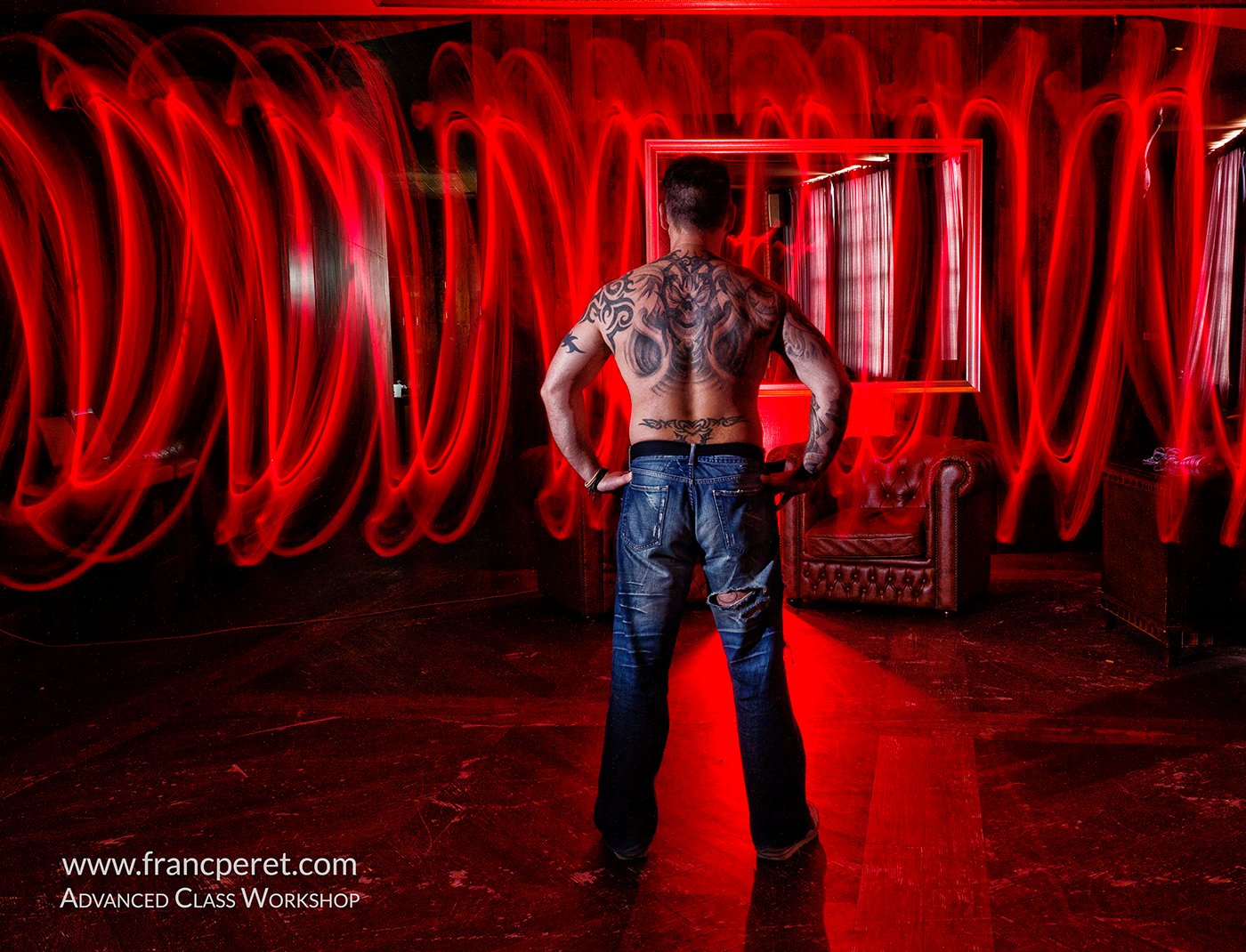
Using red for creating a mood for those tattoos (Liam’s back)
Trick is simple and affordable as you just need a camera, an average lens (as you work with regular aperture f5.6 – f8), a tripod (a chair or a table work perfectly too), a long exposure, some cheap flash, a partner, some torch or lights, a dark room and your imagination.
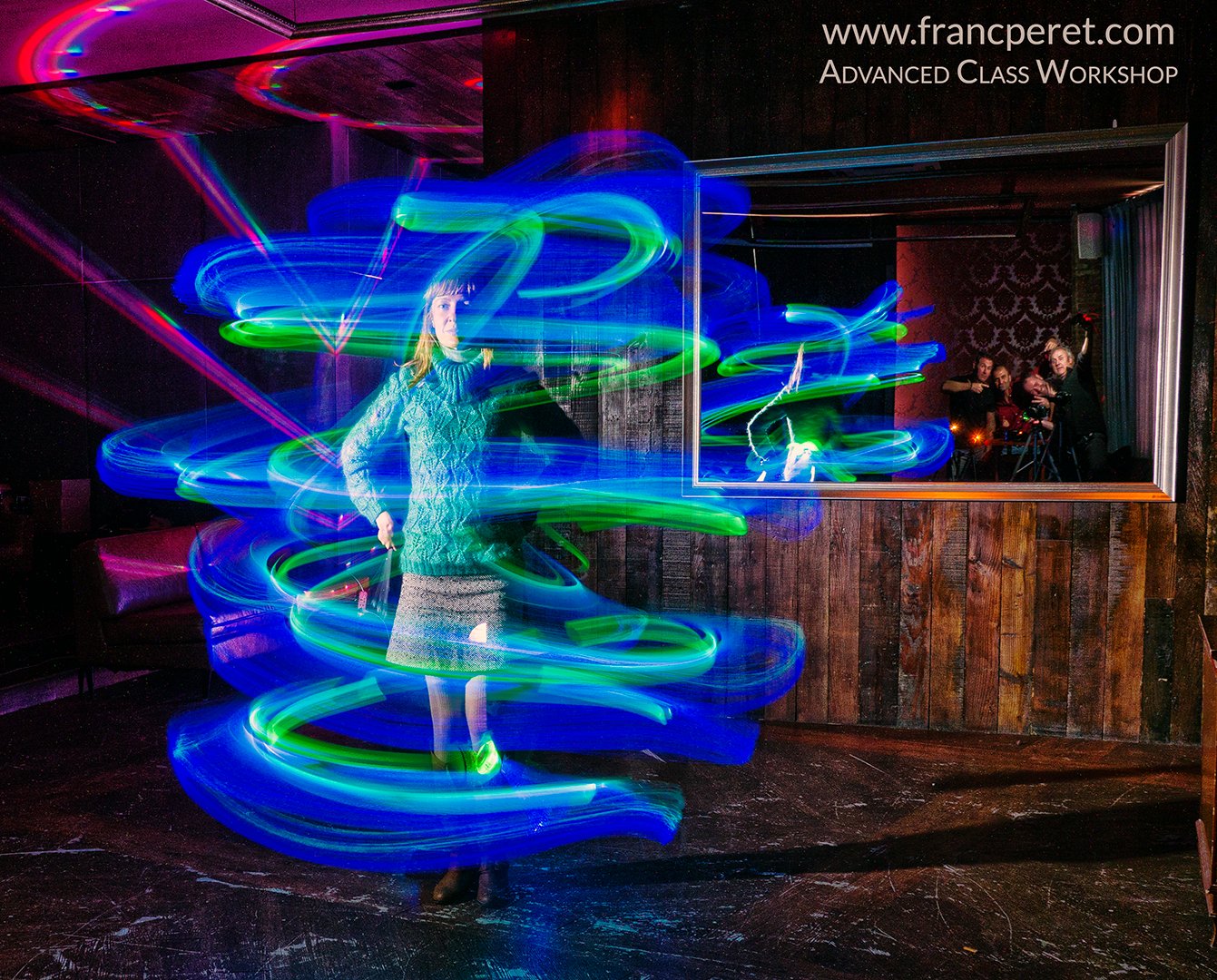
Traveling in time in a bubble of light.
This is a more advanced step in photography as the camera becomes completely secondary to the process.
Guess how Eugenio did this light move.
As soon as you set up well the camera with the right setting, you don’t think about it anymore and your focus you mind and imagination on the choreography you are going to organize in front of the lens.
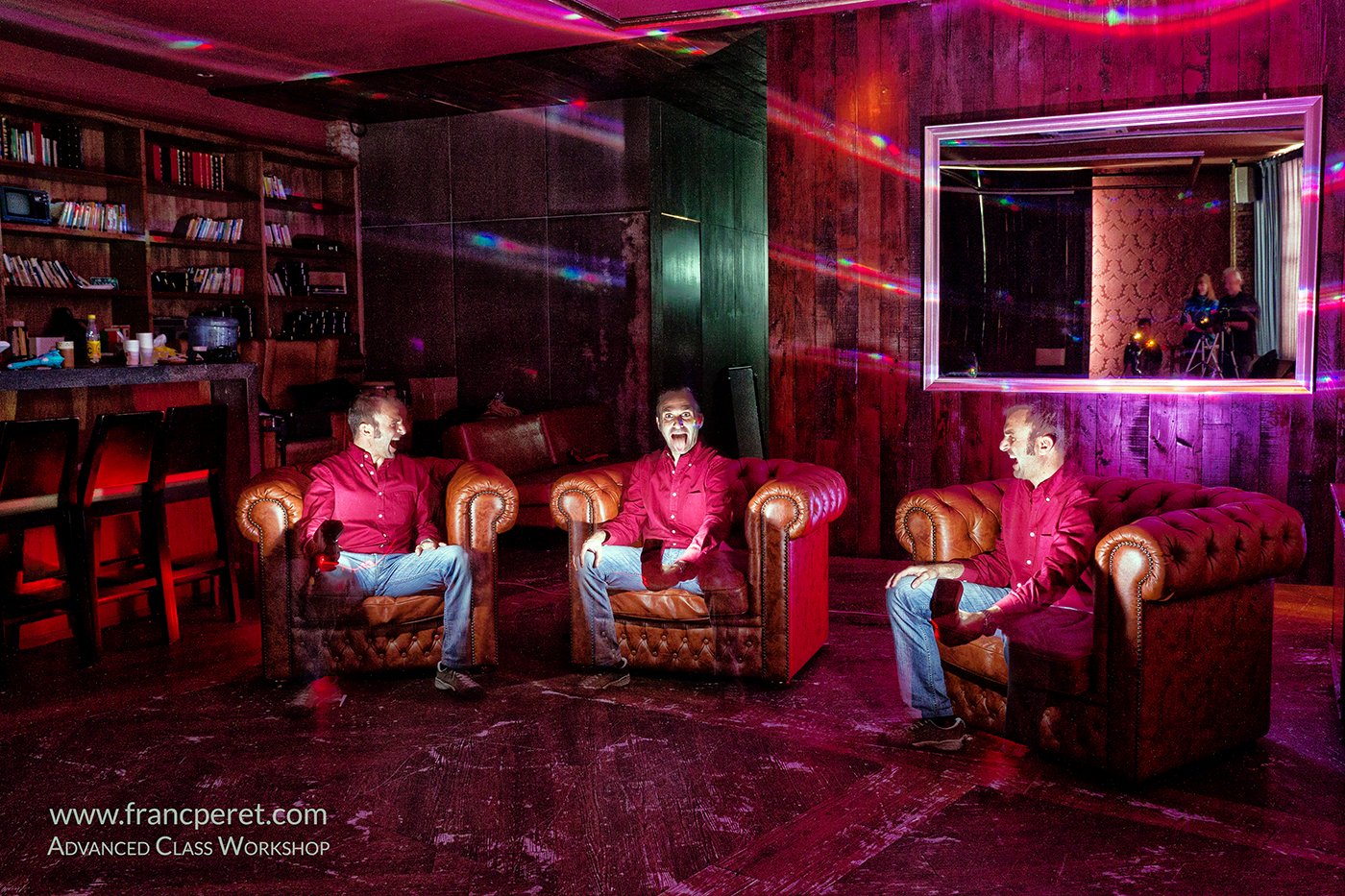
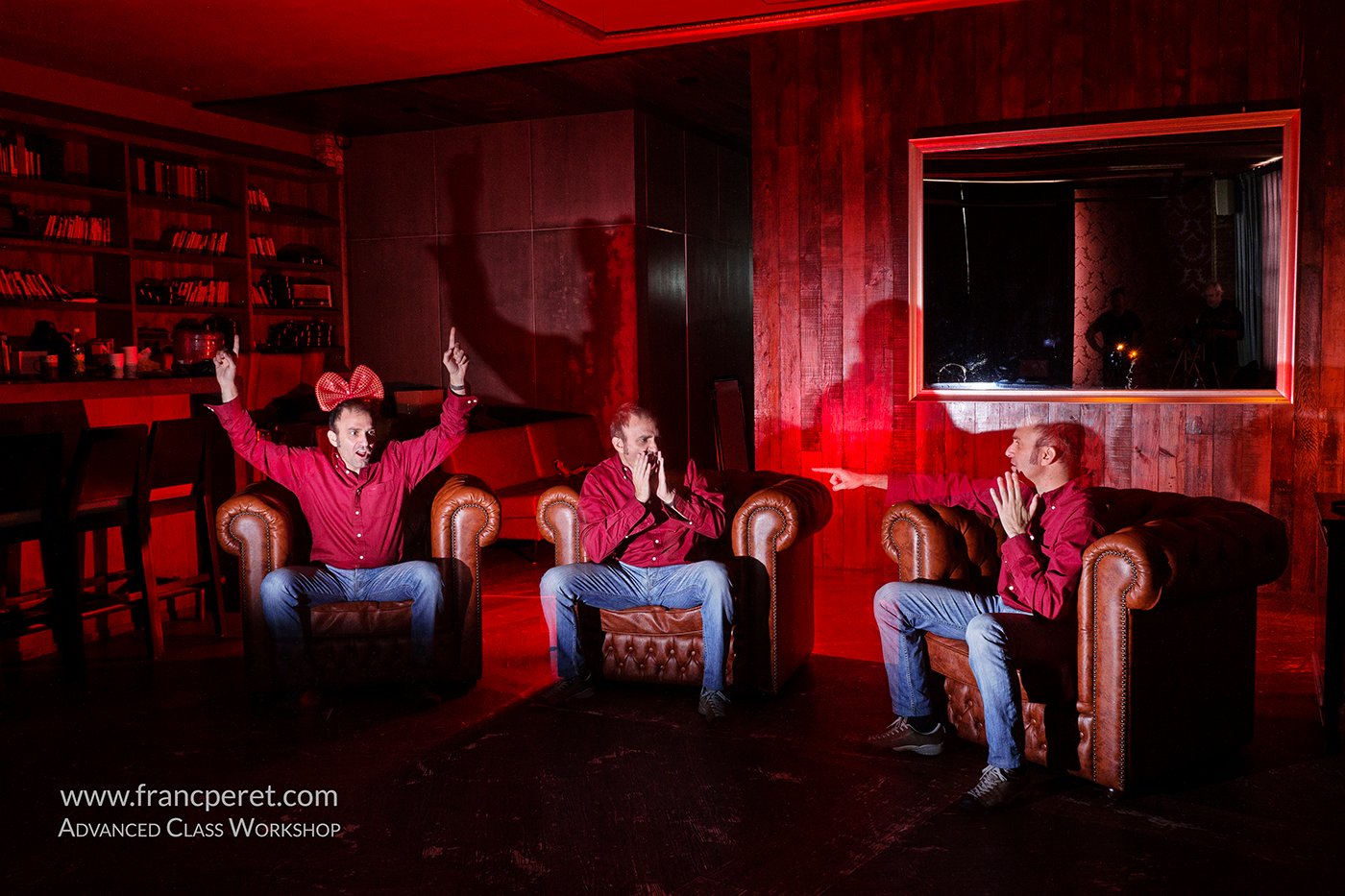
For triple exposure of the same person, we used 2 different techniques. Here Eugenio is holding a speed-light (narrow zoom position) he will flash 3 times.
It is a great exercise of anticipation, as with experience, you are able to imagine exactly what is going to happen and how it will look like.
For triple exposure of the same person, we used 2 different techniques. Here Eugenio is receiving the light form an external speed-light (narrow zoom position) that will be flashed 3 times, each time in a different direction.
Most of the time, I am still having good surprises and this make the overall process always interesting as you are challenging both your imagination and your technical ability to make it happen.
In real life, Ray looks even more weird! Light is helping him here!
This type of shooting session helps a lot my student to detach their attention to the camera and to the real life, to get more involved into the pure origin of photography which is “Painting with light”!
The idea of having the huge mirror in the background was to get some interesting reflection of the surrounding light, but we finally use it as a signature by flashing ourselves in the reflection.
And I am sure this workshop is useful to really understand what “exposure” means.
FrancTeacher: Franc Peret Students on that session: Eugenio, Liam, Alexandra, Ray and Regino Special guest: China Mei.
TECHNICAL CONSIDERATION
On a technical point of view, I always take benefit of my classes to test my newest cameras to see if they can answer to any type of my professional commitment.
All those pictures had been shot during my teaching session with Panasonic GH4 and 12-35 mm f2.8 lens set at f5.6 or f8 depending light work. Manual focus. Manual Exposure. ISO200 (Which is the base ISO on this camera).
Hot spots
Despite the base ISO, I noticed lots of hot pixels and color noise. I usually don’t have those parasites with my other camera (Nikon D800) when doing long pose (10 to 15 seconds).
Monitoring
Second problem I met with the GH4 is the lack of accuracy of the LCD screen. Image looks perfectly exposed on the screen, but histogram is telling the truth and I discovered that image could be under exposed 2 stops without having this result on my screen.
It seems that despite my screen luminosity NOT being set to auto, the GH4 is still compensating to render an acceptable image on screen, even the picture taken is truly underexposed.
Ergonomic
Out of those 2 points the GH4 is a joy to use with its fully articulated screen and its manual focus assistance features. Raw file are easy to work with, but exposure compensation often create noise in shadow area.
Discover here some pictures of our Studio Flash shooting session we had during Franc’s Advanced Photography Workshop on Saturday November 1st. Here is the first part, action pause with Elisa and Diego.
By Franc Peret
For this Advanced Photography Class Workshop held in The Apartment (Yongfu lu, Shanghai), we had the chance to get 2 different topics.
You can discover some pictures here, done with a great pair of Copaeira dancers, Elisa and Diego from Italy, who are based in Shanghai.
In another post, you can check what we had done with our Model Isabelle during that same class.
1 – Acrobatic composition with Elisa and Diego, two Capoeira Teachers (http://capoeirashanghai.com).
Capoeira: Sometime girl almost hits boyThis could be a logoCapoeira: Sometime boy almost hits girl
Some more solo and duo figures
2 hands1 handKickingKicking 2Cropping
This class was a great success, Thanks to Elisa and Diego’s enthusiasm, energy and professionalism.
Franc
Special Thanks to Nico to give us the chance to discover such great talents.
Discover here some pictures of our Studio Flash shooting session we had during Franc’s Advanced Photography Workshop on Saturday November 1st. here is the second part. Modeling shots with Isabelle.
By Franc Peret
For this Advanced Photography Class Workshop held in The Apartment (Yongfu lu, Shanghai), we had the chance to get 2 different topics.
You can discover some pictures of our modeling shot here, done with Isabelle (a sweet lady from Quebec) and in another post you can see what we had done with Capoeira dancers.
It was a pure joy to work with Isabelle who get all the the quality we are looking for, from a model: natural attitude, patience, motivation, joy and sens of humor.
It is not that easy to stand in front a group of photographers, especially when few of them are quit strange (will not tell the name here!) and Isabelle adapted herself perfectly.
2 – Modeling session with Isabelle.
Spring in the darkIsabelle is a Femme fataleSpring on a SofaI guess I am the boss
This class was a great success, Thanks to Isabelle’s enthusiasm, energy and professionalism.
I do not advise my Essential Photography Class students to use the Manual setting in an uncontrolled environment, but sometimes I am personally forced to do so and I am explaining here how to handle such situation.
By Franc Peret
I am teaching to my Essential Photography Class students how to precisely and quickly control their camera in semi-automatic Aperture priority mode as it is the most efficient way to get it right, in real life photography.
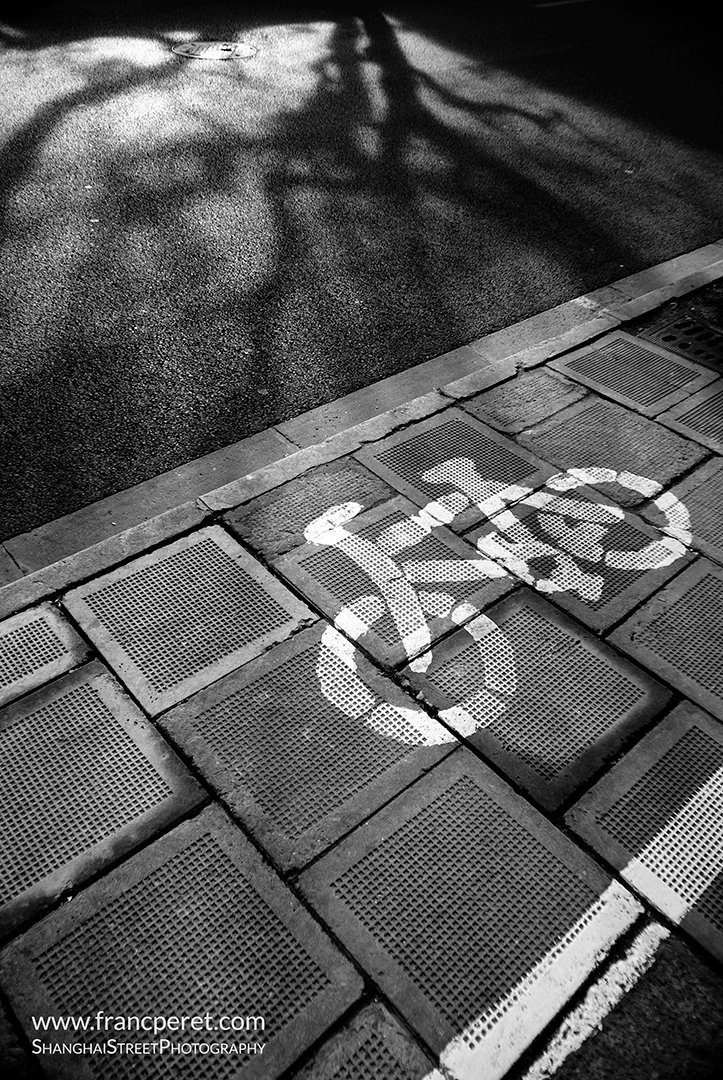
Nikon1 V1 and Cine Nikkor 10mm f1.8. With Sign and Shadows. Using a wide lens imposes to fill up the frame with interesting things (textures, Shape and Lines).Nikon1 V1 and Cine Nikkor 10mm f1.8. With Bicycle.
On my own, as I like to experiment a lot, I am often working with a strange combination of cameras and lenses linked by an adapter. And sometimes the 2 entities refuse to communicate with each other as they were not supposed to be connected.
Public Phone in the street. Soon to disappear… Nikon1 with 10mm f1.8 (equivalent to 27mm on a FX camera or 18mm on a DX)
Then, I am on my own, forced to use a full manual set up for both focus and exposure.
Last summer, I spent 2 months with such a strange combination. I adapted a collection of very old Cine-Nikkor C-mount lenses on my Nikon1 V1.
Therefore, for every shot, I had to guess the exposure and getting confirmation after the shot by checking the histogram to know if I were right or wrong.
One tip I am teaching to my students is this:
If you can see blue sky over your head and you are shooting someone under sunlight, the exposure value is matching (@ISO100 – f8 – 1/250s) or (@ISO100 – f5.6 – 1/500s) or any other combination at the same EV14.
For example, I might use (@ISO100 – f2 – 1/4000s) for portrait or for freezing high-speed action.
Having a base line to start with
EV14 is there in an average situation and in an average location.
In Australia Outback (no air pollution and lots of reflection from the sand), in The Alps, Himalaya, Tibet or Xinjiang high altitude (closer to the source of light) this value can be double (EV15) or even more.
That means the combination will be (@ISO100 – f8 – 1/500s)
In average situation, like in French Burgundy, I preset my camera to the EV14 value under a blue sky (@ISO100 – f5.6 – 1/500s) for a common subject.
If my subject is under the shadow, I know the EV is dropping at least by 2 stops so I will reduce my speed by 4 (@ISO100, f5.6, 1/125s) or open up my aperture by 2 stops (@ISO100 f2.8 1/500s) to compensate.
Taking care of parameters
My decision will depend on the fact I need or not speed to freeze motion or depth of field to get more things in focus.
This is a Quick and approximate decision without taking my eye out of the viewfinder. Shadow will be darker if the subject is not surrounded by reflective surfaces (such as a white wall).
And I will adapt my decision according to this parameter.
With the Nikon1 and my C-mount lenses, the Aperture ring is on the lens, and the shutter speed is controlled by a button next to my thumb.
Very handy.
Experience helps indoor
Now let’s imagine my subject is moving into a house with windows and white wall.
Outside is sunny and I know that the EV will be around 8 to 16 times slower (3 or 4 stops) indoor…
This is an approximation but if you are used to your environment, you should be able to guess quite accurately after few test shots. This will help you later on to get closer to the truth in few steps.
Most of the time, I got it right at first shot.
Variation will depend on reflection around (white wall or trees) the subject.
Working with human brain
Of course, during an overcast day, I have to do more test and try as I am having no reference anymore. Not every grey curtain or clouds in the sky deliver the same exposure on earth! It can be dramatically different from one day to another, one hour to another.
Step by step, knowing my environment, and having my eyes and brain used to communicate each other in this “guess what is the exposure here” game, I became more and more accurate in guessing the exposure of the place I were shooting my subject.
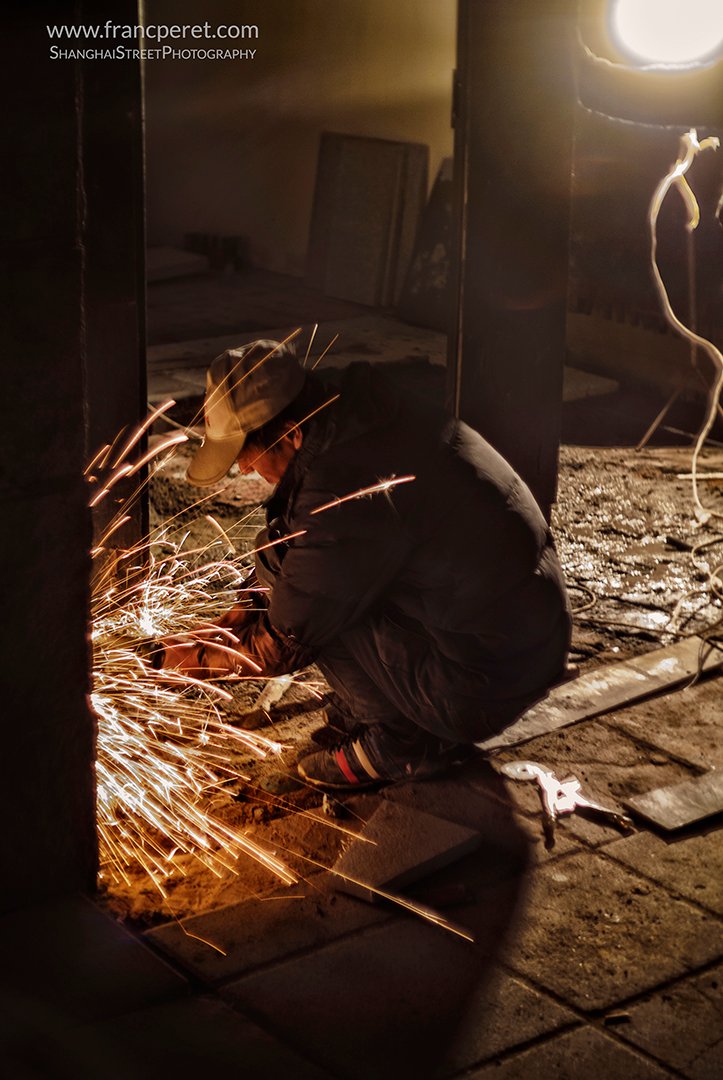
Nikon1 V1 @ ISO100, f0.95, 1/13s. I just stabilized myself with a tree, and waited my subject to be steady. My advice: Always immediately check the result you get to see if you really need to increase the ISO or not.Nikon1 V1 with an Angenieux 25mm f0.95 lens. Manual Focus and Manual exposure as this is a 30 years old lens without any “smart” contact with the camera body. I could increase the ISO a bit, but among the 10 shots I had done half of them are sharp enough so I had no reason to lose quality to raise the speed. Also, keeping a slow speed helped to get longer sparks.
Concerning focus set up, I was used to manual focus when I started my photography career back in 1986, so this didn’t bother me much since the viewfinder of the Nikon 1 is sharp enough for me to hit the focus right even using the f0.95 lens.
Finding the right balance
Manual focusing is like finding the right balance between too far and too close.
Actually, the best way to hit the right focus point is to turn the focus ring until you get your subject sharp in your view finder and then you just turn the focus a bit more until you lose the sharpness.
10mm f1.8 @ f2, Nikon1 @ ISO400, 1/10s
Then you turn your focus ring in the opposite direction until the subject appears perfectly sharp, again.
Cine-Nikkor 10mm f1.8. Shot done at ISO400, f1.8, 1/10s. Harder to shoot when the car is moving but still workable. Camera is still the Nikon1 V1. Manual Exposure, Manual focus, hand held.
To be more precise you can turn a bit more and see if it is better or worst, and then go backward again.
It is long to explain, but very quick to do
Overall, I was so seduced by the result (color, mood, character…) I got with the combination of the Nikon1 and my old lenses, that I left my GH4 and the Lumix lenses at home, despite the lack of any exposure and focus assistance from the Nikon1.
10mm f1.8 @f2. Advantage of small sensor camera is to get enough depth of field even wide open. Nikon1 V1 ISO100, 1/60s.10mm f1.8 @ f8 on Nikon1 @ ISO100. 1/160s
Of course, I would be very happy to get a firmware update or a hack to get the Nikon1 able to work on semi-auto Aperture priority with a dumb adapter.
That would make it even more enjoyable to use.
Just remember that in Photography, nothing is impossible and all is a matter of logic. And, if it is time-consuming and brain tiring to shoot fully manual, it is quite rewarding to be able to achieve the exact shots I had predicted without any assistance.
However, if I were using the exact same combination in the same location with a camera able to work in semi-auto Aperture priority, I might have many more interesting shots, especially of people and things on the move and I would be able to concentrate more on the composition and subject placement by freeing my brain from technical consideration dedicated to the exposure only.
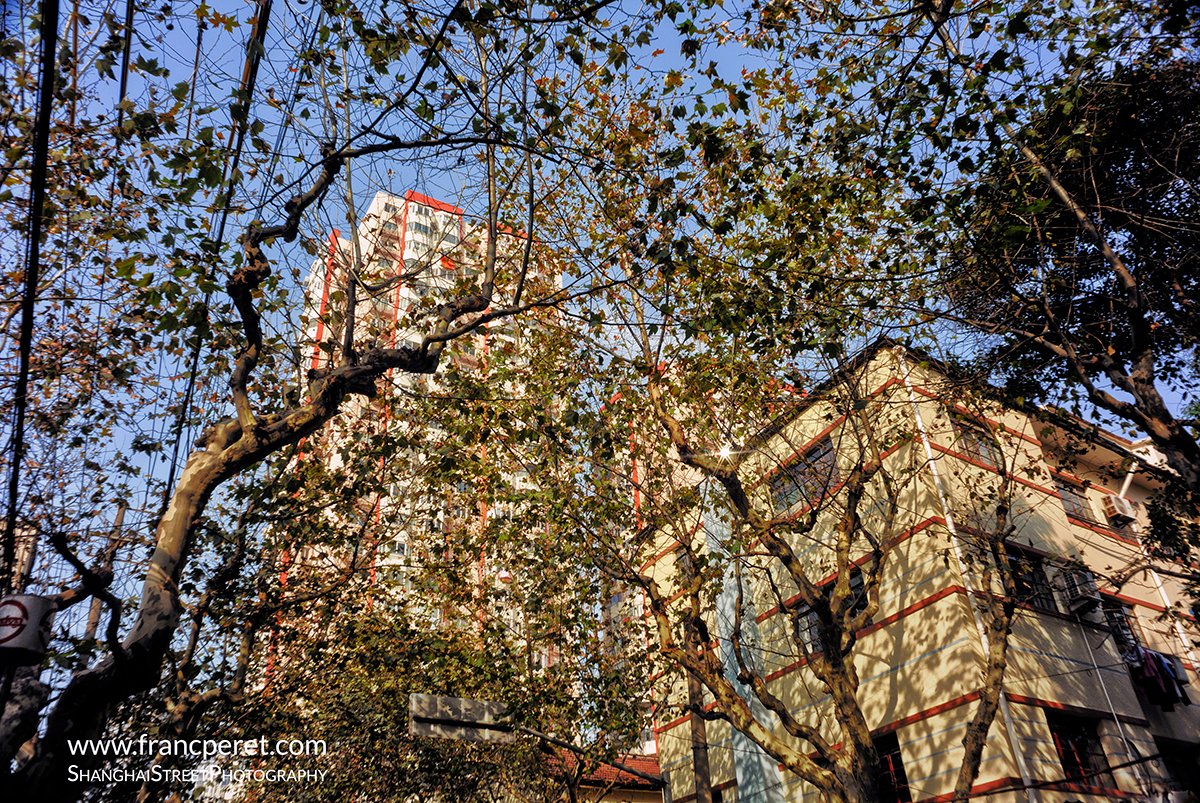
Autumn is a great season in Shanghai, thanks to the lasting blue sky and the numerous sycamore trees planted in the French concession.
By Franc Peret
To take benefit of the great lighting and the tawny color leaves falling on the ground or elsewhere, I went out with my Advanced workshop students for a 3 hours walk searching for interesting composition to memorize with our cameras.
Here are some of the shots I had done, working on structure, shape, colors, texture and humor…
Enjoy!
Franc
Black is best for reflection
Cars are everywhere nowadays, but nature is still taking over
When dust looks like marbleDust, leaves, spot of light and shadows
Decorum of the French concession
An open window for breaking down the symmetry and for catching colorful leavesFake flowers but real underwear.Leaves are ‘sitting’ anywhere, drying quietly under a filtered sun light..
People are also part of the decoration
When a leopard lady is wearing orange shoes, she sits on a Dulux painting pot.
High contrast lighting is cutting out the street in sharp shape and edges
From circle to oval.Crossing lines and shaping in 3D.Wheels in jail
Locked street cart collection for inspiration
Mixed disorder creates new order.Freed the tree!
When photography meets sculpture
One of my student standing there, his shadow reaching a leave and the magic just happened.Work and bicycle in progress.
Things always need to get fixed in Shanghai
3D game of light.Hope the knot is well done.Porsche Fan shooting a Porsche logo.Trees escaping from the fence.
Standing next to a traffic light to get traffic
Skating on Huai Hai Zhong lu.Waiting for a green light to roll again.
Photographer and target
Passing by a City sunsetLiam has 3D arms
Past and future
Connection relic, from the pre-wifi age.Monkey want to play too.
Connecting people in the street
Smiling firstPuffing second.
Riding and resting styles
Fashion in, fashion out.Riding a small bicycle barefoot is exhaustingStill some space in the taxi trunk for the baby?
Taking care of details
Make it Shine or at least less sticky.
Urban structures and monsters
Welding next to a monsterMetallic structure to fill up the sky.
My first Autumn 2014 Advanced Photography workshop was very successful. Topics was freezing water with speed, using flash or strong and constant light allowing high shutter speed.
Photos Franc Peret (Panasonic GH4)
I Wanted to share the set up, mood and some results from that first Franc’s Advanced Photography Workshop session I had done for this 2014 Spring Term.
To be able to record as many details as possible, a fast rate shooting camera is a plus, such as the Lumix GH4 able to sustain 12 frame per second
Like most of the different things students are discovering in this 10 weeks course, the set up of the action is as important as the camera setting. Photographer needs to be an orchestra conductor and not only a shooter hidden behind his/her camera.
Students are working as a group of 2 giving each others advises and alternatively handling the water choreography in front of their classmate camera.
The picture belongs to the person who set up the concept, the one who is creating the movement and the photographer who is framing and pushing the button.
As usual my students will get even more interesting pictures than mine, as I am too busy to take care of everything.
Liam and Alexandra concentrated on their mutual moment of creationThe set up of the action is as important of the camera setting in that type of photography work.
We had a great team of students: Alexandra, Dirk, Harald, Liam, Sarah, Eugenio, Regino and Jana. Ray was not there, but he will be back for the second workshop.
Stay tuned, as I am going to post all the things we are doing in class.
Dirk and Harald are working in natural light. It is possible to freeze movement without increasing the ISO in mid day with the sunshine coming into the room to light up the tank.The second way of freezing water is to use a flash in a darker environment. The short duration of the speed light compensate a slower shutter speed (1/250s in average)Harald and Dirk at workLiam working on his composition, ready to freeze a splash.
For 3 years, from 2006, I decided to only carry one compact camera with me for my everyday use while going out with my Essential Photography Class students. This was both a challenge and a reasonable choice.
Photos Franc Peret (Canon A640)
Stray cats in Shanghai (2008) shot with the Canon A95 compact camera.
This choice was a challenge as many person consider a small sensor camera not being good enough to deliver an interesting result. I proved it wrong on many occasion and I am still delighted to re-discover the shot I had done at that time with this type of underestimated camera.
I personally consider this choice of “limited” camera perfectly accurate as I wanted to prove to my students that, in term of creation, the photographer matters more than the gear, as soon as he gets control over it (ISO, Aperture and Shutter speed).
This portrait had been taken during one of my street photography class in 2008.
I was with a group of students outside Shanghai Main Train station looking for portrait of people without being noticed.
Perfect cameras to capture genuine expression
With my compact camera, a Canon A640, it was a piece of cake as I was using the flipping screen of my camera to compose my shot without directly looking at my subject, thus I was able to be really close to the person I wanted to shoot without having his natural expression changing.
I took this picture at ISO 80 (the lowest of this camera as outdoor light was good enough) and set up my aperture at f8 to get more depth of field and as much detail as possible.
I used those compact cameras for 3 years almost daily, keeping discreet and ready for whatever was happening. The A95 is packing 5 millions pixel and the A640 double that number, but this was not a visible improvement. the two times bigger screen was much more important to me.
My Shutter speed get down a bit too much (1/40s) but we were both stable. I took another shot at f5.6 to raise one stop the shutter speed (1/80s), but I preferred the first shot as his facial expression was much more interesting.
Bigger is not always better
As a conclusion, it is always interesting to go against mainstream ideas to be creative.
For example, a large majority of people thinks that bigger is always better.
Great, just lets go for a smaller camera to challenge this conviction and to see what’s happen.
Portrait shot with a Canon A640 Compact Camera: 1/40s f8 ISO100 jpg formatShooting street photography with a compact camera is a joy in Shanghai as it is a goldmine for local people portrait.
And I discovered strong points form that type of camera which helped me to be always ready to grab instant and genuine facial expression: compactness, flipping screen, convenience of AAA batteries and great colors and resolution of the jpg straight out of the camera.
Good enough for my teaching
In the ppt of my photography class, I am using lots of pictures I had taken with that compact camera, and I never had a student telling me: “How come you shot that picture with a compact camera?”
Pier in Okinawa (Japan), also shot with a compact cameraOkinawa (Japan) sightseeing shot with Canon compact camera in 2008.
Nobody never mention about this as it is impossible to notice a difference for that type of use.
Here are some more pictures I had taken with the canon A640 or its predecessor (A95) in China and Japan
Unfortunately, i had to stop to use this marvel because its battery consumption got crazy due to an electronic problem which is too costly to fix.
Japanese Harbor mini truck and container structure shot on compact cameraThis compact camera with a swiveling screen was very convenient to experiment with new point of view without having back-hack
This line up of camera does not exist anymore which is a big mistake form Canon.
Since then, I switched to Panasonic Lumix M4/3 series (GH1 to GH4) and Nikon1 to continue with my personal shots using smaller package.
This construction area had been shot with Canon A95 a 5 millions pixel compact camera.Another shot done with a compact Canon A95 which delivers nice natural and saturated jpg
We set up a backdrop in the classroom with black and sparkling curtain.
3 camera shots in the same time.
1 x Panasonic GH1 on a slider
1 x Panasonic GH2 on a tripod
1 x Panasonic AF103 on a tripod or hand held
A wide collection of lens were adapted:
Voigtlander 25 f0.95, Nikon 50mmf1.2, Nikon 85 f1.4, Angenieux 25mm f0.95, Nikon 35mm f1.4…
Main subject
Dantes, the French singer who is singing in Chinese, composed and wrote the lyrics.
We specially had done this simple video to promote this song on the French market.
Equipment
Light set up was all tungsten with Fresnel 300W and 650W.
Final (live) Sound recording was done at the end of the video with the inboard microphone of the AF103.