Since I am living in Asian big cities, I deeply enjoy shooting at night as there is so much going on with so many light sources, potential silhouette and reflective surfaces. Best of all, it is always a pleasure to share my knowledge and experience about such a very specific topic with some of my favorite students.
By Franc Peret
Here is what I achieved while running this Fall 2015 Night shooting class in the heart of Shanghai.
This is the first of a series of night shooting with and without tripod.
You can discover the second hand held night walk session here.
In search of interesting reflective surfaces and bright dots in background. Nikon D750 ISO100 1/20s 50mm f/1.8 @ f/1.8Audi bright lines. Nikon D750 ISO200 1/6s 50mm f/1.8 @ f/2
I worked with a Nikon D750 and three cheap and bright lenses: Nikon AF-S 50mm f/1.8G, Nikon AF-S 35mm DX f/1.8G and Sigma 28mm f/1.8.
Wide night world in marble. Nikon D750 ISO100 1/20s 50mm f/1.8 @ f/1.8
Surprisingly, the 35mm DX (designed for crop sensor camera, such as Nikon D7200) is working very well on my Full Frame camera.
Abstract car’s light on aluminium panel. Nikon D750 ISO100 1/6s 50mm f/1.8 @ f/2.8Double Rey and his Sony A7. Nikon D750 ISO100 1/8s 50mm f/1.8 @ f/1.8
Set on some Aperture and focusing closer, a strong vignetting appears, but I am avoiding this quit easily. It is a great little lens, sharp and light.
Dream Team of students with (from left to right) Rey, Natacha, Charlie, Isabelle, Monja, Klaus, Gwen, Liam and Jana. Nikon D750 ISO800 1/20s 35mm f/2 @ f/2.2
To Compare, I brought along an old prime lens: Nikon AF-D 35mm f/2 which is still a good performer as you can see on the group shots.
An emergency shot done just before the parked car with the red lights is going away. Hard to be quick, to compose and to be stable. Nikon D750 ISO200 1/10s 35mm f/2 @ f/2
The 28mm f/1.8 Sigma is an old Manual focus lens that I bought second hand more than 10 years ago in Japan for less than 300 RMB (50 USD). It is bright, light and a joy to use.
Kerstin at work: stability and concentration. Nikon D750 ISO400 1/8s 35mm f/2 @ f/2
For many years, Nikon Camera are having a great and helpful feature for focusing, especially at night with a fully open bright lens.
A green dot is lighting up in the left corner of the view finder, as soon as any lens fixed on the camera is getting in focus. It is very accurate and a time saver sometime.
Wood Men in Suits. Red and Blue. Nikon D750 ISO200 1/15s 35mm f/2 @ f/4
TO come back to the night shooting Class, our group didn’t have to cover a long distance as there is so many things to see, with trained eyes, in what supposed to be darkness.
Game of Lines, Silhouette, Light and Shadow. Nikon D750 ISO200 1/4s Sigma 28mm f/1.8 @ f/2.8
3 hours class between 6:30 to 9:30 pm were sufficient to collect hundred of shots.
Here is a short selection of that inspiriting time.
Sakura Hotel, a difficult High Contrast Scene that would deserve a tripod and a HDR treatment with a series of bracketed shots. Nikon D750 ISO400 1/20s Sigma 28mm f/1.8 @ f/2.0
When my Students start to find aesthetic interest in garbage can, I know that my teaching was efficient and meaningful to them. I am having a joke about this in my essential photography program.
When my Students start to find aesthetic interest in garbage can, I know that my teaching was efficient and meaningful to them. Klaus at work with his Fujifilm Camera. Nikon D750 ISO400 1/10s 50mm f/1.8 @ f/2.0
I am teaching that the most dangerous topics for photographer and kids and pets (especially kitty).
In the world, the biggest calendar sell are still cats.
Nothing can beat cats in term of visual attraction to most middle age house wife who are buying those calendars.
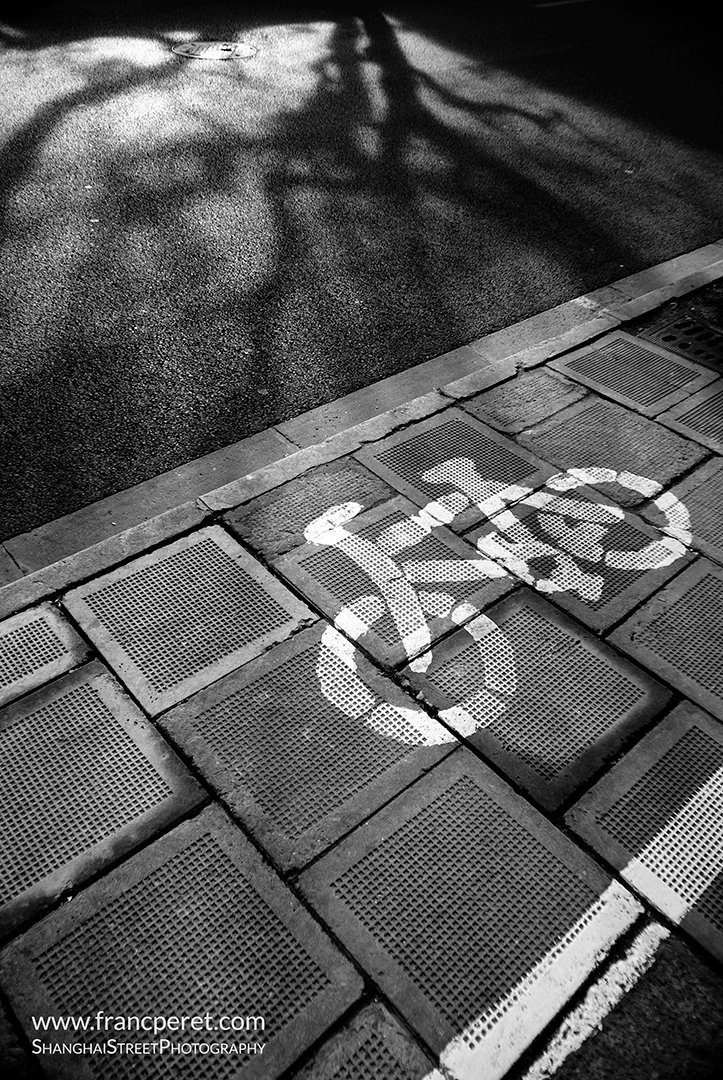
Handling the Handle bar. Nikon D750 ISO100 1/6s 50mm f/1.8 @ f/2.0Painted words and side light. Nikon D750 ISO100 1/6s 50mm f/1.8 @ f/2.0
Problem with pets and kids is that they are attractive on their own. Show a picture of a little kid or a baby cat and viewers are going to love your pictures.
Handling the Handle bar, version 2. Nikon D750 ISO100 1/10s 50mm f/1.8 @ f/2.0Handrail. Nikon D750 ISO100 1/30s 50mm f/1.8 @ f/1.8
Frustration comes on the fact that, viewer do not specifically like your picture, they like the subject instead.
And here comes the garbage can parabola.
I am teaching to my students that if they are able to bring positive emotion to viewers while showing them their garbage can picture, they would have achieve something genuinely good as photographer…
Success will not belong to the subject itself, but to the photographer only.
And night shooting, with all its magic, is the best place to give it a try…
If you liked this post, you can discover the second hand held night session in Shanghai here.
From now on, I am going to collect and add to this post my Photography Class students group pictures, starting from the very early Class I ran in Shanghai in 2005, 10 years ago! Great memories to share with all participants!
By Franc Peret
In 10 years, I had 750 students in Photography, Advanced Photography and Film making class.
It is an amazing number and I can hardly trust it myself, but my mailing list proved it to me.
My very first Photography class starting in 2005 with Xin Zhang, Anke Kroener, Sabine Gösker, Caroline De Lagasnerie and many others (Thanks to Xin Zhang)
Why being so surprised myself?
I think the pictures I am posting here are going to give you part of the reason.
I am having so much fun to share with great attractive people dedicated to my teaching!
2005 Class: for our outdoor session we all met in a Park in Pudong (picture by Anke).Intensive training (getting dirty is good for creativity!)for the 2005 Class (picture by Anke).Sabine Gösker comments: It was our complete class meeting in a compound and then walking along HuangPu in Pudong… and in the afternoon we did our first panning exercises. I remember well the photos I took of Anke running. Too bad I lost them all! (picture by Anke)
I am never going to be tired of teaching and it is such a joy for me that I do not count the time, the effort or the number of students I am teaching to.
2006 Private Class2006 Photography Class2006 Photography Class
My students are coming from different countries (40 different origins so far!), they have also diverse ages, occupations, social ranks, motivations and characters, but they all have something in common: the excitement of learning something new from me.
And I love that!
2007 Photography Class2007 Photography Class
Lets come back to the pictures.
2007 Photography Class2007 Photography Class
To start in chronology order, I had to dig deep into my record to get those pictures and few are missing unfortunately, but day after day, I am going to add more pictures of the different classes until I reach the present one. Stay tuned!
Here is a couple of my single class shot in March 2006, in Shanghai Jiao Tong University. ELC started its teaching activity there. My students were Kathryn Ferb, Tom Shoesmith, Matthew Worrall, Cath Barnes, Sarah Ghan Stephanie Wong, Anne Yu, Karin Wiedenhoefer, Kate Macleod, Louise King and Shannon Ellis.
Thomas Knop, Lina Zhao, Silke Niestroj, Patricia Portillo Suarez and Jeanine Jordaan.
I am used to my cameras and when I buy a new one, it is very rare I am selling the older model. I am keeping them all and sometime, I am going out with one of them for shooting.
By Franc Peret (Nikon D40)
I also do not sell most of my older camera as they have little commercial value which cannot compete against the sentimental value they get for me.
But I don’t like to see those “antic” glories inactive too long, so when weather is fine and I am willing to take a walk, I pick up one of them for a couple of hours and shoot around my home in Shanghai.
Street cleaning lady on the start. 50mm prime @ f2.5, ISO200, 1/125s.Flower tea in the plastic glass. Zoom @ 58mm, f5, ISO200, 1/125s.
This habit is interesting and I am always learning something from it.
Cameras are becoming more and more sophisticated, endlessly breaking new records of resolution (number of pixels) and High ISO value (something I barely use).
Thus, that day, I went out, for less than a couple of hours, with a 8 years old camera, a Nikon D40, a very compact and simple DX model I bought second hand (almost new) for less than 200 USD.
Autumn Bicycle. Prime 50mm @ f5, ISO200, 1/80s.
This light model (which is the ancestor of the actual D5300) gets only 6 millions pixels (my newer model packs 36 millions pixels) a small viewfinder and few lines in the menu.
Its base ISO is 200 and I shot all my pictures at that value, despite the change in lighting situation.
Mother and son. Prime 50mm @f1.8, ISO200, 1/400s.
It didn’t bother me that the day was ending as I carried 2 Prime lenses with a max aperture of f1.8 to compensate for the growing ambient darkness at the end of the session.
I love this camera for its compactness and its simple sensor, which a CCD and not a CMOS.
CCD are rarely used nowadays and they disappeared from photography camera production due to their higher cost.
Rising Roses. Prime 50mm @ f2, ISO200, 1/320s.
To my eyes, their big advantage was color rendition, with natural and vivid jpg straight out of the camera.
All my newest camera are using CMOS and colors often does not look right to me, and pictures need correction in post treatment.
CCD are offering a more organic feel. Also the the lowest resolution is of great help for any lens put on the camera to shine.
Feeling followed. Prime 50mm, f2, ISO200, 1/640s.Rose against balconies. Prime 50mm @ f2, ISO200, 1/250s.
Anything I am using on this 6 millions pixel camera will deliver sharp and contrasty results.
Modern cameras are having at least 16 millions pixels.
More resolution means more details to be recorded through the lens and if a lens is not perfect, it can be seen on a file build up with bunch of pixels.
It’s about lines. Zoom @ 24mm, f8, ISO200, 1/500s
Therefore Few of my older lenses are working perfectly well on my 36 millions pixel Nikon D800, while they are all doing a great job on my previous cameras which had less than 12 millions pixels (D40, D200, D90).
Pixel count and high ISO are 2 “easy to market” considerations that pushed camera makers in some extremes comptetition.
Lines and Clouds. 50mm prime @ f5.6, ISO200, 1/1000s.
And this is not all good.
Important is the final visual we are recording with the camera, and for my personal use, I don’t need that much resolution as I do not print my images.
My client needs it and it is the main reason of my purchase of a Nikon D800.
With this 36 Millions pixel monster I discovered that the slightest shaking, the slightest mistake in auto focusing or the slightest weakness from a lens resolution would result in a bad pictures.
This is a very demanding camera and its greatness finally limit its usability.
End of the street. Zoom @ 24mm f8, ISO200, 1/320s.Cars and people on the wrong place. Prime 35mm @ f2, ISO200, 1/125s.
Somehow, I would prefer a modern camera less demanding on that matter to get pleasing result all the time, whatever lens I am using on my camera.
I find this advantage with the Nikon D40 and it is just a pity its viewfinder is not a bit larger and brighter to offer a better vision when I look through. A modern version of this camera would be very successful among photographer like me, who prefer to get a user friendly device which can freed my creativity and deliver great colors at the first place.
Heads go first in Chinese market. Prime 50mm @ f2.8, ISO200, 1/60s.
For this series of shot I used 3 lenses: Nikon 35mm 1.8G + Nikon 50mm 1.8G and an old zoom: 24-120mm f3.5-5.6G. The 2 prime lens are working very well on the D800 (even the 35mm f1.8G is only a DX lens), but this zoom looks like crap on it. Impossible to get any sharp shot with it even the aperture closed down to f8 or f11.
Name card for service. 35mm Prime @ f2, ISO200, 1/400s.
However, on the D40, it is a great lens, sharp and contrasty wide open, without being too heavy, even it is a FX lens and not a DX one.
Globally, I think that marketing didn’t too good for photography, with the abandon of CCD sensors, too much pixels in resolution and the need to impress customers with incredible high ISO value.
Daily Milk Consumption. Prime 50mm @f2.2, ISO200, 1/250s.
Somehow, the effort were not always put were they should be, on real color accuracy, a more organic feel (images should feel less digital), greater Dynamic range and better balance between existing lenses and newer cameras.
Ball and balloons. Prime 50mm @ f2, ISO200, 1/160s.
Don’t get me wrong. I am not saying older is better. Great progress had be done, especially on the quality of the viewfinder, the build quality, the price and the offer. New models are coming out much more frequently and they concern new type of cameras. Choice had never been so huge! Overall I am always excited by my newest camera and they do force me to adapt myself which is a very good way to discover new things, to not get bored and to never feel outdated!
Franc is running an Essential Photography Class in Shanghai. Check it Here
Here are some pictures taken during my street photography outing with my Essential Photography Class Students. All shots done with Panasonic Lumix GH4.
by Franc Peret
Once during the 25 hours (10 weeks) Essential Photography course, I am going out with my students to give them a chance to practice what they had learn so far in term of technical set up and composition.
Sunny Hairs (GH4 and 12-135mm f2.8)Wet Broom
I am taking benefit of the class to demonstrate some ideas and to develop Student’s inspiration by just walking around the block close to our starting point, which is The Apartment on Yong fu lu.
Splash of shadows on a Wall and a Rusty gate (GH4 and 12-135mm f2.8).
No need to walk long distance to get a wide collection of shots. Imagination is not calculated in meters.
Side leavesCenter Leave
Shanghai former French Concession is a great place for shooting due to its historical background (trees and houses) and the traditional life local people are still enjoying there.
Checking the bill.
On this series of shots, I tried to extract structures out of the element of the environment.
Passing byGrey Cubism
Whatever I am shooting is not real anymore, it becomes my own interpretation in term of association (color, shape, texture) and balance (contrast or common point).
“Kuaidi” means Express delivery.
This is what I am calling “structuralism”.
Having a seatEmpty Chair
Sometime it can be quit close to a reproduction of the real life, sometime, it is pure reformatting of the surrounding i am in.
Camouflage
light, Shadows, Lines, texture, colors and shape are directing my eyes and inspiring my brain.
And there is much more to come!
I am not turning my camera in the direction of real people, trees, car or building.
What are they shooting? My Saturday Essential Class students in action.
I am not choosing a specific subject or person according the way they look as is, I am assembling elements and collecting interesting reflection of light for reaching a personal feel of balance.
Shape and ColorsGate and WindowA red, pink and blue world
My pictures might not please or attract viewers, but this doesn’t matter much to me as I am using my own language to build up my images and I am not expecting that everyone is going to understand it or, even if they understand it, to agree with it.
Wrong hand position! A lens is not a cup of tea!Shooting a shooter.Shooting Fever. My students at work…
Creation is something personal and as soon as I know what I am looking for, I guess that I know it better than outsider who might have a totally different sensitivity and approach to street photography.
Gate and leavesAnd more leaves!Texture and shape on Gate and wall
I am simply true to myself, building up my image according my need of structuring things visually and I am just trying my best to succeed to do so.
Pier knows how to use his camera with style.Antic on wheel
Even, when I am not carrying a camera, I am composing with things I am seeing, it is always useful, like a training, helping to detect interesting combination faster when I am having a camera in hands.
Mini Yukie loves Mini carMini Car
Composition is an extension of being sensitive to light, reflection of light and its character.
In China, dogs drink white paint…
I might say, in Photography, the light is the verb and the composition the adjective. They helps to build up the phrase we started by picking up a subject.
Yukie hides and…Philippe seeks
Actually, we often pick up a subject not for what it is but for what he/she is doing.
A couple of parrots shot by a couple of students
To get more information about my Essential Photography Course, check it here
I do not advise my Essential Photography Class students to use the Manual setting in an uncontrolled environment, but sometimes I am personally forced to do so and I am explaining here how to handle such situation.
By Franc Peret
I am teaching to my Essential Photography Class students how to precisely and quickly control their camera in semi-automatic Aperture priority mode as it is the most efficient way to get it right, in real life photography.
Nikon1 V1 and Cine Nikkor 10mm f1.8. With Sign and Shadows. Using a wide lens imposes to fill up the frame with interesting things (textures, Shape and Lines).Nikon1 V1 and Cine Nikkor 10mm f1.8. With Bicycle.
On my own, as I like to experiment a lot, I am often working with a strange combination of cameras and lenses linked by an adapter. And sometimes the 2 entities refuse to communicate with each other as they were not supposed to be connected.
Public Phone in the street. Soon to disappear… Nikon1 with 10mm f1.8 (equivalent to 27mm on a FX camera or 18mm on a DX)
Then, I am on my own, forced to use a full manual set up for both focus and exposure.
Last summer, I spent 2 months with such a strange combination. I adapted a collection of very old Cine-Nikkor C-mount lenses on my Nikon1 V1.
Therefore, for every shot, I had to guess the exposure and getting confirmation after the shot by checking the histogram to know if I were right or wrong.
One tip I am teaching to my students is this:
If you can see blue sky over your head and you are shooting someone under sunlight, the exposure value is matching (@ISO100 – f8 – 1/250s) or (@ISO100 – f5.6 – 1/500s) or any other combination at the same EV14.
For example, I might use (@ISO100 – f2 – 1/4000s) for portrait or for freezing high-speed action.
Having a base line to start with
EV14 is there in an average situation and in an average location.
In Australia Outback (no air pollution and lots of reflection from the sand), in The Alps, Himalaya, Tibet or Xinjiang high altitude (closer to the source of light) this value can be double (EV15) or even more.
That means the combination will be (@ISO100 – f8 – 1/500s)
In average situation, like in French Burgundy, I preset my camera to the EV14 value under a blue sky (@ISO100 – f5.6 – 1/500s) for a common subject.
If my subject is under the shadow, I know the EV is dropping at least by 2 stops so I will reduce my speed by 4 (@ISO100, f5.6, 1/125s) or open up my aperture by 2 stops (@ISO100 f2.8 1/500s) to compensate.
Taking care of parameters
My decision will depend on the fact I need or not speed to freeze motion or depth of field to get more things in focus.
This is a Quick and approximate decision without taking my eye out of the viewfinder. Shadow will be darker if the subject is not surrounded by reflective surfaces (such as a white wall).
And I will adapt my decision according to this parameter.
With the Nikon1 and my C-mount lenses, the Aperture ring is on the lens, and the shutter speed is controlled by a button next to my thumb.
Very handy.
Experience helps indoor
Now let’s imagine my subject is moving into a house with windows and white wall.
Outside is sunny and I know that the EV will be around 8 to 16 times slower (3 or 4 stops) indoor…
This is an approximation but if you are used to your environment, you should be able to guess quite accurately after few test shots. This will help you later on to get closer to the truth in few steps.
Most of the time, I got it right at first shot.
Variation will depend on reflection around (white wall or trees) the subject.
Working with human brain
Of course, during an overcast day, I have to do more test and try as I am having no reference anymore. Not every grey curtain or clouds in the sky deliver the same exposure on earth! It can be dramatically different from one day to another, one hour to another.
Step by step, knowing my environment, and having my eyes and brain used to communicate each other in this “guess what is the exposure here” game, I became more and more accurate in guessing the exposure of the place I were shooting my subject.
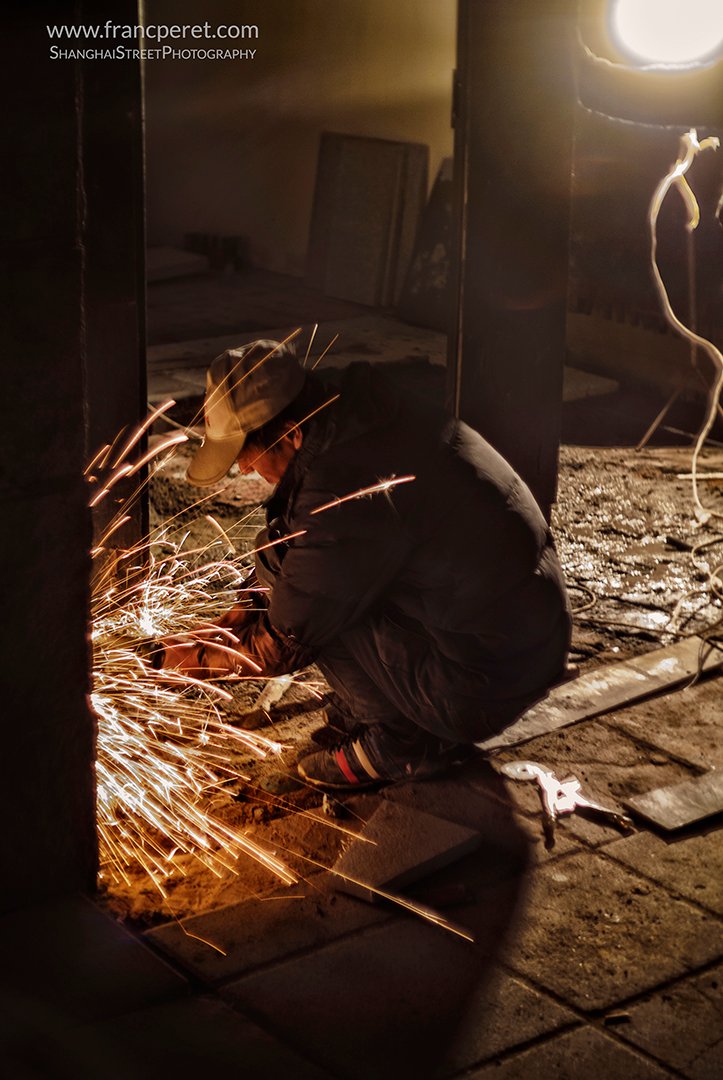
Nikon1 V1 @ ISO100, f0.95, 1/13s. I just stabilized myself with a tree, and waited my subject to be steady. My advice: Always immediately check the result you get to see if you really need to increase the ISO or not.Nikon1 V1 with an Angenieux 25mm f0.95 lens. Manual Focus and Manual exposure as this is a 30 years old lens without any “smart” contact with the camera body. I could increase the ISO a bit, but among the 10 shots I had done half of them are sharp enough so I had no reason to lose quality to raise the speed. Also, keeping a slow speed helped to get longer sparks.
Concerning focus set up, I was used to manual focus when I started my photography career back in 1986, so this didn’t bother me much since the viewfinder of the Nikon 1 is sharp enough for me to hit the focus right even using the f0.95 lens.
Finding the right balance
Manual focusing is like finding the right balance between too far and too close.
Actually, the best way to hit the right focus point is to turn the focus ring until you get your subject sharp in your view finder and then you just turn the focus a bit more until you lose the sharpness.
10mm f1.8 @ f2, Nikon1 @ ISO400, 1/10s
Then you turn your focus ring in the opposite direction until the subject appears perfectly sharp, again.
Cine-Nikkor 10mm f1.8. Shot done at ISO400, f1.8, 1/10s. Harder to shoot when the car is moving but still workable. Camera is still the Nikon1 V1. Manual Exposure, Manual focus, hand held.
To be more precise you can turn a bit more and see if it is better or worst, and then go backward again.
It is long to explain, but very quick to do
Overall, I was so seduced by the result (color, mood, character…) I got with the combination of the Nikon1 and my old lenses, that I left my GH4 and the Lumix lenses at home, despite the lack of any exposure and focus assistance from the Nikon1.
10mm f1.8 @f2. Advantage of small sensor camera is to get enough depth of field even wide open. Nikon1 V1 ISO100, 1/60s.10mm f1.8 @ f8 on Nikon1 @ ISO100. 1/160s
Of course, I would be very happy to get a firmware update or a hack to get the Nikon1 able to work on semi-auto Aperture priority with a dumb adapter.
That would make it even more enjoyable to use.
Just remember that in Photography, nothing is impossible and all is a matter of logic. And, if it is time-consuming and brain tiring to shoot fully manual, it is quite rewarding to be able to achieve the exact shots I had predicted without any assistance.
However, if I were using the exact same combination in the same location with a camera able to work in semi-auto Aperture priority, I might have many more interesting shots, especially of people and things on the move and I would be able to concentrate more on the composition and subject placement by freeing my brain from technical consideration dedicated to the exposure only.
In 1997, being in Beijing, I took advantage of my journalistic eye to catch some shots in sensitive areas, where people were kicked out from their traditional beloved houses for the good of modern profit.
Photos Franc Péret (Shot on slides, Fuji Provia100)
In 1997, I was in Mainland China for the first time and I was there with a mission.
As a western journalist able to understand Chinese (which was rare at that time), I was sent in Beijing a couple of weeks by a European Press group willing to develop a car magazine in mainland China.
Few cars in 1997 as people were mostly riding bicycle. Thanks to modernization, traffic jam and pollution level never cease to increase.Street names are not going to change, but the fancy lifting of the city is on its way.
I had two jobs in one: preparing a series of article on car reality (industry, regulation and drivers habit) and doing a market study regarding magazine creation, production and distribution in Mainland China.
Looking for magazines
Just for the anecdote, I discovered that magazine were sold in the street, not in bookstore chains and most of successful publication were available by subscription on a list in post office.
Chinese people have the logic of recycling from destruction. All bricks, tile, wood, doors and windows are carried away to villages in need of construction material.Horses are carrying away Beijing Architectural heritage.
For those who knows China a bit, no need to say that under table money was surely necessary to get a spot there.
Anyway, I took benefit of my first stay there to visit and shoot as much as I could. I can only show here my private work.
A student is drawing the street surrounding her school. Her work is a valuable memory now as this area totally disappeared.
I was amazed by the “out of time” feel of the old houses surrounding the forbidden city and fall in love for it. It was like historical movie background I had seen (such as Farewell my concubine).
Skyscrapers as goldmine
Don’t search for it now, they were all destroyed starting from 1995 to get replaced by office building and other gold mine dedicated to profit.
A timeless moment captured in the Forbidden CityFamous tourist spot without foreign tourists. They were very rare at that time.
When people are still speaking of Beijing as a culture center of China, it make me laugh with sorrow.
… to entertainment.From culture to…
Might be true for some individual, but certainly not for the architecture. Culture has no weight in front of business, despite 4000 years of history.
Gold is not pouring out of old stones. it does from real estate speculation.
More cranes in the sky than cars in the street during Beijing lifting.From left to right: Old houses, Destruction, new ugly buildings. For a better life says the propaganda.
Chinese pride is elsewhere, in what money can buy. This opportunism treats life like a prostitute.
No need educational background and culture enlightenment to get her and enjoy it. Money is All.
The ghost of Architectural Heritage
The few “old” houses you can find close to the forbidden city are all fake, made in 2007 from concrete and covered by tiles which look like bricks, for a clean preparation of the Olympic games. Another gold mine (not speaking about the medal here).
Home sweet home. It needed a nice clean up and refurbishing to go for another couple of centuries…
Back in 1997, I was invited by several people to visit their house, they lived in for several generation.
All the area surrounding the Forbidden City will be destroyed, step by step for opening the space to a lifeless concrete new reignA nice place to be for several generation of people located in Beijing center. The crane in the background announces a dark future for locals.
Before they got destroyed, they wanted to share their anger, as official were forcing them to get relocated in far suburb area.
A resident, soon to be kicked out from her historical house.
And worst of it, to avoid nostalgia from this population, they were splitting original neighbors in different suburb to not let them keep tight connection.
Global trouble
I had stop there my investigation as police got curious about me and I didn’t want to bring more trouble to those friendly local people, victim of a newly adopted capitalism. Such things are also happening in Western democracies, as bad.
Farewell traditional life…Crane, colorful flags and propaganda, some signs for a changing Beijing.
As far as huge corporate profit is concerned, individual people lifestyle and happiness has no value anywhere in the world.
So far, a great part of Beijing architectural heritage had been destroyed for the good of a globalized business model.
For 2 years, from 1994 to 1996, I had to go to Hong Kong every 2 months to renew my Taiwan visa, as it was almost impossible, for a freelancer like me, to get a working visa for a year. This was an expensive trip, but at that time, HKG was the place to be, the most fascinating one on earth for me.
Photos by Franc Peret (scanned slide)
Good Vibes!
I was greatly enjoying my life and my work in film industry in Taipei, but I had to save money for my forced bimonthly trip to HKG.
My wage in Taiwan was as low as a local one, and the cost of flying to HKG plus staying there for a night or two, represented a huge investment for me, at least 3 weeks of full time work.
I should hate those trips and hate the destination, but in fact it was the opposite.
Memorable Return trips
I was always impatient to return to HKG as I loved this place so much, at that time. I still like HKG, but everything was so much stimulating back to 1994.
First reason was the amazing excitement of landing aboard a Boeing B747 on one of the tiniest airport on earth, located in the heart of one of the most crowded city on earth.
Landing between buildings
I remember, while being in approach to HKG airport at low altitude, seeing through my porthole an old lady cleaning a carpet on her balcony. Our sight crossed, I wave a hello to her and she answered back to me…
Flying through the city
Second reason of my love for the place is the atmosphere of the city itself, an astonishing mix of people, sounds, flavor, occupation, creation and scenery, all packed in such a compact place.
So much to discover in every corner of this magic city
Third, I was used to meet a friend there, one of the person I admire the most: Christopher Doyle, one of the greatest director of photography in the film industry.
Christopher Doyle shooting still picture while monitoring the editing of a TV commercial.Casual and relaxed Christopher Doyle and Wang Kar Wai at the early stage of their fame in 1994
And Christopher was working with the other person I admire the most: Wang Kar Wai, one of the greatest movie director on the planet.
Meeting the Dream Team
Together they achieved several masterpieces such as “In the mood for love”, “Happy Together”, “Fallen Angel” and “Chung King Express”.
Christopher Doyle guiding me through HKG and Kowloon area to discover some of the shooting spot of “Chung King Express”
I met both of them at the very stage of their fame.
Chung King Express was just starting to get a huge success and Christopher kindly guide me for a visit of the different places they had shot the film.
HKG is never falling asleepBeing too short on money to pay for an Hotel room at that time, I spent some of my night shooting sceneries.
Since them, almost each time I had to go to HKG, I had the chance to meet Christopher for a drink or to visit him on a commercial shooting.
Choice Making
Too bad that my income didn’t allow me to stay longer as I wanted to discover much more and even try my luck working in the film industry in HKG, but my future was in Taiwan where I had the chance to learn film making while being paid in the meantime.
And Taiwan is also a place to be, a wonderful one, but this is another story.
One of the most amazing thing I had discovered in Taiwan is how the population celebrate the great number of temple everywhere in the country.
By Franc Péret (shot on slide film)
There is so many unexpected presents to the different divinities such as karaoke parties, puppet theater play, Taiwan opera performance, outdoor film projection and even topless dancers show! Out of all of this, The most impressive one to me is still the Qi Gong ceremonial.
Qi Gong’s Make Up are designed to frighten ghosts and bad spirits.Qi Gong warming up in front of the temple
Qi Gong are a group of Taoist disciple specially trained to endure any kind of torment without fear of apparent pain, such as beating their back or head with harsh weapons, forcing long needle through their skin or cutting their tongue with huge knifes.
Self-chopping under assistance
Local people dedicated to certain temple hire them as a gift to the gods, and the demonstration in front of the crowd is a proof of the protection of the gods in this area as Qi Gong are able to accomplish their bloody demonstration without any complain or sign of pain.
Qi Gong with their weapons, dancing before the beating
They all have an assistant to spit alcohol on their wound and to wake them up when they are going too far in their beating, too close to death.
Do not open the picture gallery if you are too sensitive to the vision of blood.
By damaging their body without a sound, Qi Gong demonstrates their communication with gods
There is a lot here and to tell the truth, I was so busy during the shooting to think about my position, my composition and my camera setting that I was not really thinking about what I was recording. I only felt sick the first time I reviewed my pictures (slides).
All those shots had be taken in Chiyai, a small town not far from Taichung.
Taking a rest before the ceremonyWeapons carrier with kids helpWeapons carrier ceremonialQi Gong dancing in front of templeQi Gong opening the way through the publicHuge crowd surrounding Qi GongMake Up to frighten ghosts and bad spiritsQi Gong on hard back beatingQi Gong cutting his tongueQi Gong supported by his assistant holding a bottle of pure alcoholNeedle through the faceAssistant throwing alcohol on the woundClose-up of the main character
While living in Taiwan, I was hired by a local publisher who wanted to edit a tourist guide dedicated to Paris. He sent me 3 weeks in the French capital to take as many pictures as possible.
Photos: Franc Péret
Funny thing is that I truly discovered Paris during that dedicated shooting session, despite the fact that I was born, lived, studied and worked in Paris suburb my whole life before my departure to Taiwan!
Here is a selection of some of the shot which were published in the guide book. Enjoy!
(Shot on Fuji Velvia and Provia slides film)
Here is the final result, the cover of the 200 pages Paris Guide published in Taiwan
Vertical Vision
Pigeon, subway, tower and clock
Taking a rest
Stylish balcony in quartier LatinChairs meeting in the parkCrunching ball on the move
Famous spots
Triumph ArchDeserted TrocaderoSculpture keeping an eye on the Eiffel TowerLouvre Museum and its pyramid
Having a look
Watching the newspaper readerWatch the dog instead!Feeding dukes familyWho is watching ?Undercover book salesmanThe hidden Apple
Night lives
Another Paris by nightFontaine and Eiffel TowerConcorde place with an Obelisque lighted in blue
Heavy Metal
Metropolitan sign born in 1900Subway entrance, Art Nouveau styleGreen Bridge in Paris suburb
Traffic
Romantic ridingScared Red Horse by the passing red car. Birth of the Ferrari logo?Periphery ring Traffic jam under the rainAdvertisement facing the night traffic
Cars in Streets
Night Shot in Pigalle areaA legend in the street: Fiat 500Another legend; Renault 4L in blue night
Sunsets
Purple sunset on Seine riverWinter sky in summertimeSeine river topped by Tour EiffelGuarding the Sunset
As a correspondent in Asia, based in Tokyo, I was used to travel by myself, renting and riding local motorcycle anywhere in Asia. This complete freedom allowed me to follow my destiny, as nothing was exactly planed at first.
Photos: Franc Péret (slide film)
Vietnam was just starting to open up to tourism and adventure was there, waiting for me in whichever direction I chose, trying my luck.
Searching for my next destination
This story was published in several magazines in Japan and there was a lot to tell as everyday was a different adventure. I am not going to sum up everything here, but in short, without a proper map, it was easy to get lost, especially starting from Hanoi and heading close to Chinese border.
Nothing is impossible on a bicycle in Vietnam
I did some tandem riding with a peasant bringing her back to her farm as her bicycle fall in a river, I was adopted by villager who had never encounter westerners before me, I was arrested by police and spent one night in their station as my presence in a very sensitive area was considered suspicious, I was invited by locals fishermen for fishing, dining and night stay.
My diner and the cook
All of this happened to me without being able to exchange any words in Vietnamese except that “hello”, “thanks”, and “goodbye” (Shot on Slide Fuji Provia ISO100. I used a tripod for self portrait and group shots).
Chopsticks factory output drying under the sunVietnam typical postcardLotus in a pondI found a new family in VietnamSugar can delivery man taking a restOfficial demonstration against AIDSKilometer 0, where everything starts or endsRiding, shooting and overtaking in the meantimeSunset on Ha Long Bay