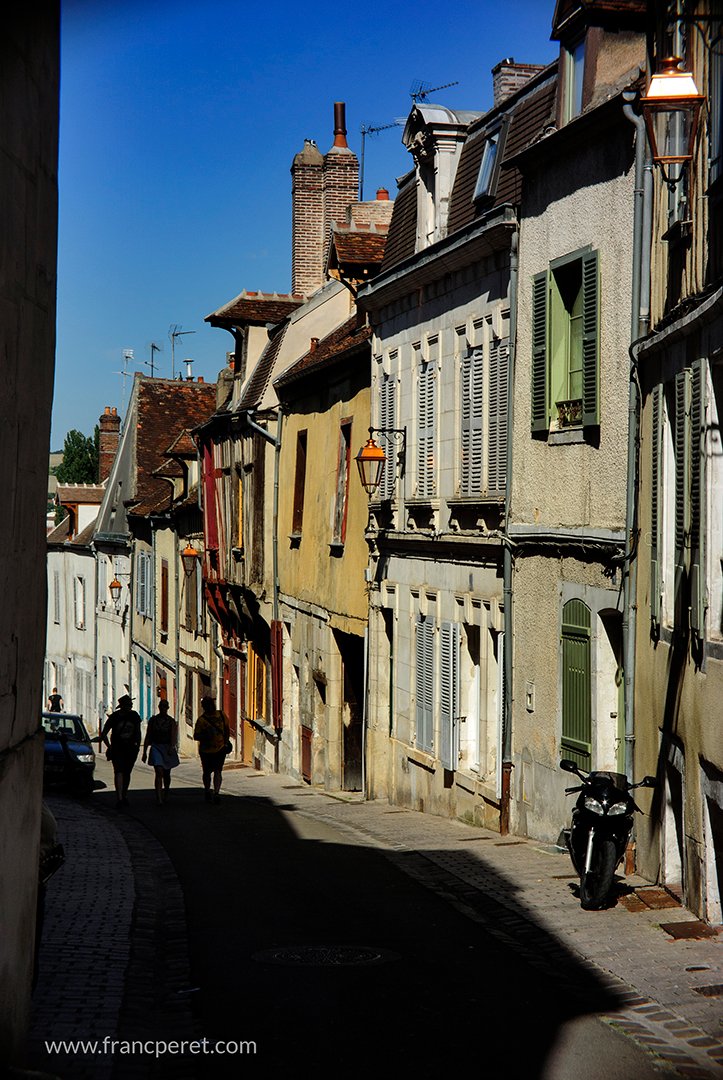
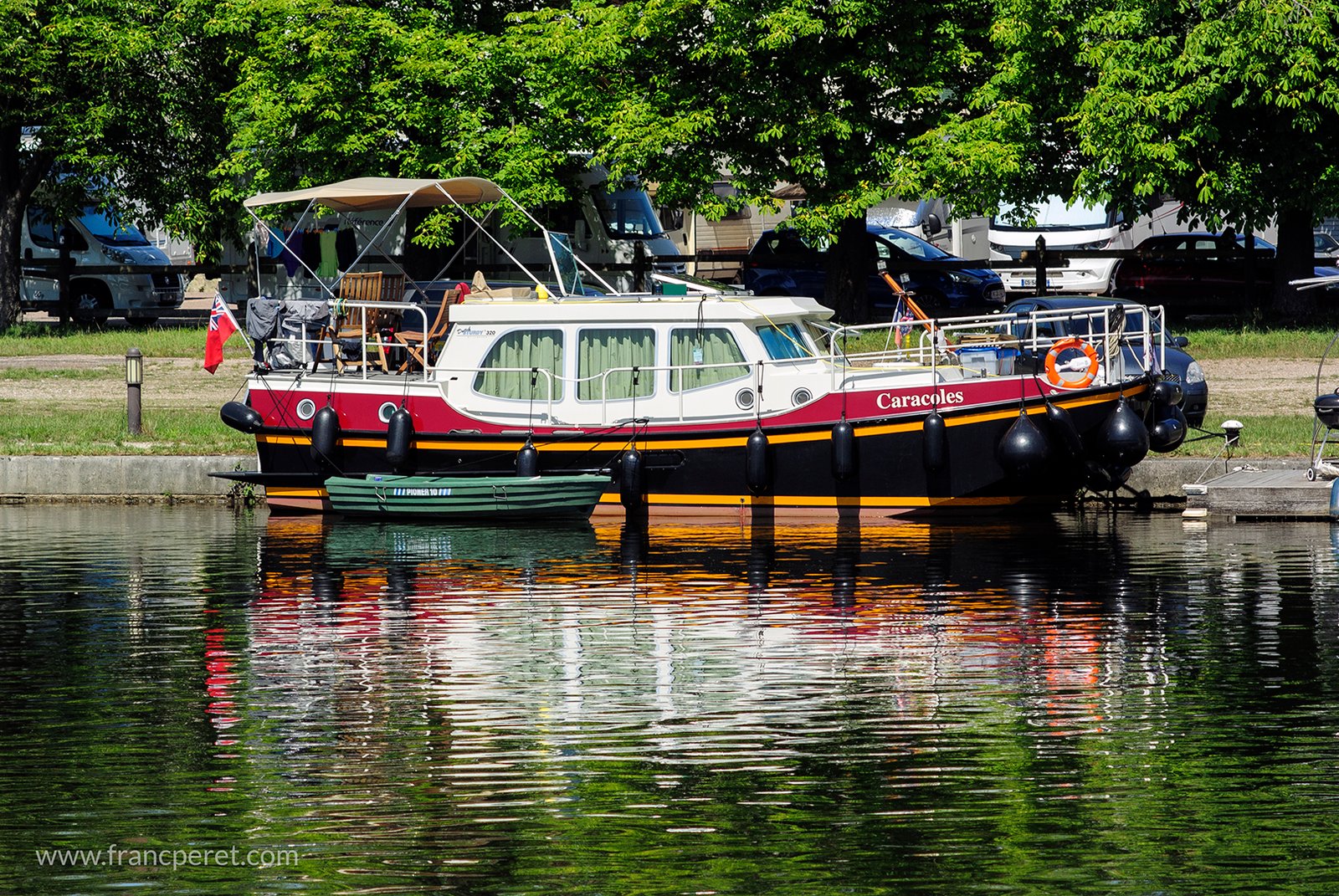
Auxerre (Burgundy) is the biggest city near my home, not far from Paris, but in the middle of the countryside. This place is steeped in history and when the sun lights up the sky, I like to take a photographic walk there…
Photos by Franc Peret (Photography Teacher)
Double click on pictures to get the best quality view.
Auxerre (Bourgogne) est la plus grande ville près de chez moi, pas très loin de Paris, mais en pleine campagne. Cet endroit est imprégné d’histoire et quand le soleil illumine le ciel, j’aime y faire une promenade photographique…
Double cliquez sur les photos pour les apprécier en qualité maximale.
View from Yonne river. Vue de l’Yonne.Going up the hill to city center. Monter pour rejoindre le centreSummer refreshment // rafraichissement d’étéMarina // Port de plaisanceAnother view of Auxerre from Yonne river
Une autre vue d’Auxerre prise de l’Yonne.iron curtain and light strip Rideau de fer et bande de lumièreHairdresser // Boutique de coiffeur.A shutter block.Chinese Shadow in Auxerre, Burgundy, France.Traditionnal bookstoreOld print on the wall and flattened pipe // Vieille inscription et tuyau aplati.Détail de l’Église Saint-PierresilhouettesCathédrale Saint-EtienneTypical cross road // croisement de rues typique
Auxerre’s country-side surrounding.
The traditional place where I am buying my daily milk
La ferme où j’achète mon lait au producteur.fairy barbed wire // barbelés féeriques.Wheat fields in sunset // blé baigné de soleil.Harmony of Old bricks and old wood. Harmonie de vieilles briques et vieux bois.Getting mess in order and colors.
To see more pictures of that series, check my album posted there Flickr
Spring is here, white stork going back home. Picture Shot with Panasonic G85 + Lumix 100-300 mm f/4-f/5.6 lens.
By Franc Peret
Living in Burgundy in France for a while after so many years in China, getting back to nature and wildlife environment is a blessing.
I am always carrying a camera with me to record whatever happens in the countryside.
I am used to driving on a very small road and I spotted an area where migrating birds were used to take a rest.
Full Frame was not the best tool for this shot
That day I was carrying my Nikon D750 and an old 80-200 mm f/2.8 zoom, but the reach was not long enough and anytime I tried to get closer to the bird, they were flying away, in the wrong direction from my point of view.
At home, I am having a 300 mm Nikon lens, but according to my initial shots, I knew it would not be long enough.
M43 for wildlife
The next day, I came back with my Panasonic G85 and my longest lens.
Panasonic or Olympus are M43 type camera and with their smaller sensor (compare to APS-C or Full Frame) actually “crop” the lens internally by 2 compare to Full frame.
Thus, a 100 – 300 mm M43 zoom lens delivers an image which is equivalent to a 200 – 600 mm FF zoom lens.
This is a big advantage for wildlife photography as you can be 2 times further away from your subject + the lens is at least 2 times lighter (less tiring without monopod) than its Full Frame equivalent.
Another advantage is the fact that @ f/4, an M43 sensor delivers the equivalent depth of field @ f/8 on an FF sensor.
Therefore, I am using a lighter (also much cheaper, and surprisingly good) lens, with a long reach and plenty of depth of field.
Last but not least, my Panasonic G85 combines both stabilizations on the sensor and the lens to allow the use of slower shutter speed.
This is a great feature if you are shooting something steady.
However, here, as the birds are flapping, I have to shoot at around 1/500s – 1/1000s shutter speed.
Here are my settings:
– Aperture priority mode
– Continuous focus – ISO 100: I should put ISO 200 (which the base ISO on this camera) but I was shooting something steady just before this one and I had no time to switch.
Spotting the stork
Higher ISO would give me a little bit more speed or allow me to close down a bit more the Aperture for more sharpness and less motion blur. – Aperture f/5.6: Zoom was at 276 mm and its max aperture at this range is f/5. It is very important on such a zoom lens to never zoom in completely as image get less sharp at the longer end of the zoom.
Also better to never work at its max Aperture. Closing a little bit will always deliver a sharper image. – Resulting Shutter speed: 1/640s. 1/1000s would have been better and ISO200 would have help on this.
Still, that speed was ok. Actually bigger the bird, less shutter speed you need as they are flapping at a slower frequency than smaller birds. – Exposure correction: +0.7.
Another great feature of the M43 camera is their electronic viewfinder with histogram constantly visible in it.
Thus, on this Panasonic G85, I can immediately correct under or overexposure by turning a wheel under my thumb without pressing any button. This is immediate and very useful when “magic finger” is not possible (like in this case).
As I am shooting against the sky, close to the source fo light, I had to force my camera to shoot a brighter image to not get the bird as a silhouette. – Post processing: Some people like (and promote the idea) to correct this kind of exposure compensation in post processing (by pushing brightness in shadows), but M43 sensors have their limit (weakness) and this is one of them.
Correcting too much in post create lots of noise.
As I am “old school” I am used to set my camera at the exact right exposure while shooting as with slides, they were no way to correct mistakes later on.