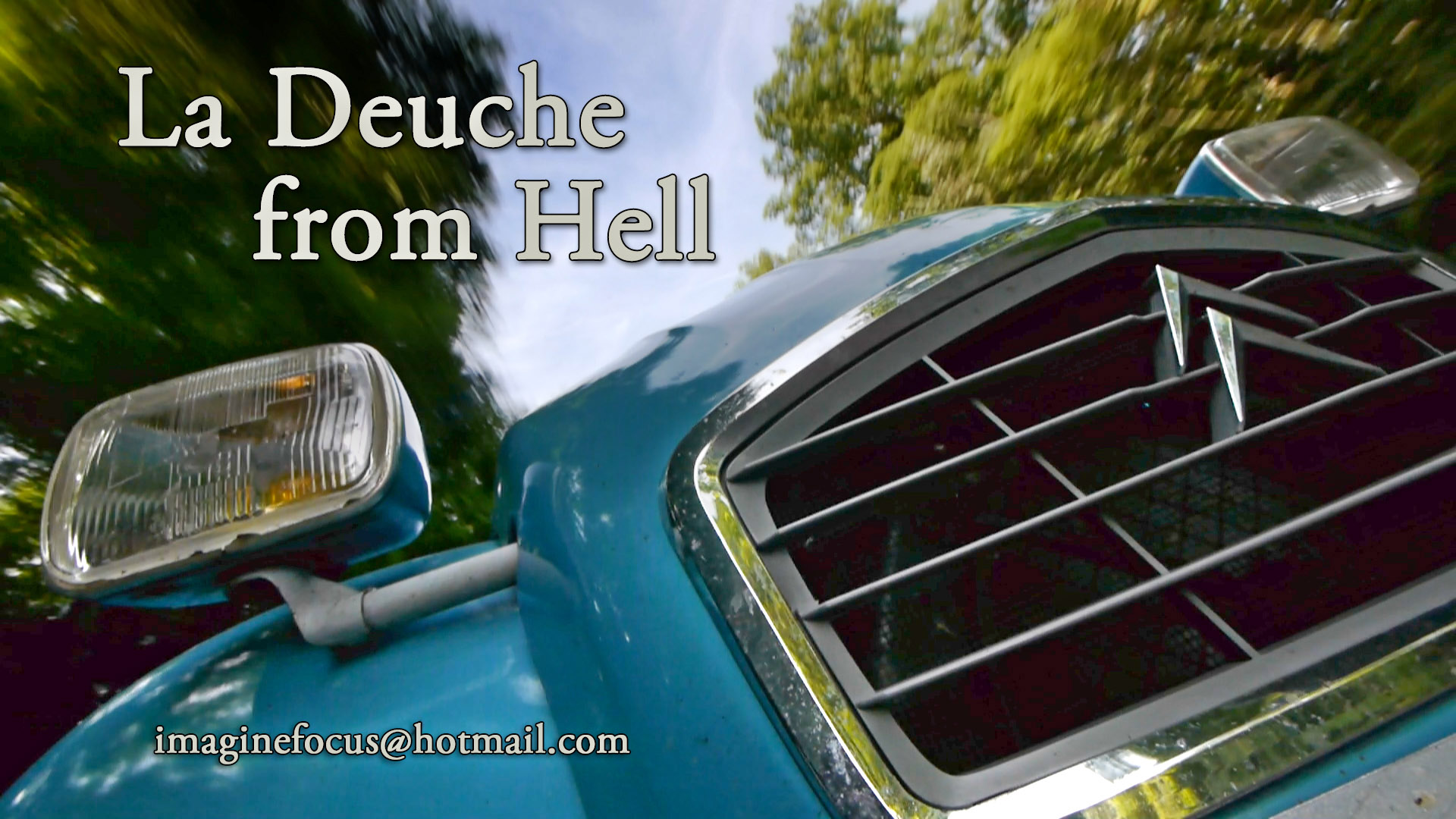
Shot in France countryside in summer 2012, this is not a trailer, not a short movie but an experimental piece named “La Deuche from hell”. It can be considered as a Pilot, a video synopsis, an idea we translated into images to get an overall idea of the mood and the character we were willing to implement in this story.
We made it the 4 of us: myself, Sarah Wang (assistant and producer), Kenny (actor and AD) and Kevin (actor). We are willing to shoot the complete story if we succeed to find enough help to finalize this project.
“La Deuche” is actually the nickname of the blue car in the movie. It comes from its real name “Deux chevaux” (2 administrative horse power), a famous car in French history designed by Citroen just after the Second World War and produced in 1950s. Concept dates back to 1936 (high ground clearance, light weight, front wheel drive, flat twin, air cooled engine). This car was sold until the 1980s. It was the cheapest and most versatile car at that time. People are still using it daily, especially in countryside.
This is a crazy story of a car possessing people, related to it, to change them into serial killers. A Death spreader.
The first dialog is an introduction to the whole story. Actually, in French we have an expression: “Ca sent le sapin” which means “It smells pine tree”, but in fact, the real meaning is: “It smell death” as cheap coffins are made with pine tree wood. This is emphasized by the fact that there is no pine tree in this forest.
The yellow pine tree shaped deodorant hanging on the back mirror of the car is there to remind this sentence all the way, kind of devil sign.
The idea comes from the region where I am living when I am going back to France, every summer. This area is well known for several real French serial killers stories starting from there in the last 20 years: Louis, Fourniret and Trebert.
There is a beautiful forest nearby, named “foret d’Othe” and, even nowadays, people are still finding dead body in it. When we were shooting the ax and chainsaw scene, a forest ranger stopped nearby to check what we were doing and told us. “Funny you are shooting this film here, we found a hanged women few meters away last week.”
The 2 actors are two friends, my neighbors who are eager to gain experience in film making and who are serious about it. Every year, we are actually working on a film project with Kenny.
We had great time, shooting the raw lines of the story I had in mind. We shot everything in 3 days with an amazing camera, a Panasonic Lumix GH1 and some great lenses. We got wild inspiration on the go. Key point was to achieve a certain look, an overall tense atmosphere and a fast pace in the different scene. I wanted it minimalist, to work more on the raising unease and fear of the viewer than projecting liters of blood on the screen. I carefully chose my lenses and camera angle to achieve the image and the emotion I was looking for.
For example the opening shot was done with an AF-S 300mm f2.8D Nikon lens to isolate the hitchhiker and the car. Nobody can help. The ax scene was shot with a 25mm f0.95 Angenieux lens, a 40 years old movie lens without modern coating, delivering less contrast and a spooky swirling out of focus area.
Why did we shoot that film? Because I had the camera, the lenses, 2 actors, a location and the desire to give a try to the “horror” film style I had never try before. If people like it, I might invest in it and shoot an overall story from that pilot.
Shooting film and video is my job. If you like the result, you can hire me as a script-writer, a cinematographer (DP), a cameraman or an editor. I am doing everything, but achieving image from ideas and text is my major.
It is quit funny, as important decisions are changing my life every 10 years. Here are some of my key steps in 1985, 1995, 2005 and 2015.
By Franc Peret
– In 1985, I decided to work all year to prepare a car and motorcycle race I wanted to participate in: Atlas Rally in Morocco.
It costs me about 6 months salary in investment, and I was in search of sponsors.
To seduce potential partner, I got the idea to ask to different magazine if they would accept to publish an article from my experience, being a complete rookie in such races, one of the youngest participant.
Yannick Picard, who was a chief editor of Moto Magazine, a cooperative type of publication (which means open minded and ready to take risk) was the only one to accept to give me a chance.
And I will never thank him enough for this, as without him, I would never had a chance to find my way.
I worked a complete year to participate to this 1986 Atlas Rally: With 600 kms average on tough rocky tracks everyday, racing on the Beach was like been on a highway
Yannick filled up my hand with a load of Fuji roll of slide film, wishing me good luck.
From there, my only aim was to finish the race, whatever happen, as I needed material (pix and stories to tell) to get published.
Here are my pictures from my participation to Atlas Rally in Morocco (Photos from Friends and Maindru).
At age 23, I was the second youngest participant of this international car and motorcycle rallyRocks, dust and palm trees, and magic names: Missour, Erfoud, Tagounit, Agadir…
In the bag around my hip, I was carrying a shockproof compact film camera (offered by another great guy, a photographer) to record my experience of the week long (5600Km) off road race, I absolutely needed to finish.
And I made it, despite several crashes and many problems, I was able to write and illustrate a 6 pages story which will become my first article published in a professional magazine.
Thanks to this race I became a photojournalist shortly after, starting with Moto Magazine as Yannick appreciated my very first article.
He needed someone able to write article about off-road racing and I was at the right place at the right time for this.
And it launches my career of photo journalist for good, learning my craft and improving both my writing and my pictures step by step for the 10 years to come.
My very first report as a journalist opens up a new career opportunity. Thanks to Yannick from Moto Magazine
– In 1995 I quit France to set up in Taiwan and this was the start of my life in Asia and a career in Film making and Lifestyle Photography, which last until now.
One of my first shot working on an historical film in Taiwan (scan of a paper picture)One of my picture which serve to promote the movie “Red Kaki” released in 1996. I worked 4 month on this film and learned a lot from it.
I started there as a still photographer for movie, but quickly learned the film-making craft being an Assistant director and finally a cameraman
One of the most interesting scene from the film Summers which allowed me to get some interesting view to emphasize the action and the cartoonish character of the film
I was hired by Leon Dai, a Taiwanese director to shoot his first feature film: “Summers”
Lots of shots were done in natural light which was very challenging.Another interesting set up in the street of Taipei for an action scene on the shooting of Summers.Taipei 2000: Shooting my first film as cameraman and Director of Photography for Dai Li Ren (Leon Dai) in 2000. My assistant is not very concentrate.
– In 2005, I decided to set up in China and I added a new activity to my arsenal by becoming a photography and film making teacher…
2005 to 2015, 10 years of teaching photography in Shanghai
What will happen in 2015? Another big change for sure and I already know the answer as you can see with this picture taken recently.
My 2 months old daughter raising her head for the first time.
It was both very challenging and a great chance to start my career as Sport photographer, especially in the film area (without any possibilities to immediately check the result).
By Franc Peret
Challenging because shooting moving things (especially fast ones) is one of the most difficult technical thing in photography as you have to solve several problems in the meantime.
The most obvious are getting the right focus point (while following movement), anticipating shutter speed to get the right effect (Freezing impact or tracing motion with blurred background) and getting the right exposure as it might change along your tracking.
At 20 years Old I started an exciting life by racing Side-Car-Cross. I am here on number 6.
One more thing, which is often unknown if you are not used to action shot, is “tempo”: which means pressing the shutter button as the exact right time, when the action reach its climax or when the subject is perfectly positioned in your frame on the right focus point (in case of predictive focus) without overlapping with disturbing things in the background.
Getting out to keep the balance was my mission, a tough one, when others were hitting my back with their front wheel or throwing stones with their rear wheel (same race, me on Number 6)
As far as I am concerned, the fact I was a racer before becoming a photographer did help me greatly on this.
When you are involved in Motorsport, so many things are happening at the same time, your brain needs to process very quickly and action is seen almost in slow motion. Sliding full gas in a long curve, an exciting way to start a life full of sparks and adrenaline, which helps me later on to become a sport photographer.
All of this seems complicated a long to explain, but the reaction of the photographer has to be instantaneous.
Somehow, a sport photographer has to be as fast as competitor themselves, adrenaline is part of the game as well to record the shot on the right tempo.
Our usual price after the finish line: dust, sweat and pain mixing up, but it was nothing compare to the exciting load of adrenaline.
As far as I am concerned, the fact I was a racer before becoming a photographer did help me greatly on this.
When you are involved in Motorsport, so many things are happening at the same time, your brain needs to process very quickly and action is seen almost in slow motion.
Since I was 19 years old, adrenaline was my drug, while racing Side Car Cross for 3 Seasons. I choose this sport because,as a student, I couldn’t afford a racing bike and to follow up on a season on my own.
My second Season racing with a new pilot, new engine and a lefty side car from England
And being the “Monkey” in the side car, I was part of an extreme thrilling experience without having to worry about cost.
My investment was purely physical and I often invested more than I got, despite my long and intensive physical training before each race.
I am trying to fly over the bumps, full throttle, pushed by a Norton 930cc
I was exhausted, hurt and sometime wounded, but this was one of the most exciting part of my existence and a very good start to not be scared by anything (except boredom) later on, for the rest of my Adult life.
All those shots of me racing between 1983 and 1985 were taken by two of my best friends of that time (Lionel Prieur and Jean-Louis Toribio).
In 2013, I bought a Nikon1 V1 new for very cheap, and as soon as I tried my collection of old C-mount Cine Lenses with it, I felt in love for the combination. Since then, for my personal work, I am using the Nikon1 more than any of my other cameras (Nikon D800 and Panasonic GH4), despite the fact I am forced to shoot everything in full manual mode.
Don’t search for it in a store, the Nikon1 V1 is not sold new anymore. Nowadays the third version, Nikon1 V3 is on the shelves but I have no idea how good it is.
I am going in this post to present my lenses and to show some of the shot I had done with them attached to the Nikon1 V1, last summer, back to France.
My Favorite Chinese tourist. Nikon1 V1 and Angenieux 25mm f0.95.800 years old bridge, Ahun, Creuse, France. Nikon1 V1 and Cine-Nikkor 6.5mm f1.8Auxerre, Burgundy, France. nikon1 V1 and Cine-Nikkor 6.5mm f1.8
In term of sale, the Nikon1 V1 had a very difficult start due to a very high price tag (in 2011) for what it was offering compared to a well established strong competition (M43 Olympus and Panasonic Lumix).
Barbel-wire. Nikon1 and Cine-Nikkor 50mm f1.8Wheat fields in sunset. Nikon1 V1 and Cine-Nikkor 50mm f1.8
Some reviewer on the net criticized its lack of external control (for exposure compensation, ISO or White Balance for example), others judged its sensor too small (1 inch) to be attractive with not enough pixels (10 millions) to impress.
At its original high price, it was difficult to understand what was the idea behind this camera.
The Tamron 25mm f1.6 is not a Cine Lens, but is is so light (40g) and so small that I often leave it attached to my Nikon1 V1.
Logically, after such a bashing, this camera sold badly, and therefore it got highly discounted when the new model came out (V2).
And this gave me the opportunity to give it a try for very cheap, less than 200 USD (1/3 of the original price).
Sunset Flower. Nikon1 V1 and Cine-Nikkor 50mm f1.8Haidresser in Auxerre (Burgundy, France). Nikon1 and Cine-Nikkor 6.5mm f1.8
My first motivation was its CX format sensor, equivalent to 16mm film camera, which is smaller than my M43 camera (Panasonic GH) and I thought it might be a perfect match for my C-mount lenses which were vignetting too much on my Lumix.
Ready for a vintage ride. Nikon1 V1 and Cine-Nikkor 50mm f1.8Honda Benly 50cc in the field. Nikon1 V1 and Cine-Nikkor 50mm f1.8
At first, what I liked the most about The Nikon1 V1 is its efficient simplicity.
The Joy of Nikon1 V1
Its viewfinder is clear and sharp (sharp enough to be able to manually focus).
Its long lasting battery (a day of shooting) is the same model I am using in my professional camera (Nikon D800).
Its menu is short and logical and its body fits perfectly in my hand with a nice high quality feel.
Globally, it has been a joy to use since day 1.
Landscape from my favorite village in Burgundy. Nikon1 V1 and Cine-Nikkor 6.5mm f1.8Sunset on Apple. Nikon1 V1 and Angenieux 25mm f0.95
Holding this camera is a delight.
Also, its Sensor is very special, delivering great vivid and natural (accurate) colors which remind me my film time. And 10 millions pixel are enough for me who is not going to print big anyway.
The shot is a bit blurry as Piggy was begging for food, but I like it this lively way. Nikon1 V1 and Angenieux 25mm f0.95.Door and Windows closed down. Nikon1 V1 and Cine-Nikkor 50mm f1.8
Another film analogy is the ISO limitation, I never push the Nikon1 V1 sensitivity higher than ISO400, as noise starts to be on the way. Actually it is a pleasing type of noise which also looks like film grain… In my film time, I was 90% of the time shooting with ISO100 slides.
Candle and Stain-glasses in Monpazier, Perigord, France. Nikon1 V1 and Cine-Nikkor 6.5mm f1.8Chairs in Church in Monpazier, Perigord, France. Nikon1 V1 and Angenieux 25mm f0.95
And I am working the same way with the Nikon1, using bright lenses, my Cine Nikkor series and some other high quality old lenses matching the 1 inch Sensor size (which is similar to 16mm movie camera). The fastest aperture of my set of lenses is ranking from f1.8 to f0.95!
The magic of C-mount Cine Lenses
Second hand C-mount lenses were often used on old type of cameras such 16mm for film and documentaries, TV News video camera, and surveillance cameras.
kenny is a young guy who own a (small) collection of old French cars. Nikon1 V1 and Cine-Nikkor 13mm f1.8.My favorite French actor, who performs in 3 of my movies: Revol’verte, L’annonce and La Deuche de l’enfer. Nikon1 V1 and Cine-Nikkor 13mm f1.8.
14 years ago, I had the idea to shoot a short film with on board video-surveillance camera (no Go pro at that time) and I started to buy high quality C-mount lenses to get the best image possible, especially at night. I bought bunch of them on Ebay for very cheap prices as nobody were using it anymore.
Once, I had a box full of lenses for less than 80 USD and some are worth a lot more nowadays.
Auxerre city and Yonne river, Burgundy, France. I am spending most of my summers in this quiet area. Nikon1 V1 and Cine-Nikkor 13mm f1.8.Purple at dusk. nikon1 V1 and Cine-Nikkor 50mm f1.8
Among my collection, I get some jewels, such as a series of Cine-Nikkor Lenses which were used on 16mm film camera. They are very rare, but I succeed to get almost a complete collection, ranking from 6.5mm f1.8 to 50mm f1.8 (which means 17.5mm f1.8 to 135mm f1.8). Compare to full frame camera the cropping factor if the Nikon1 is x2.7.
A shutter block. Nikon1 V1 and Tamron 25mm f1.6Robinet = Tap. Nikon1 v1 and Cine-Nikkor 50mm f1.8
Those lenses reach professional standard with a sturdy build and a very practical design for film making: For example, they all have the same length to ease the placement of accessories around them (filter holder with matte box, follow focus…).
Monpazier, Perigord, France. Nikon1 V1 and Tamron 25mm f1.6Brick Frame, Burgundy, France. Nikon1 V1 and Angenieux 25mm f0.95My favorite Chinese tourist in Burgundy. Nikon1 and Cine-Nikkor 50mm f1.8
Despite little bit of dust, oil and wear inside the glass (they all need a serious cleaning), the optical quality is great with a very sharp center even wide open and most of the frame getting sharp when the aperture is closed down.
The Full Manual challenge
They have lots of character, a greenish tint to them which is easily corrected in post. They are a match (in term of color and optical rendition), which is important for cinematographer concerned by continuity.
My hometown forest, 25km away from Paris. Nikon1 V1 Cine-Nikkor 6.5mm f1.8Velib (public rental bike) in Boulogne, France. Nikon1 V1 and Angenieux 25mm f0.95.
I love those lenses and the result I get out of it, despite the great difficulty to use it on my Nikon1 V1 as there absolutely no assistance from the camera in term of manual focus (no peaking, no green light in viewfinder) and exposure.
Here is the traditional place where I am buying my fresh milk daily. Nikon V1 Cine-Nikkor 6.5mm f1.8
Everything is completely manual and for 2 months of daily use, I had to guess the exposure and check it out after the shot on the histogram. I am quit good now to guess the needed exposure in many different situation.
Sunflower at dusk. Nikon1 V1 and Angenieux 25mm f0.95Getting mess in order and colors. Nikon1 V1 and Cine-Nikkor 50mm f1.8
This complex process remind me my early works in photography back to 1986.
Beside my Cine-Nikkor, I am having also a glorious Angenieux 25mm f0.95 and a tiny Tamron 25mm f1.6.
I am going to start with this lens for presentation.
Chinese Shadow in Auxerre, Burgundy, France. Nikon1 V1 and Cine-Nikkor 6.5mm f1.8Sunset in Burgundy. Nikon1 V1 and Cine-Nikkor 50mm f1.8Paris Suburb forest. Would love to get a place like this next to Shanghai… Nikon1 V1 and Cine-Nikkor 6.5mm f1.8
To see more pictures, check my album posted there Flickr
Lenses Presentation
Tamron 25mm f1.6
The Tamron has a “Ninja Star” kind of Aperture blades design. The lens is very sharp but has some vignetting coming in the way at certain Apertures. I got it for 8 USD.Without the adapter, Tamron 25mm f1.6, Cmount, 40g, minimum focus distance: 0.25m
Angenieux 25mm f0.95
Angenieux 25mm f0.95 weights 160g and its minimum focal distance is 18 inches.Angenieux 25mm f0.95: A rare lens which has a double personality, fully open (Fuzzy) or closed down a stop (Sharp). I got it for 80 USD 10 years ago.
Nikon Cine-Nikkor 50mm f1.8
The Cine-Nikkor 50mm f1.8, weight 170g and use an eight blades aperture with a typical curved shape which sometime appears in the out of focus area.Cine-Nikkor 50mm f1.8, The sharpest of the lot, but minimum focus distance is not close enough: 1m. I got it for 100 USD.
Nikon Cine-Nikkor 25mm f1.4
The Cine-Nikkor 25mm f1.4 presents a classical hexagonal Aperture, but shape still has the same curved signature than the others Nikon lenses here.Cine-Nikkor 25mm f1.4, the brightest of Cine-Nikkor series, but not the best one. I would only use it for continuity purpose (to get same character then the others) in a short movie shoot. I got it for 80 USD.
Nikon Cine-Nikkor 13mm f1.8
Different characteristic than the other Cine-Nikkor for the 13mm with 6 blades for an aperture which looks like a star.The Cine-Nikkor 13mm f1.8 wieght 150g with a minimum focus distance of 0.4m. It is a very sharp lens, but has trouble with vignetting at any aperture. I got it for 100 USD.
Nikon Cine-Nikkor 6.5mm f1.8
The Cine-Nikkor Lens 6.5mm f1.8 is the widest and the most expensive (very rare) one. This lens is far to be flawless, but I love its character. I got it for 300 USD.The Cine-Nikkor Lens 6.5mm f1.8 presents an hexagonal aperture shape.The Cine-Nikkor Lens 6.5mm f1.8 is one of the most impressive lens of the series due to its size and its very wide field of view without much distortion.
To see more pictures about this topic, check my album posted there Flickr
I didn’t had time yet to write down English subtitle and description but it will come soon., Waiting for this, here is the original short movie in French.
By Franc Péret
Descrition in French:
Un visiteur se rend au domicile d’une personne pour répondre à l’une des annonces qu’il a publiée. Commence alors une histoire surréaliste, ou tous les personnages se comportent de manières inattendues, jouant un rôle improvisé qui s’affranchit de toute logique. Et si tout cela n’était qu’un jeu ?
Sous un air potache, ce film décrit d’une façon volontairement légère et décalée une tranche de vie où cohabitent tendresse innocente et “beaufitude” homophobe.
Dans ce monde imaginaire, la “beauf attitude” ne pervertit pas aussi facilement l’innocence des sentiments. Les blagues salaces et homophobes n’y changeront rien.
Finalement, ce monde fictif n’est-il pas moins absurde que le réel ?
Materiel utilisé :
Panasonic Lumix GH3 et GH1, Voigtlander 25mm f0.95, Nikon 50mm f1.2, Computar 75mm f1.4, SLR Magic 12mm f1.6, 100W kinoflo, LED panel, Soft bulb (125W).
Equipe technique : Franc et Sarah
Duree de tournage : 6 jours
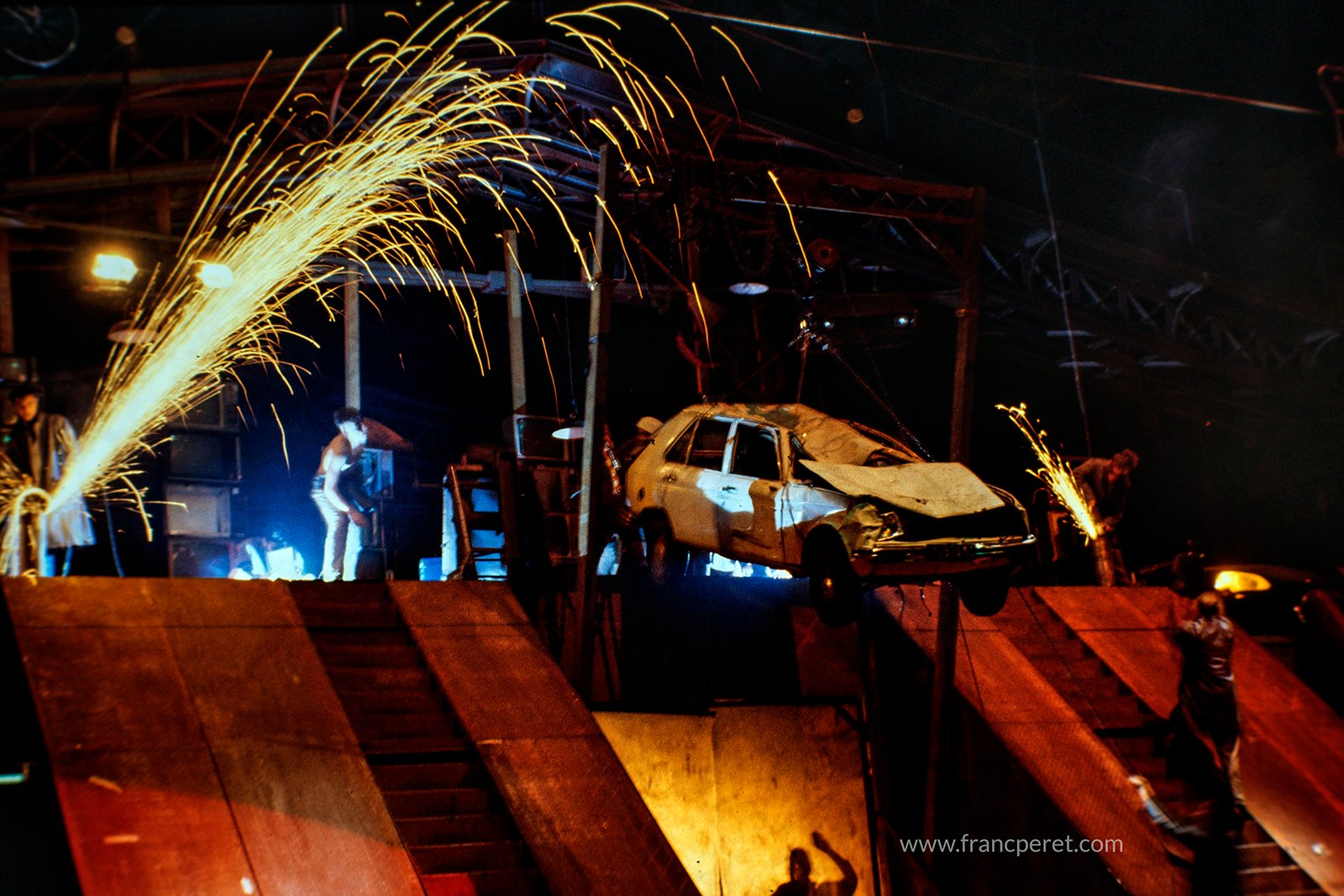
Long before any other Circus (such as world famous “Le Cirque du Soleil”), Archaos was the very first contemporary, alternative, theatrical circus of its time.
Photos by Franc Peret (ISO400 Slide Film)
Fighting Clowns with chainsaws
Created in 1986 by Pierrot Bidon, this circus without animals (except a pig), was featuring dangerous stunts like chainsaw juggling, fire breathing, wall of death and so on.
The performance under the huge tent was a mix of action, aestheticism, destruction, derision, poetry, theater play and live music with “The Thunderdogs” an independent alternative rock band playing during all the show, with masterpieces such as “Beautiful Destruction” or “Underworld” (I still have their CD they were selling at the end of the show).
Dreaming to be a clown with a chainsaw
Archaos got international success during a World tour starting in 1989, especially in England where it won « The best name », Oscar of the most creative artistic proposition of the year.
Car Crashes, smoke and Alternative Rock, welcome to Archaos
One of my best friend, Stephane, was part of the show doing motorcycle stunts and he gave me the opportunity to assist to the performance to take some pictures in the dark, to do some mind-blowing interviews and to write a story about it in a magazine (I have to find it back and do a scan).
Gym on a London CabMagician: The candle is burning a finger, the smoke is coming out from the mouth.
I was so shocked and seduced by the global “Madmaxian” atmosphere of this anti-conformist Universe that I was considering to leave my journalistic work and my (almost) sedentary life to join the Archaos experimental group.
Full metal Jacket clown
Unfortunately, I had no talent for it, despite my kid’s dream to become a clown one day…
I partly succeeded. though, as I am making my photography Students laughing a lot during my classes.
Following erratic movement in the dark
Here are some of the shots I took back in 1987 and 1988.
Finding the balance in colonial gearsGrace and muscles
The very dramatic lighting and random movement represented tough conditions, especially with slide film, which didn’t offer any latitude in exposure mistakes, compare to negative for film or (even much more correctable) digital raw file.
Car destruction workshop
I was using a Nikon FE2 in full manual mode (exposure and focus) with some bright prime lenses such as 50mmf1.4 and 85mm f2.
Construction Machine on the scene were part of the sound and smoke mix to create a contrast between flesh and steel.Jumping out the table, I underestimated how high the acrobat was going to be
By experience and observation, I had to guess and adjust according subject movement and pursuit light strength to get both focus, exposure and composition right.
Controlling Emotion for good
Most difficult thing, actually, was to not get too emotional because of the exciting live music and the thrilling performance in front of my eyes.
I had to concentrate on my shooting without enjoying the show as deep as I would like.
Being a photo journalist, I was not an usual spectator anymore, but a magic moments collector.
A last move on the roof
You don’t need to search on Google or Youtube “CIRQUE PIERROT BIDON”, “PIERROT LE FOU BIDON” or “CIRCUS ARCHAOS”, to find interesting stuff about it, anymore.
Thanks to Mischa (Bouinax), the best place to find everything collected to keep alive Archaos memories is here: http://archaos.info/index.aspx
Archaos was a start of a new trend of choreographic shows, but as everything creative getting mainstream (like this show organized by French Lottery, La française des jeux), the original “borderline” concept got sweeten a lot and lost its soul to fit the “acceptable” for the mass.
You must have a look at this amazing collection of videos, pictures and stories, even it will never replace the feeling of being there. You are going to miss the exhaust pipe’s smoke, the steel sparks and the burning smell!
From 2003 to 2005 I had the chance to be the Editor in Chief of 2 Motorsport magazine.
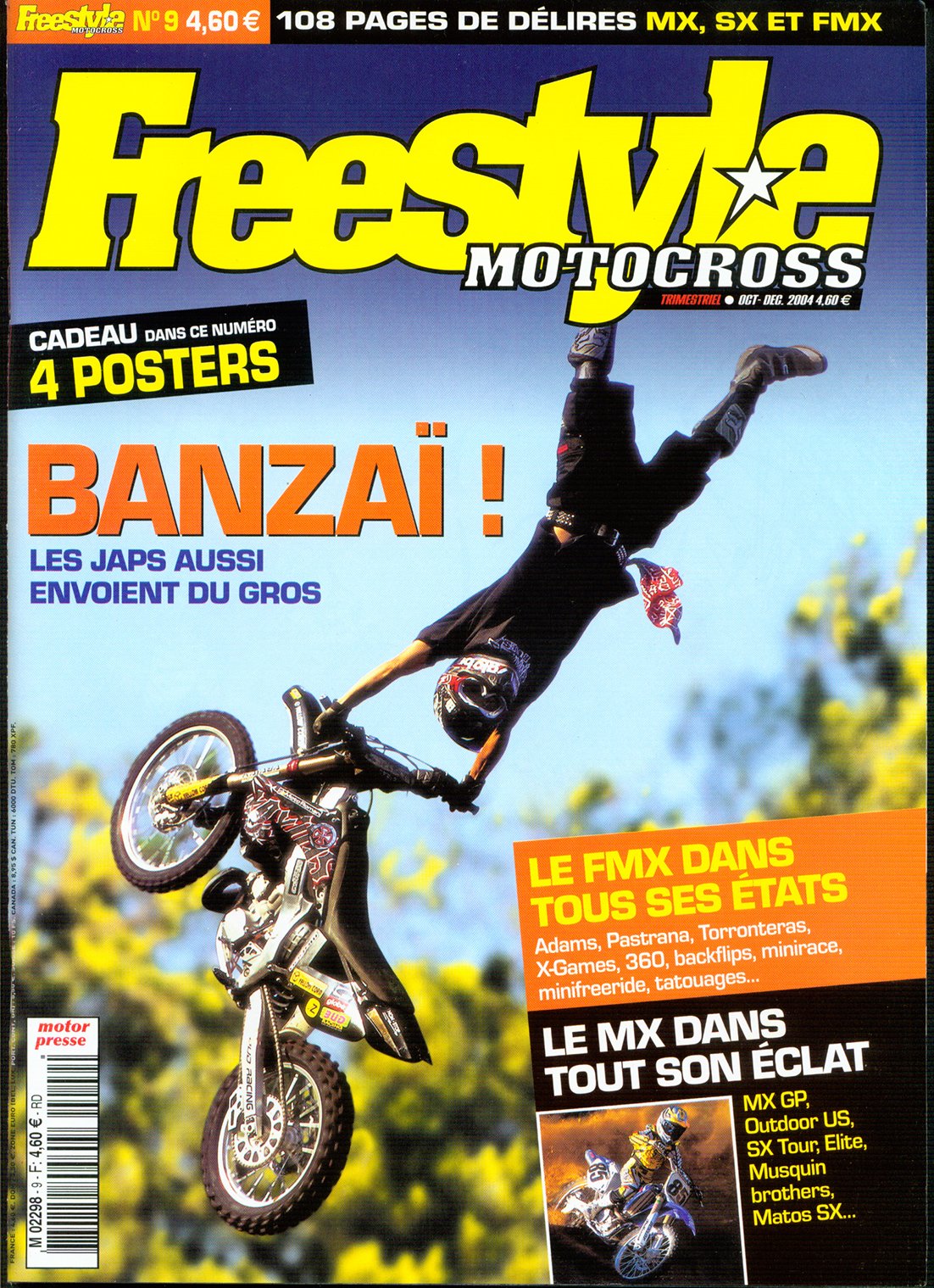
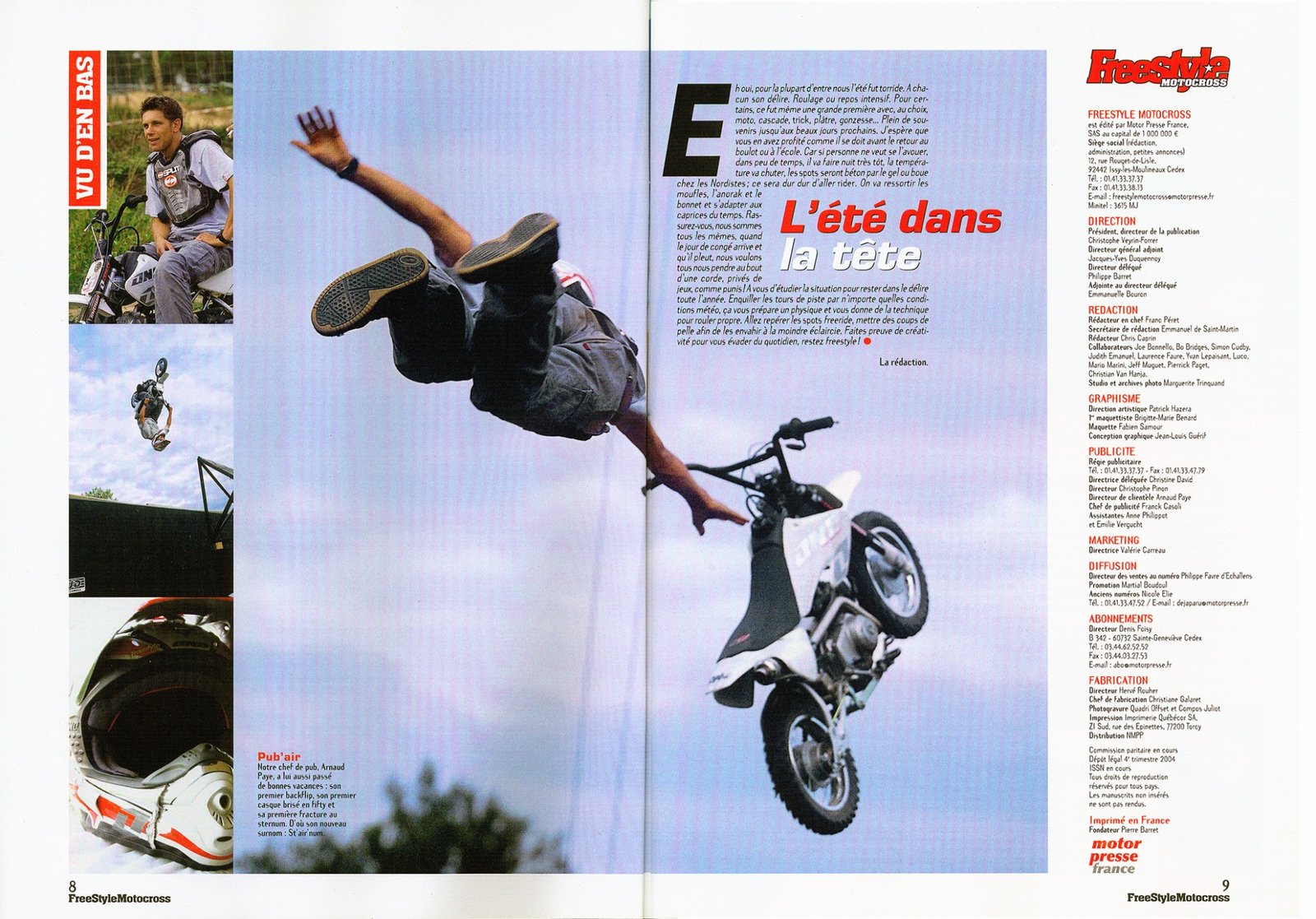
My favorite of the two was Freestyle Motocross as I got a complete freedom to choose the spicy editorial tone, the wild layout and the eccentric type of topics I wanted to fill up the 120 pages with.
By Franc Peret
Being the Orchestra Conductor of this magazine for almost 3 years, I fully let it go to develop my own Freestyle experience, and it was one of the greatest period of my life.
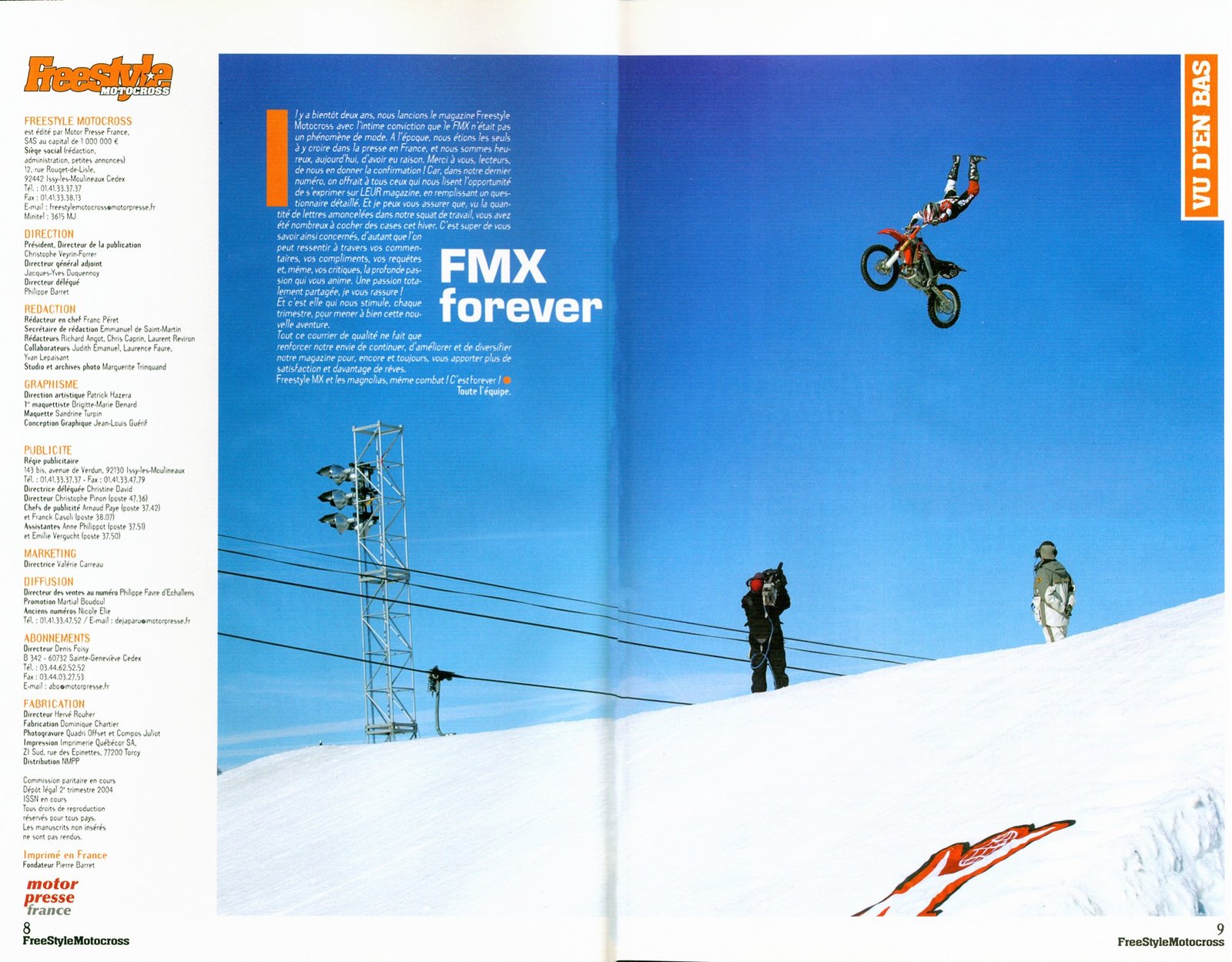
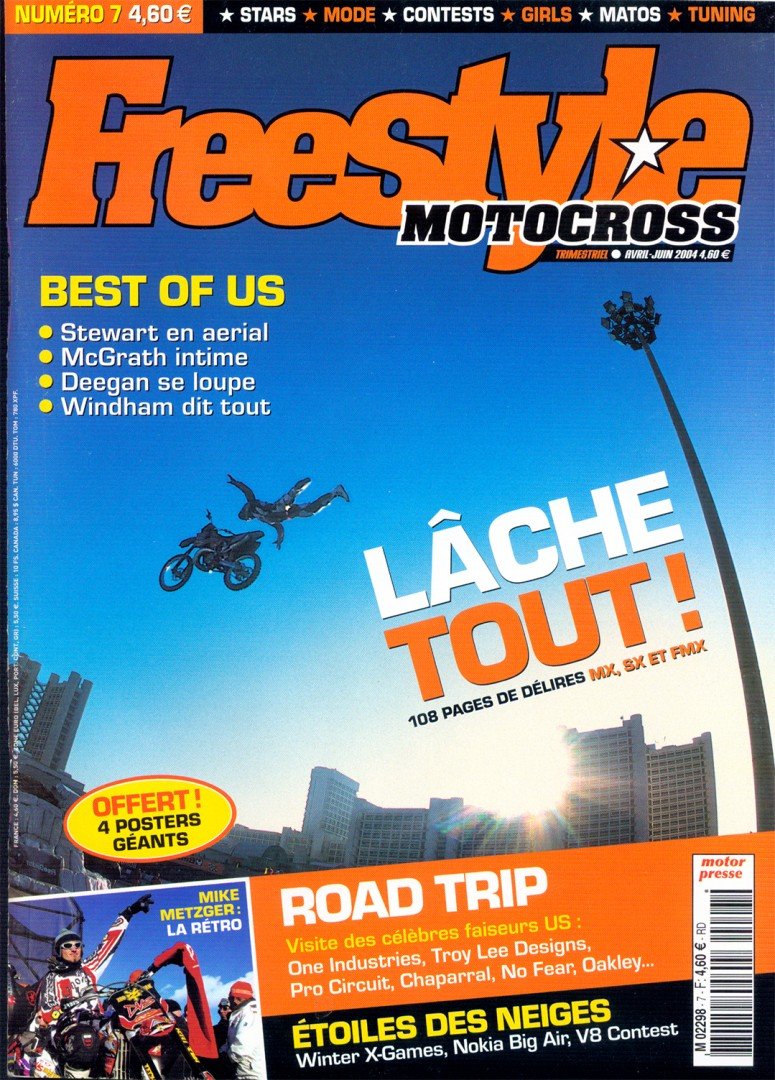
FMX7FMX6
The people I admire the most are pioneers, the kind of person who do not hesitate to escape from the mainstream by suddenly trying an original idea before anyone else, sometime, at the cost of their own life.
The X Attitude
Freestyle riders are pioneers and I just wonder how a guy could imagine one day to take off as high and as far as possible, while jumping out of the bike, his body flying freely in the air, and getting back on command just before the landing.
FMX9FMX8
Freestyle performance also offers a great opportunity to achieve amazing pictures and I was very proud of the work of my small team. Up to 30000 people were enjoying our magazine which was unique in Europe and still exists nowadays.
FMX11FMX10
Here are some front cover and some of my editorial (double page) to give an idea of the work I was leading at that time. There is so much more inside with interviews, contest, human experiences, tattoo description and so on… Let me know if you want to see more!
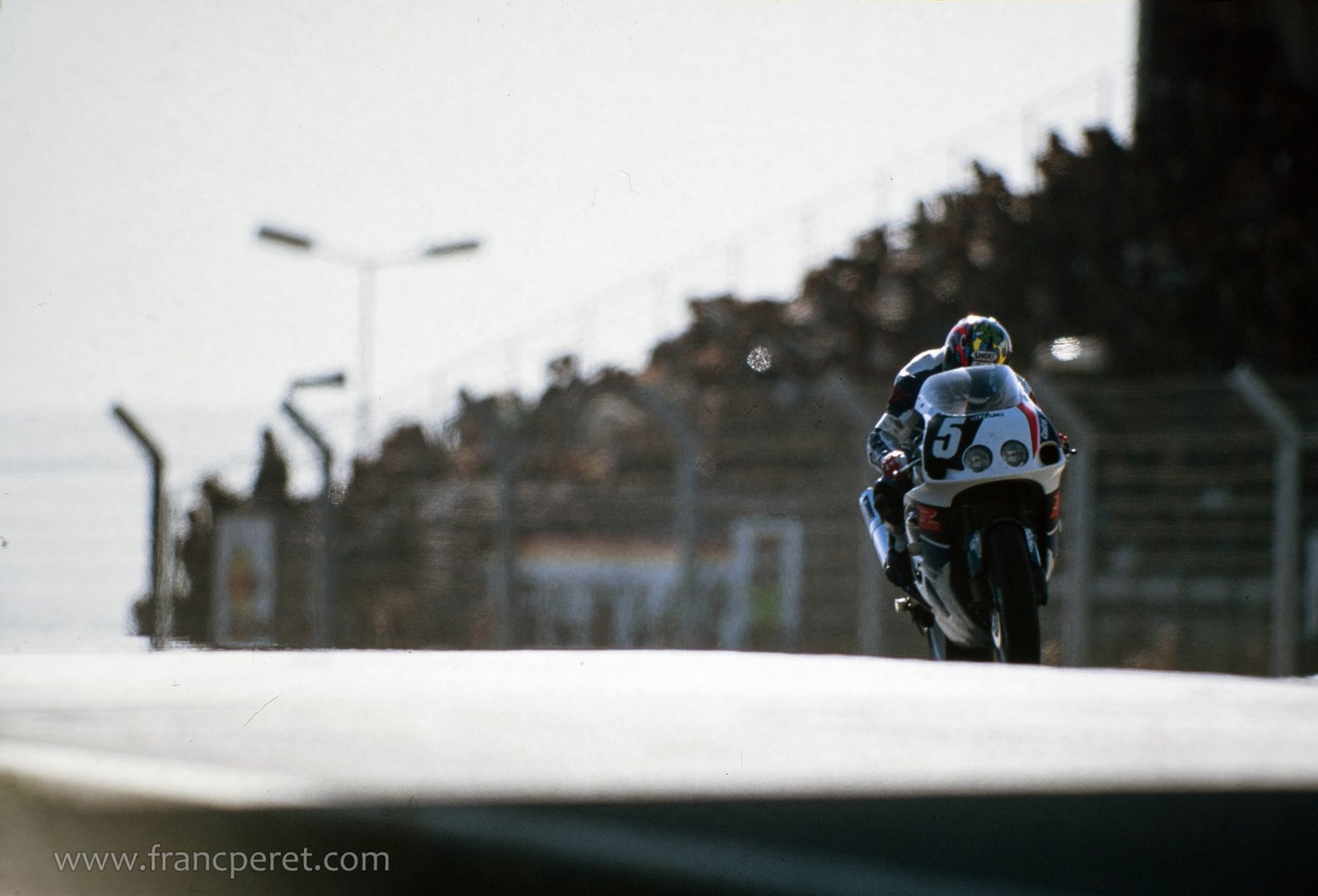
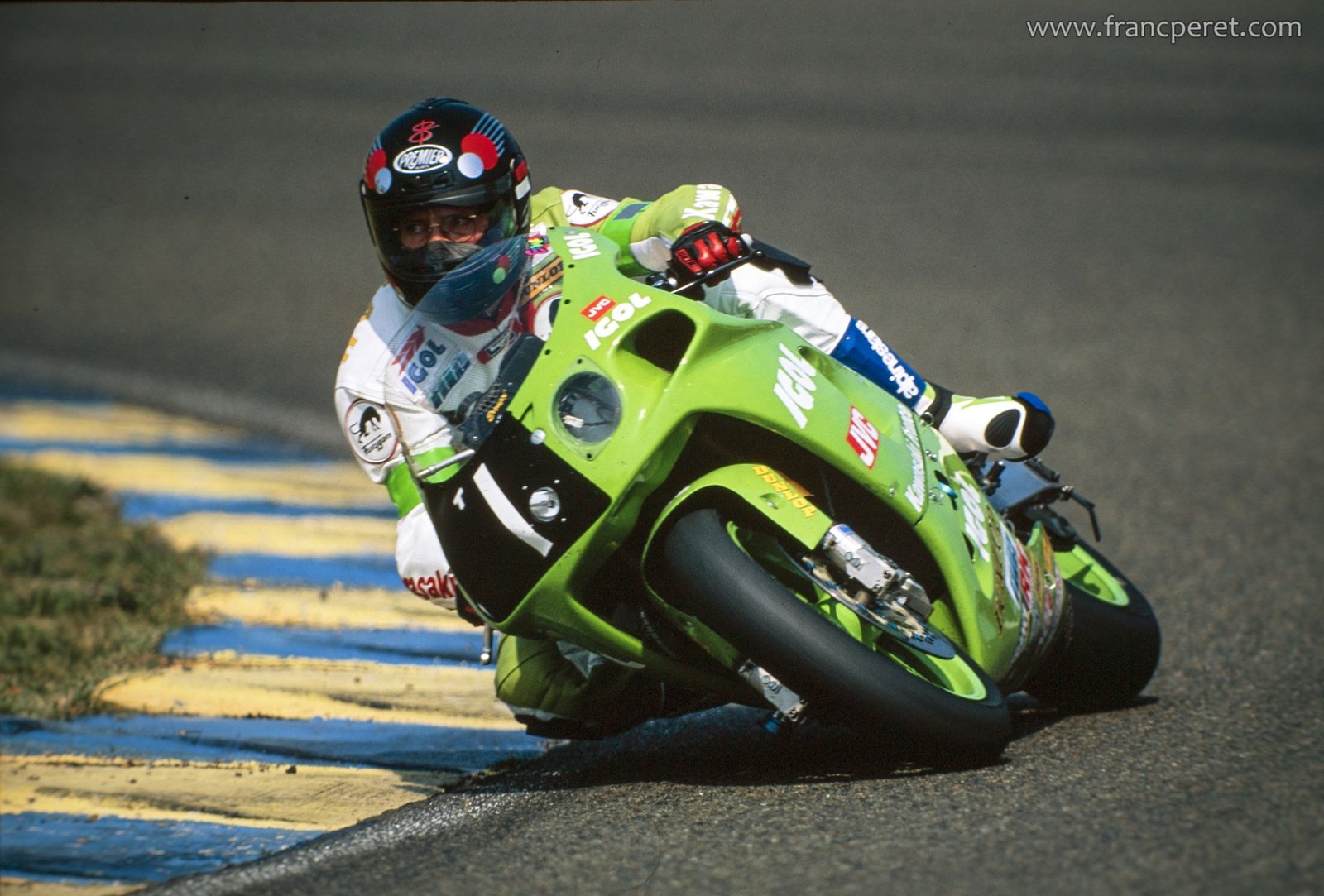
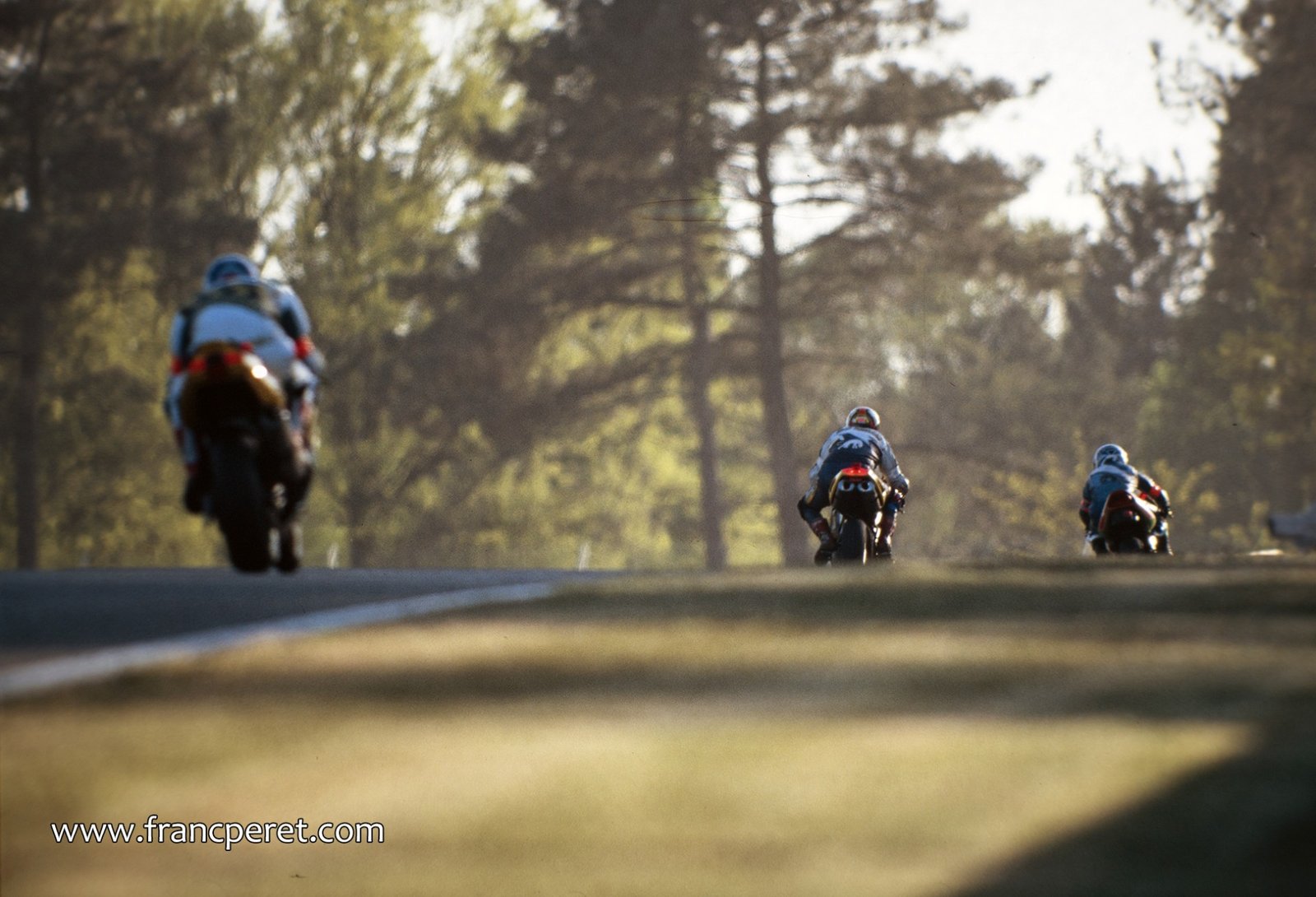
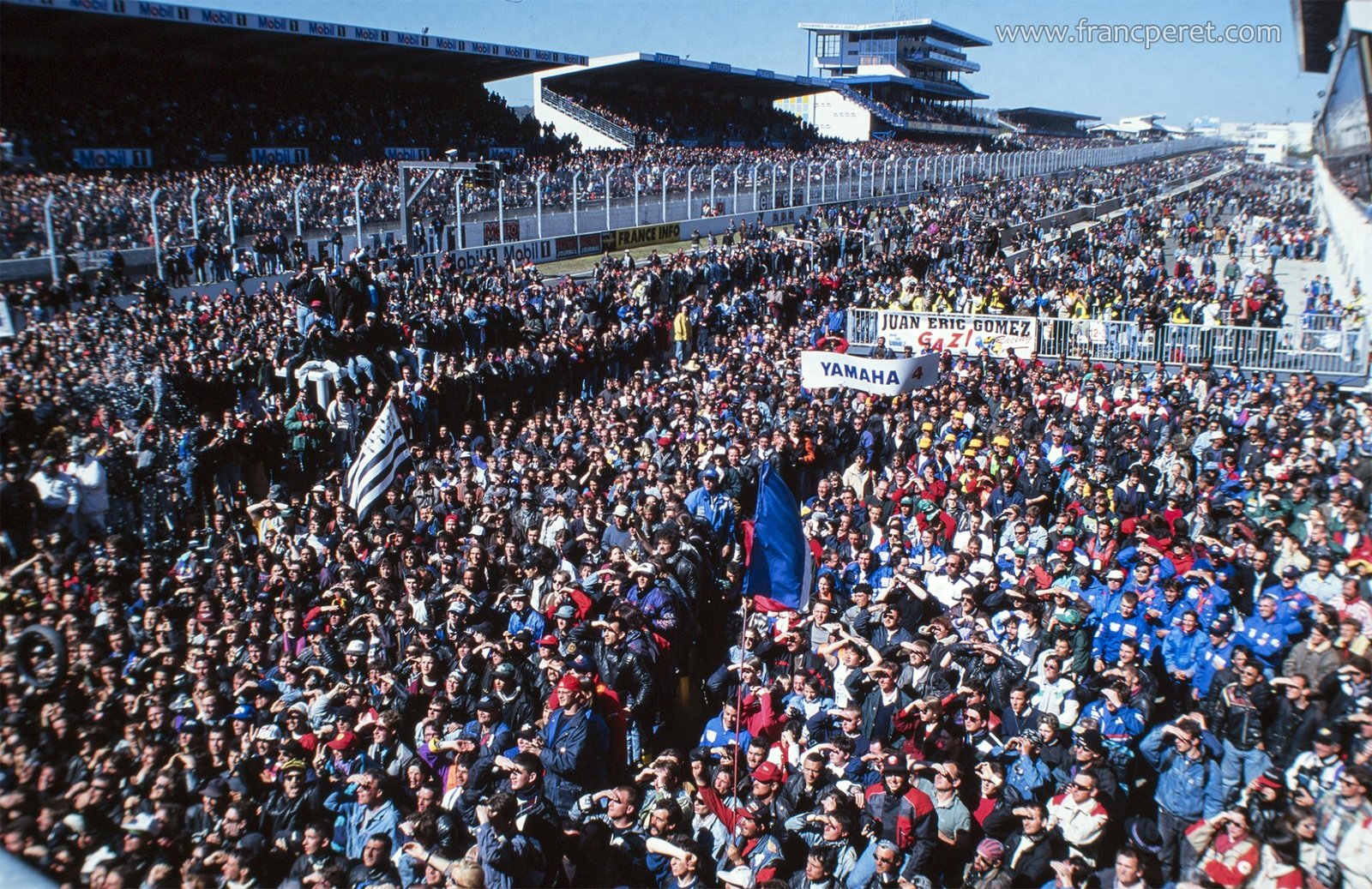
24 Hours of Le Mans is one of the biggest Motorsport event in the world with 100 000 spectators and hundreds of riders competing for the most important Endurance title of the year. More than the competition itself, I focused on the ambiance on the track and the way people were enjoying the show.
Photos Franc Péret (shot on Fuji Provia ISO100)
At a very early stage of my career, practicing Motorsport myself (see some details here) before becoming a journalist, I had to master sport photography, which was a difficult task, at start.
Only experience allows to compose such a shot with a film camera, a basic auto-focus system, a very long lens (600mm f4) a challenging lighting condition and subject in high speed motion jumping into the frame.
This was especially true at the beginning of my career 28 years ago, when I was working with film camera limited to low ISO (Most of those shots had been taken with ISO 100 films), limited in number of shots (could not carry and pay for thousands of film roll) manual setting and manual focus lenses.
Best way to join the event with a complete family + a dog? A side car.
It is quit surprising nowadays, having so many photographers complaining, on forum, about their newly released Digital camera not being efficient enough (number of focus points, focus speed and accuracy) for shooting moving subject .
It sounds like newcomers in photography never have enough technology to compensate their lack of training or practice, and now, some are even asking for more lens or sensor stabilization and greater high ISO value.
Left!Motorcycle Racing is based on quick decision making when the unexpected just happened. Should I go left or right?
Lack of success in Photography is rarely the fault of the camera (especially nowadays), and instead of waiting for a miracle auto-stabilized and auto-focus system able to track a specific subject at any speed and in any direction, photographer should question themselves, their knowledge and their personal skill or technique. At a certain extend, too much technical assistance is heading to the end of needed human skills to achieve creative shots. Thus, we already have a new breed of “photographers” who didn’t exist 15 years ago: the pixel peeper.
Crowd on feet, playing with silhouettes against the sun
Ultimately, people who have difficulties to grab motion shots are very welcome to join my Essential Photography Class, as I am teaching to everyone “target speed”, “freezing or tracking movement”, “anticipation”, “tempo”, “predictive focus” and “tracking subject in motion”.
Dynamic wide shot: Track signs help to keep everyone on the tarmac, especially at night.
All the pictures posted here were shot with a film camera. I couldn’t see the result in term of sharpness, focus accuracy and exposure but this limitation didn’t forbid me to take risk and to determinate the right decision (setting and composition) in some difficult, but interesting, lighting condition while shooting high speed motorcycle in motion.
Comfort is vital to watch a 24h race
Cherry on the cake, I was at this period of my life “official” Pentax France photographer and they sponsored me by lending for free all the equipment I needed for my job.
Among my colleague, my nickname became Franc Pentax, as I signed all my published article and picture by Franc Péret(Pentax).
Bertrand, one of my former workmate (test rider at Moto Journal) won twice 24h Le Mans Race (1998/1999)
I was the only pro sport photographer in France supported by Pentax (everyone else was working with Nikon and Canon) and it lasted several years, until I left France for Japan.
Before that, I lived in Taiwan for a while and despite my new location, Pentax France kept lending me camera and lenses for my work in Taiwan. This friendly support, due to years of successful relationship, helped me greatly for starting a parallel career in film making industry.
But this is another story.
Sun rising in the middle of the day
To get back to 24 H Le Mans, my main camera was a Pentax Z1p and for that specific race I got for free a 600mm f4 lens weighting almost 7 kg! (value: 5000 USD at that time!)
I needed a small trolley to carry it around the race track and a Monopod to sustain the weight while shooting.
When racing looks like a colorful ballet
Beside this monster i had my usual 20mm f2.8, 35mm f2, 50mm f1.4, 85mm f2.
I had auto-focus system on my camera, but this was 16 years ago technology!, with few focus point in the viewfinder and a system not that fast to react.
The night was long for racing teams and short for spectators
At that time, except the sharpness of the lens and the color of the film, the results did not depend on the technology, but was relying on the photographer skills and knowledge to be able to achieve those results.
A professional photographer was not just a guy with a camera, as it seems to be nowadays.
Magic racing moment in natural environment under late afternoon sunlight. Lets forgot about the race and feel the mood of the nature surrounding the track.
As soon as I was sure to be able to capture motion, I worked on my composition and the mood I could get out from different lighting situation.
As the race last 24 hours there was plenty of option to play with.
Photographer were already doing “Selfies” at that time. Here in a charming fire woman’s helmet
This was especially true as out of the race itself, I was mainly interested in the public vision of the event sharing most of my time with them behind the protective fence.
sport photographer skill: Being there, close to the action without slowing down the team work
To underline this double vision, I had alternated racing shots and ambiance shots in this post for you to feel the interesting bipolarity of that event and the great possibilities for an open minded photographer.
Enjoy
Franc
100 000 spectator seen from the winner point of view, one privilege of being a professional photographer.Car drivers are opening the space for motorcyclist to go through the traffic. 100 000 people are going back home, half of them riding motorcycle in a continuous lineFriendly sign to the photographer from the motorized spectator leaving the race track