It is quit funny, as important decisions are changing my life every 10 years. Here are some of my key steps in 1985, 1995, 2005 and 2015.
By Franc Peret
– In 1985, I decided to work all year to prepare a car and motorcycle race I wanted to participate in: Atlas Rally in Morocco.
It costs me about 6 months salary in investment, and I was in search of sponsors.
To seduce potential partner, I got the idea to ask to different magazine if they would accept to publish an article from my experience, being a complete rookie in such races, one of the youngest participant.
Yannick Picard, who was a chief editor of Moto Magazine, a cooperative type of publication (which means open minded and ready to take risk) was the only one to accept to give me a chance.
And I will never thank him enough for this, as without him, I would never had a chance to find my way.
I worked a complete year to participate to this 1986 Atlas Rally: With 600 kms average on tough rocky tracks everyday, racing on the Beach was like been on a highway
Yannick filled up my hand with a load of Fuji roll of slide film, wishing me good luck.
From there, my only aim was to finish the race, whatever happen, as I needed material (pix and stories to tell) to get published.
Here are my pictures from my participation to Atlas Rally in Morocco (Photos from Friends and Maindru).
At age 23, I was the second youngest participant of this international car and motorcycle rallyRocks, dust and palm trees, and magic names: Missour, Erfoud, Tagounit, Agadir…
In the bag around my hip, I was carrying a shockproof compact film camera (offered by another great guy, a photographer) to record my experience of the week long (5600Km) off road race, I absolutely needed to finish.
And I made it, despite several crashes and many problems, I was able to write and illustrate a 6 pages story which will become my first article published in a professional magazine.
Thanks to this race I became a photojournalist shortly after, starting with Moto Magazine as Yannick appreciated my very first article.
He needed someone able to write article about off-road racing and I was at the right place at the right time for this.
And it launches my career of photo journalist for good, learning my craft and improving both my writing and my pictures step by step for the 10 years to come.
My very first report as a journalist opens up a new career opportunity. Thanks to Yannick from Moto Magazine
– In 1995 I quit France to set up in Taiwan and this was the start of my life in Asia and a career in Film making and Lifestyle Photography, which last until now.
One of my first shot working on an historical film in Taiwan (scan of a paper picture)One of my picture which serve to promote the movie “Red Kaki” released in 1996. I worked 4 month on this film and learned a lot from it.
I started there as a still photographer for movie, but quickly learned the film-making craft being an Assistant director and finally a cameraman
One of the most interesting scene from the film Summers which allowed me to get some interesting view to emphasize the action and the cartoonish character of the film
I was hired by Leon Dai, a Taiwanese director to shoot his first feature film: “Summers”
Lots of shots were done in natural light which was very challenging.Another interesting set up in the street of Taipei for an action scene on the shooting of Summers.Taipei 2000: Shooting my first film as cameraman and Director of Photography for Dai Li Ren (Leon Dai) in 2000. My assistant is not very concentrate.
– In 2005, I decided to set up in China and I added a new activity to my arsenal by becoming a photography and film making teacher…
2005 to 2015, 10 years of teaching photography in Shanghai
What will happen in 2015? Another big change for sure and I already know the answer as you can see with this picture taken recently.
My 2 months old daughter raising her head for the first time.
It was both very challenging and a great chance to start my career as Sport photographer, especially in the film area (without any possibilities to immediately check the result).
By Franc Peret
Challenging because shooting moving things (especially fast ones) is one of the most difficult technical thing in photography as you have to solve several problems in the meantime.
The most obvious are getting the right focus point (while following movement), anticipating shutter speed to get the right effect (Freezing impact or tracing motion with blurred background) and getting the right exposure as it might change along your tracking.
At 20 years Old I started an exciting life by racing Side-Car-Cross. I am here on number 6.
One more thing, which is often unknown if you are not used to action shot, is “tempo”: which means pressing the shutter button as the exact right time, when the action reach its climax or when the subject is perfectly positioned in your frame on the right focus point (in case of predictive focus) without overlapping with disturbing things in the background.
Getting out to keep the balance was my mission, a tough one, when others were hitting my back with their front wheel or throwing stones with their rear wheel (same race, me on Number 6)
As far as I am concerned, the fact I was a racer before becoming a photographer did help me greatly on this.
When you are involved in Motorsport, so many things are happening at the same time, your brain needs to process very quickly and action is seen almost in slow motion. Sliding full gas in a long curve, an exciting way to start a life full of sparks and adrenaline, which helps me later on to become a sport photographer.
All of this seems complicated a long to explain, but the reaction of the photographer has to be instantaneous.
Somehow, a sport photographer has to be as fast as competitor themselves, adrenaline is part of the game as well to record the shot on the right tempo.
Our usual price after the finish line: dust, sweat and pain mixing up, but it was nothing compare to the exciting load of adrenaline.
As far as I am concerned, the fact I was a racer before becoming a photographer did help me greatly on this.
When you are involved in Motorsport, so many things are happening at the same time, your brain needs to process very quickly and action is seen almost in slow motion.
Since I was 19 years old, adrenaline was my drug, while racing Side Car Cross for 3 Seasons. I choose this sport because,as a student, I couldn’t afford a racing bike and to follow up on a season on my own.
My second Season racing with a new pilot, new engine and a lefty side car from England
And being the “Monkey” in the side car, I was part of an extreme thrilling experience without having to worry about cost.
My investment was purely physical and I often invested more than I got, despite my long and intensive physical training before each race.
I am trying to fly over the bumps, full throttle, pushed by a Norton 930cc
I was exhausted, hurt and sometime wounded, but this was one of the most exciting part of my existence and a very good start to not be scared by anything (except boredom) later on, for the rest of my Adult life.
All those shots of me racing between 1983 and 1985 were taken by two of my best friends of that time (Lionel Prieur and Jean-Louis Toribio).
I had a chance to do a great set of pictures for the presentation of a new brand sold on Amazon.
By Franc Peret
I always like challenge and what is more challenging than lighting round objects full of reflection, such as glasses, bottles, ice ball and mirror table?
Box. D800 and Pentax 67 135mm f4
We worked in my office, in a small space but we succeeded in producing a wide range of shots.
Some are simple product shots, others are more moody and I love those.
We worked very well together with Vida Viva Home Ltd representative having fun on a full day work.
A glass of Whisky and huge Ice ball. D800 and Pentax 67 75mm f2.8.
For this job, I used 2 different types of camera:
1 – Nikon D800 full frame with a Nikkor 85mm f1.4D, Nikkor 105mm f2.5, Nikkor 180mm f2.8, and a set of Pentax 6×7 lenses (75mm f2.8, 105mm f2.4 and 135mm f4 Macro) mounted on my Nikon camera with an adapter.
Top Red cocktail. Panasonic GH4 and Lumix 42.5mm f1.2 @ f1.2Red cocktail. Panasonic GH4 and Lumix 42.5mm f1.2 @ f1.2
I like those medium format lenses as they get a more organic feel and are designed to work with smaller Aperture without diffraction problem.
2 – Panasonic lumix GH4 (M43) with 42.5mm f1.2 lens.
This allowed me to get different point of view and more depth of field when needed
Ice coffee and pot. Nikon D800 and Pentax 67 135mm f4
As you should know, smaller sensor means more depth of field.
Technically This affirmation is not perfectly accurate, but the effect is there.
Summer set. NIkon D800 and Nikkor 185mm f2.8 @ f4White cocktail. Panasonic GH4 and Lumix 42.5mm f1.2 @ f1.4
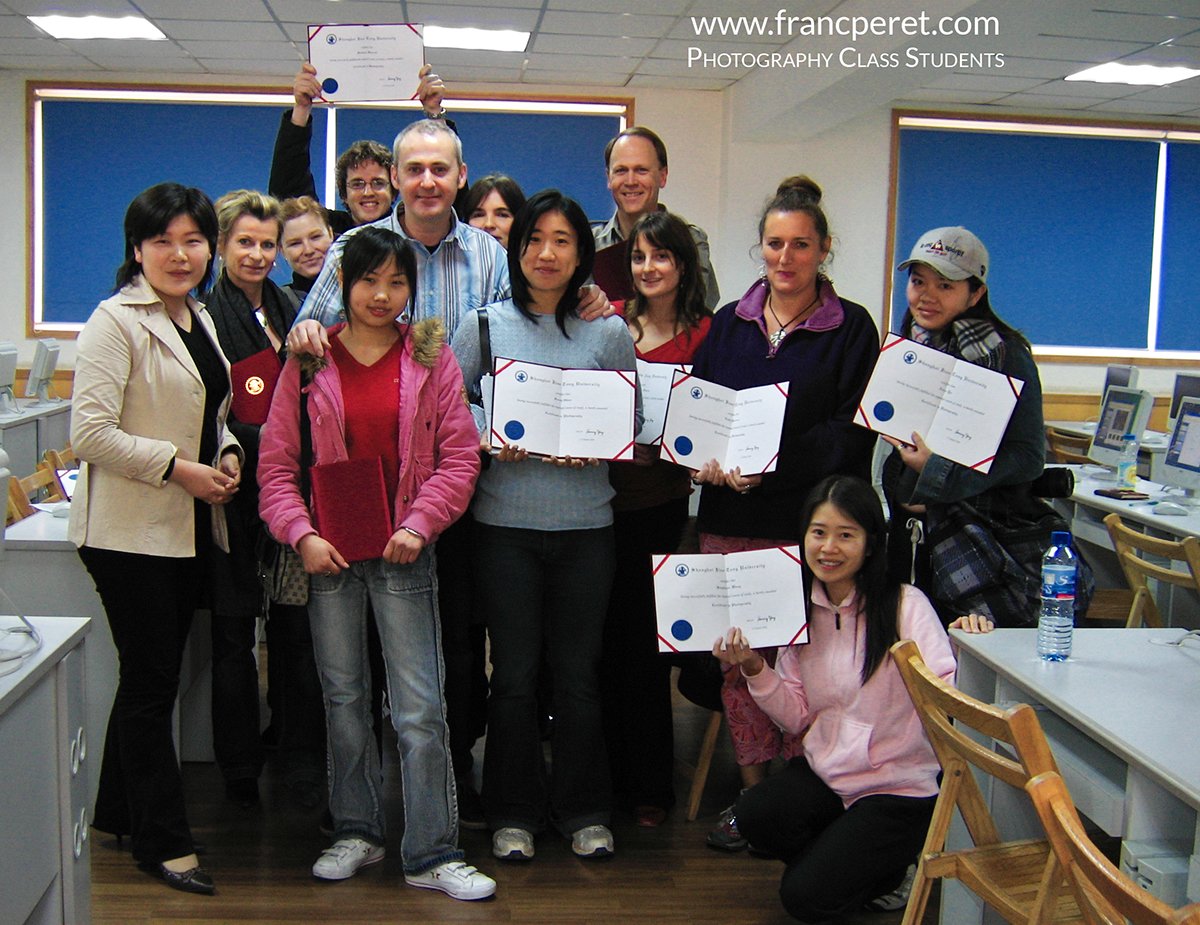
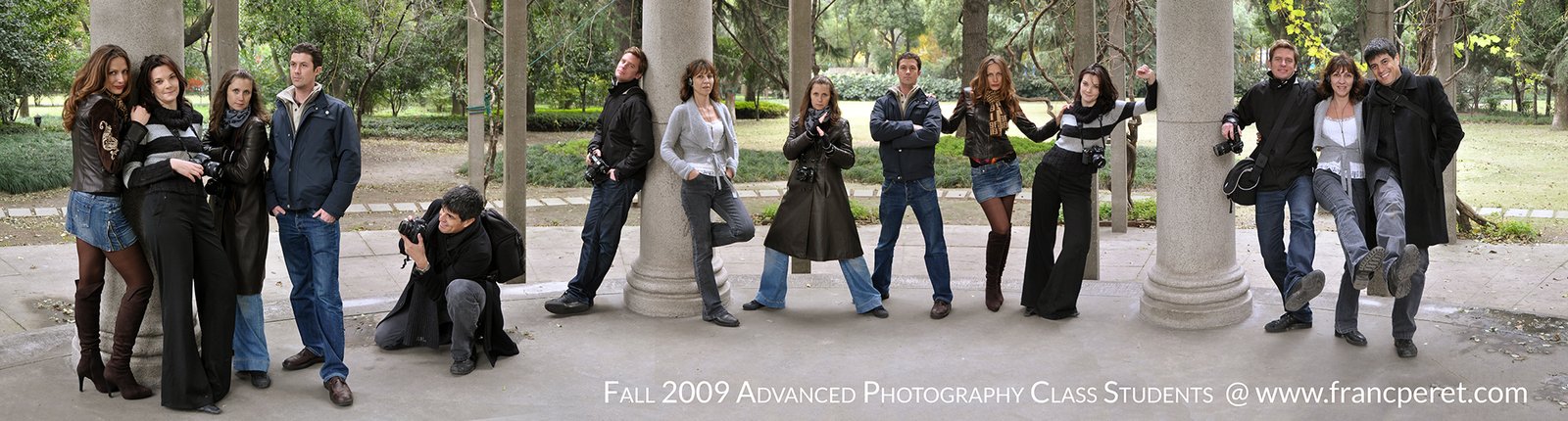
From now on, I am going to collect and add to this post my Photography Class students group pictures, starting from the very early Class I ran in Shanghai in 2005, 10 years ago! Great memories to share with all participants!
By Franc Peret
In 10 years, I had 750 students in Photography, Advanced Photography and Film making class.
It is an amazing number and I can hardly trust it myself, but my mailing list proved it to me.
My very first Photography class starting in 2005 with Xin Zhang, Anke Kroener, Sabine Gösker, Caroline De Lagasnerie and many others (Thanks to Xin Zhang)
Why being so surprised myself?
I think the pictures I am posting here are going to give you part of the reason.
I am having so much fun to share with great attractive people dedicated to my teaching!
2005 Class: for our outdoor session we all met in a Park in Pudong (picture by Anke).Intensive training (getting dirty is good for creativity!)for the 2005 Class (picture by Anke).Sabine Gösker comments: It was our complete class meeting in a compound and then walking along HuangPu in Pudong… and in the afternoon we did our first panning exercises. I remember well the photos I took of Anke running. Too bad I lost them all! (picture by Anke)
I am never going to be tired of teaching and it is such a joy for me that I do not count the time, the effort or the number of students I am teaching to.
2006 Private Class2006 Photography Class2006 Photography Class
My students are coming from different countries (40 different origins so far!), they have also diverse ages, occupations, social ranks, motivations and characters, but they all have something in common: the excitement of learning something new from me.
And I love that!
2007 Photography Class2007 Photography Class
Lets come back to the pictures.
2007 Photography Class2007 Photography Class
To start in chronology order, I had to dig deep into my record to get those pictures and few are missing unfortunately, but day after day, I am going to add more pictures of the different classes until I reach the present one. Stay tuned!
Here is a couple of my single class shot in March 2006, in Shanghai Jiao Tong University. ELC started its teaching activity there. My students were Kathryn Ferb, Tom Shoesmith, Matthew Worrall, Cath Barnes, Sarah Ghan Stephanie Wong, Anne Yu, Karin Wiedenhoefer, Kate Macleod, Louise King and Shannon Ellis.
Thomas Knop, Lina Zhao, Silke Niestroj, Patricia Portillo Suarez and Jeanine Jordaan.
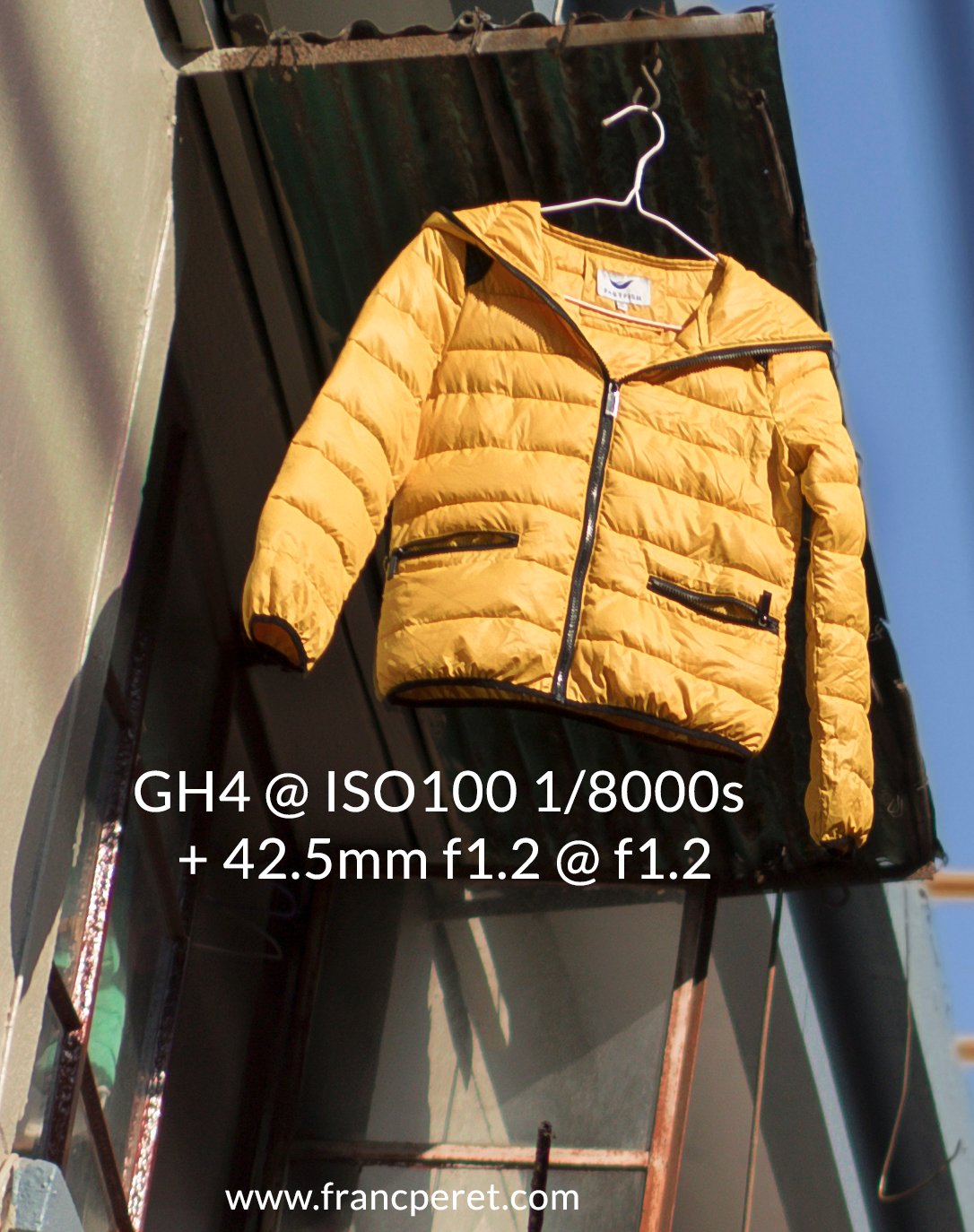
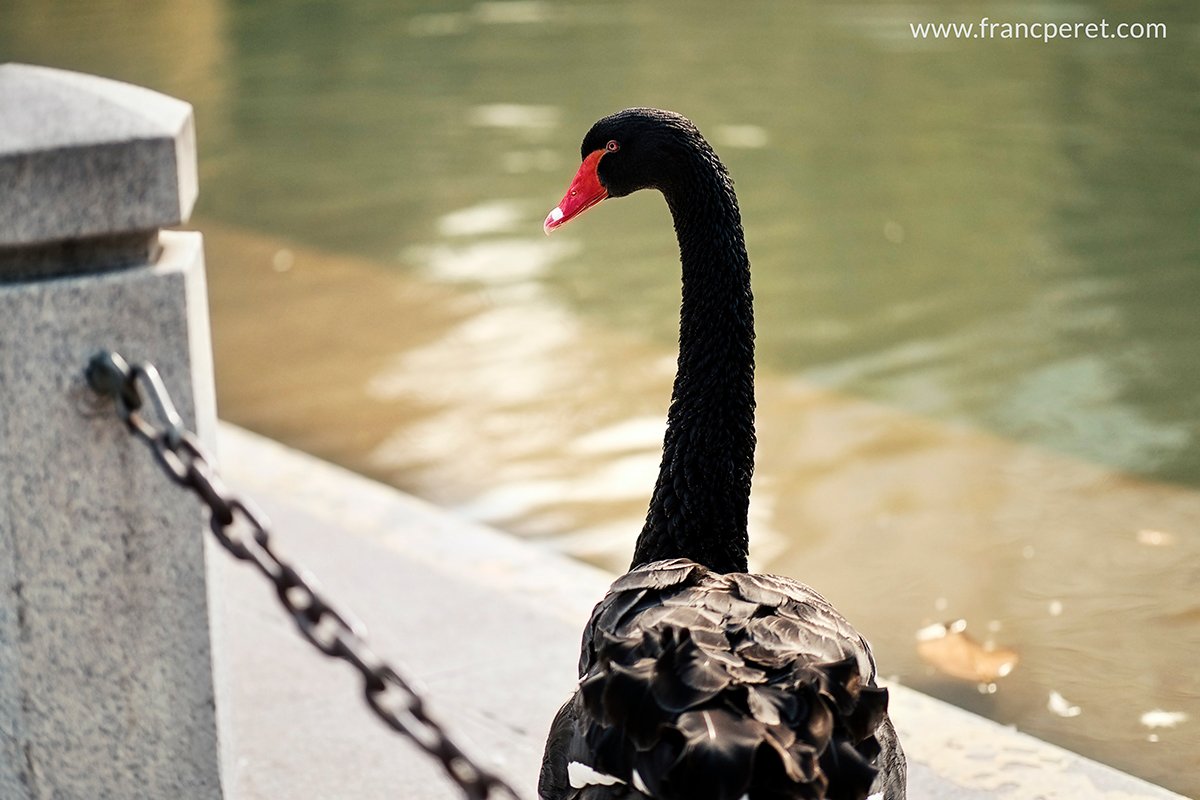
I had a chance to spend a couple of days with the Panasonic 42.5mm f1.2 and my GH4 and I tested it fully open, most the time to have an idea of its possibilities.
By Franc Peret
In China, this lens is less expensive than in the rest of the world.
A new official (1 year guarantee) copy is sold 7800 RMB, which is about 1250 USD.
GH4 and Panasonic Leica Noctiron 42.5mm f1.2
This price is still very expensive for a M4/3 lens, but all depends on what it had to offer.Here are some of my shots for you to get an idea.
GH4 and Panasonic Leica Noctiron 42.5mm f1.2
I worked on the raw file to create the jpg with a slight sharpening of 80/2/2 as the GH4 file are easy to get noise if they are pushed too much in that department.
With every full shot, there is a crop around the focus area mentioning the camera and lens datas.
All those picture were shot on 3:2 instead of 4:3 picture proportion so the maximum number of pixel is 12 millions instead of the 16 I would get on 4:3 (but I don’t like it much as I am use to 24×36)
I shot a lot with the lens fully open even it was not always the best option for the subject I was shooting (and the lighting condition) but I wanted to see what this lens offered at f1.2.
So far, I am not completely seduced and I do need to do more test may be with another camera, such as an Olympus Em-1 which render sharper images ( I know as I got both for a while).
Compare to my Nikon 85mm f1.4, used on a D800, I can notice different positive things:
– The Panasonic lens can be trully used wide open in any lighting situation (no chromatic aberration so far) mounted on the GH4.
– Focus is very fast and more accurate than on the Nikon combination. Autofocus system is different and the 42.5mm f1.2 still deliver much more depth of field than the Full frame 85mm f1.4 mounted on the D800.
– Weight and size are absolutely not a problem and the lens balance very well with the GH4. The Noctiron is lighter than the Nikon AIS 50mm f1.2, which is a classic manual focus lens without any stabilization system.
GH4 and Panasonic Leica Noctiron 42.5mm f1.2GH4 and Panasonic Leica Noctiron 42.5mm f1.2
– It seems that this lens is rendering sharper result in lower light (indoor) than in a bright environment (diffusion?).
I still didn’t get a “wow” result with this lens, but I had just few hours to try it, and my series of pictures is not interesting enough yet to deliver a valuable conclusion.
I am going to shoot more and to post more pictures and comments here, so keep in touch
Light and composition are more important than the subject itself. There is nothing more true to illustrate this concept I am teaching to my Photography Class Students, than product shot.
By Franc Peret
Product shots are usually done for commercial purpose, and pictures have to be more attractive than the object its self to be considered as successful.
Playing with Light and ShadowsPlaying with Light and Shadows
The Magic of light shaping
By learning how to use Light sources, a professional photographer is going to achieve that result, but each object will represent a different challenge according its shape, its reflection, its purpose and the target mood.
Playing with Light and ShadowsPlaying with Light and Shadows
Case by Case study
A slice of pizza is not light up and shot the same way than a camera, a jewel or a shower head (which is actually the most difficult). Only the understanding of quality of light, family of angle, masking with shadow and post processing can make a good shot possible.
New set menu shot in The ApartmentSample Menu Shot in The Apartment
Here are some sample of works done with my students during the Advanced Photography Workshop I am organizing in Shanghai. This time, Fun Special Effects was the main topic
By Franc Peret
Franc’s Advanced Photography Course is also designed for students to discover how to use set up, choreography lighting and Photoshop for imagining and creating specific effects, with different students staging as imaginary characters in strange situations.
Alexandra: Wlalking too fastRegino: Impossible to sit, I lost my bottom.Eugenio: Stretching time Tea time.
Lighting set up was done in “The Apartment”, Yong fu lu, Shanghai. A day and night creative space.
Liam: The Magic Broom
Here is a series of shots of different students in unusual posture.
With Eugenio Sandroni, Sarah Dashfield, Raimondo Pro, Alexandra, Jana, Liam, Regino and Harald. Dirk is missing again!
Harald and Ray: That was a big caliber.Harald and Ray: Fighting scene.
I am used to my cameras and when I buy a new one, it is very rare I am selling the older model. I am keeping them all and sometime, I am going out with one of them for shooting.
By Franc Peret (Nikon D40)
I also do not sell most of my older camera as they have little commercial value which cannot compete against the sentimental value they get for me.
But I don’t like to see those “antic” glories inactive too long, so when weather is fine and I am willing to take a walk, I pick up one of them for a couple of hours and shoot around my home in Shanghai.
Street cleaning lady on the start. 50mm prime @ f2.5, ISO200, 1/125s.Flower tea in the plastic glass. Zoom @ 58mm, f5, ISO200, 1/125s.
This habit is interesting and I am always learning something from it.
Cameras are becoming more and more sophisticated, endlessly breaking new records of resolution (number of pixels) and High ISO value (something I barely use).
Thus, that day, I went out, for less than a couple of hours, with a 8 years old camera, a Nikon D40, a very compact and simple DX model I bought second hand (almost new) for less than 200 USD.
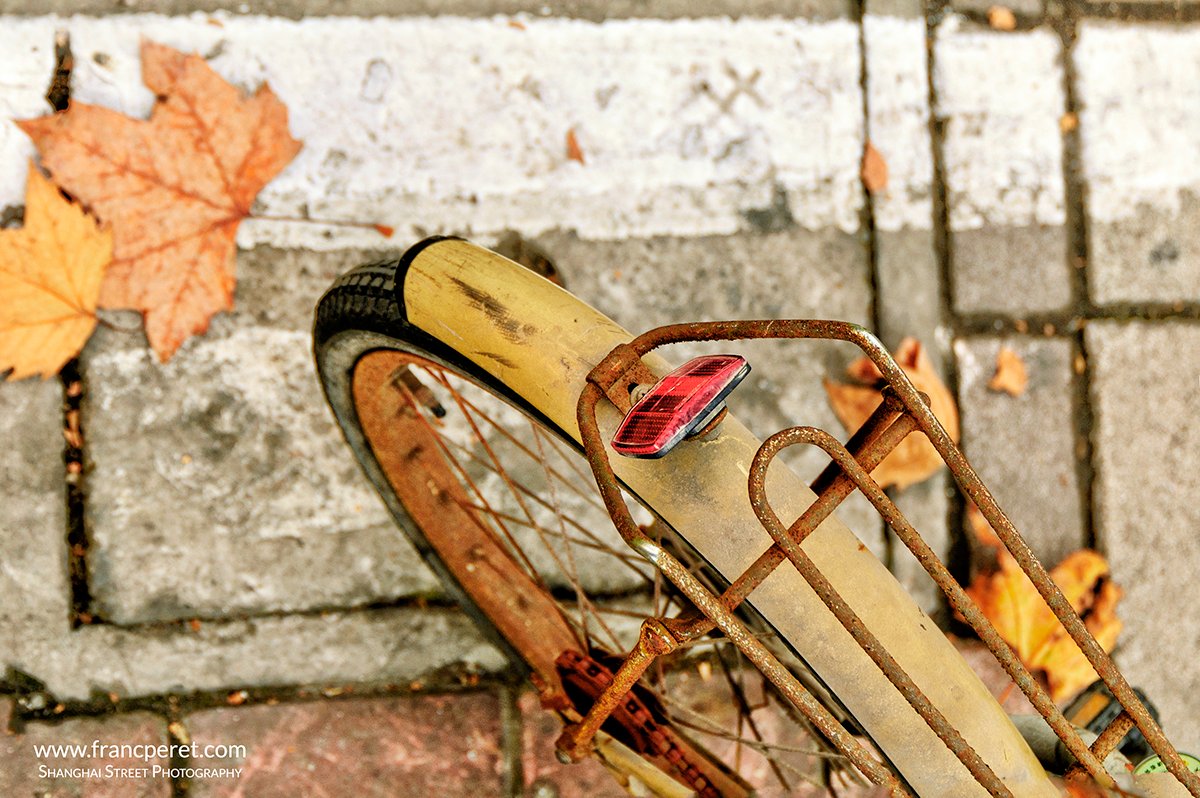
Autumn Bicycle. Prime 50mm @ f5, ISO200, 1/80s.
This light model (which is the ancestor of the actual D5300) gets only 6 millions pixels (my newer model packs 36 millions pixels) a small viewfinder and few lines in the menu.
Its base ISO is 200 and I shot all my pictures at that value, despite the change in lighting situation.
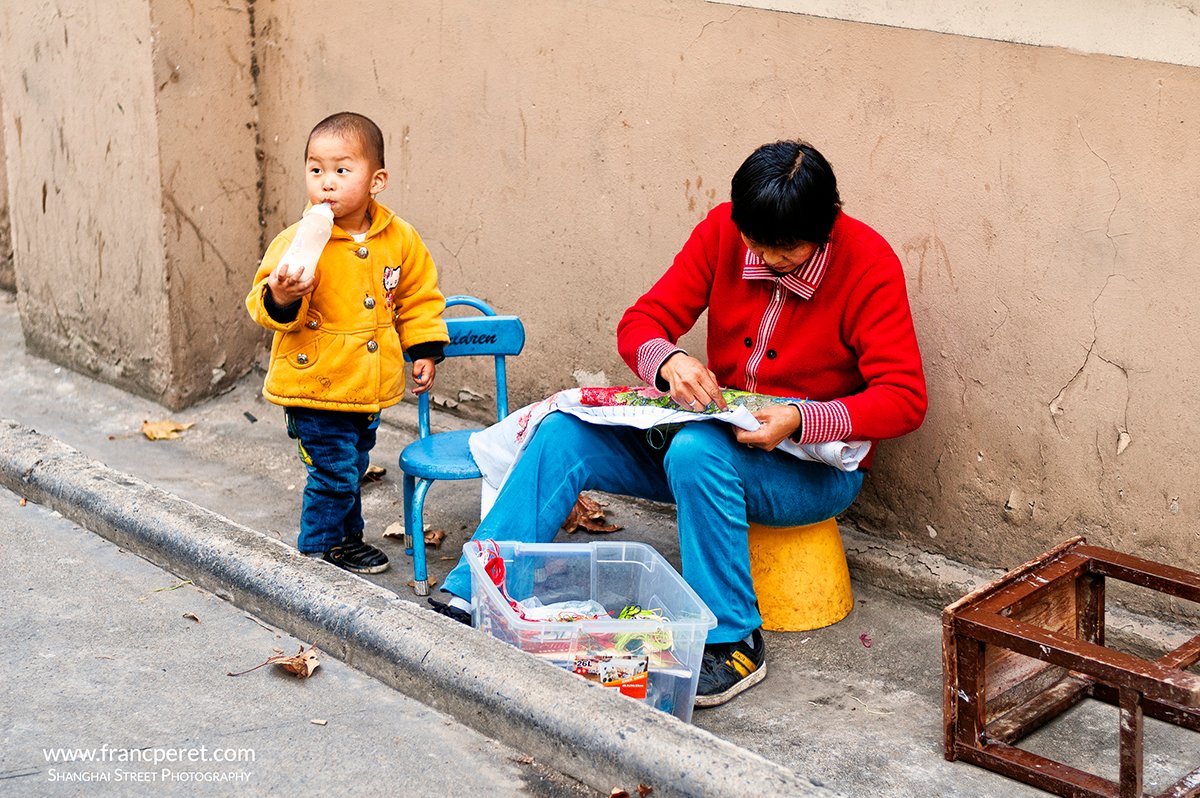
Mother and son. Prime 50mm @f1.8, ISO200, 1/400s.
It didn’t bother me that the day was ending as I carried 2 Prime lenses with a max aperture of f1.8 to compensate for the growing ambient darkness at the end of the session.
I love this camera for its compactness and its simple sensor, which a CCD and not a CMOS.
CCD are rarely used nowadays and they disappeared from photography camera production due to their higher cost.
Rising Roses. Prime 50mm @ f2, ISO200, 1/320s.
To my eyes, their big advantage was color rendition, with natural and vivid jpg straight out of the camera.
All my newest camera are using CMOS and colors often does not look right to me, and pictures need correction in post treatment.
CCD are offering a more organic feel. Also the the lowest resolution is of great help for any lens put on the camera to shine.
Feeling followed. Prime 50mm, f2, ISO200, 1/640s.Rose against balconies. Prime 50mm @ f2, ISO200, 1/250s.
Anything I am using on this 6 millions pixel camera will deliver sharp and contrasty results.
Modern cameras are having at least 16 millions pixels.
More resolution means more details to be recorded through the lens and if a lens is not perfect, it can be seen on a file build up with bunch of pixels.
It’s about lines. Zoom @ 24mm, f8, ISO200, 1/500s
Therefore Few of my older lenses are working perfectly well on my 36 millions pixel Nikon D800, while they are all doing a great job on my previous cameras which had less than 12 millions pixels (D40, D200, D90).
Pixel count and high ISO are 2 “easy to market” considerations that pushed camera makers in some extremes comptetition.
Lines and Clouds. 50mm prime @ f5.6, ISO200, 1/1000s.
And this is not all good.
Important is the final visual we are recording with the camera, and for my personal use, I don’t need that much resolution as I do not print my images.
My client needs it and it is the main reason of my purchase of a Nikon D800.
With this 36 Millions pixel monster I discovered that the slightest shaking, the slightest mistake in auto focusing or the slightest weakness from a lens resolution would result in a bad pictures.
This is a very demanding camera and its greatness finally limit its usability.
End of the street. Zoom @ 24mm f8, ISO200, 1/320s.Cars and people on the wrong place. Prime 35mm @ f2, ISO200, 1/125s.
Somehow, I would prefer a modern camera less demanding on that matter to get pleasing result all the time, whatever lens I am using on my camera.
I find this advantage with the Nikon D40 and it is just a pity its viewfinder is not a bit larger and brighter to offer a better vision when I look through. A modern version of this camera would be very successful among photographer like me, who prefer to get a user friendly device which can freed my creativity and deliver great colors at the first place.
Heads go first in Chinese market. Prime 50mm @ f2.8, ISO200, 1/60s.
For this series of shot I used 3 lenses: Nikon 35mm 1.8G + Nikon 50mm 1.8G and an old zoom: 24-120mm f3.5-5.6G. The 2 prime lens are working very well on the D800 (even the 35mm f1.8G is only a DX lens), but this zoom looks like crap on it. Impossible to get any sharp shot with it even the aperture closed down to f8 or f11.
Name card for service. 35mm Prime @ f2, ISO200, 1/400s.
However, on the D40, it is a great lens, sharp and contrasty wide open, without being too heavy, even it is a FX lens and not a DX one.
Globally, I think that marketing didn’t too good for photography, with the abandon of CCD sensors, too much pixels in resolution and the need to impress customers with incredible high ISO value.
Daily Milk Consumption. Prime 50mm @f2.2, ISO200, 1/250s.
Somehow, the effort were not always put were they should be, on real color accuracy, a more organic feel (images should feel less digital), greater Dynamic range and better balance between existing lenses and newer cameras.
Ball and balloons. Prime 50mm @ f2, ISO200, 1/160s.
Don’t get me wrong. I am not saying older is better. Great progress had be done, especially on the quality of the viewfinder, the build quality, the price and the offer. New models are coming out much more frequently and they concern new type of cameras. Choice had never been so huge! Overall I am always excited by my newest camera and they do force me to adapt myself which is a very good way to discover new things, to not get bored and to never feel outdated!
Franc is running an Essential Photography Class in Shanghai. Check it Here
Here are some sample of works done with my students during the Advanced Photography Workshop I am organizing in Shanghai. This time, Portrait with movie light was the main topic
By Franc Peret
Franc’s Advanced Photography Course is also designed for students to discover how to use set up, lighting and their camera for creating specific atmosphere, with different students staging as imaginary characters.
Lighting set up was done in “The Apartment”, Yong fu lu, Shanghai. A day and night creative space.
Here is a series of shots of different students. Each one inspired me an idea with props, posture and lighting in mind.
With Eugenio Sandroni, Sarah Dashfield, Raimondo Pro, Alexandra, Jana, Liam, Regino and Harald. Dirk is missing!
DJ LIAM
Here is my shot of the Famous DJ Liam. His line could be: “Are you talking to me…?”
This picture could be used for a flyer or a CD cover.
Lighting set is: 1 x LED lights panel + 1 x LED Fresnel lens + Silver Reflector.
Camera set up: Nikon D800 + 85mm f1.4D. ISO400, f1.7, 1/125s.
Moody Liam
For those 2 shots, set up was a bit different for the lighting
Liam in B&WLiam in Full colors
Harald, the Radio Repair Shop owner
This shot is mimicking a 1950’s commercial.
It was light up with 2 x LED lights panel + 1 x LED Fresnel lens + 1 x LED PAR64 (red spot) + 1 reflector.
First shot is done with Nikon D800 + 85mm f1.4D. ISO140 to ISO400, f1.7 to f2, 1/125s.
Harald shot with Nikon D800
For the second shot, I used a Panasonic GH4 = Speed Booster Adapter + Nikon Ais 55mm f1.2 @ f2. ISO200, f2, 1/125s
Harald shot with Panasonic GH4
Regino the CEO and Ray the Butcher
Ray is the Clumsy Butcher or The Ultimate Relation Therapist.
His line could be: “My wife had never been cooperative…”
Jean Pierre Jeunet “Delicatessen” movie inspired me for this set up.
2 x LED lights panel + 1 x LED Fresnel lens + 1 x LED PAR64.
Nikon D800 + 85mm f1.4D. ISO400, f2, 1/125s.
Regino, CEO style portrait with a touch of (photography) class.
His line could be: “Suits always shrink with time… Couldn’t close that f… button”
Will be used for Regino Linked in page.
2 x LED lights panel + 1 x LED Fresnel lens.
Nikon D800 + 85mm f1.4D. ISO140, f2, 1/125s.
Regino, the CEORay, the Clumsy Butcher
For this shot, I worked with a Panasonic GH4 = Speed Booster Adapter + Nikon Ais 55mm f1.2 @ f2. ISO200, f2, 1/125s
Here are some pictures taken during my street photography outing with my Essential Photography Class Students. All shots done with Panasonic Lumix GH4.
by Franc Peret
Once during the 25 hours (10 weeks) Essential Photography course, I am going out with my students to give them a chance to practice what they had learn so far in term of technical set up and composition.
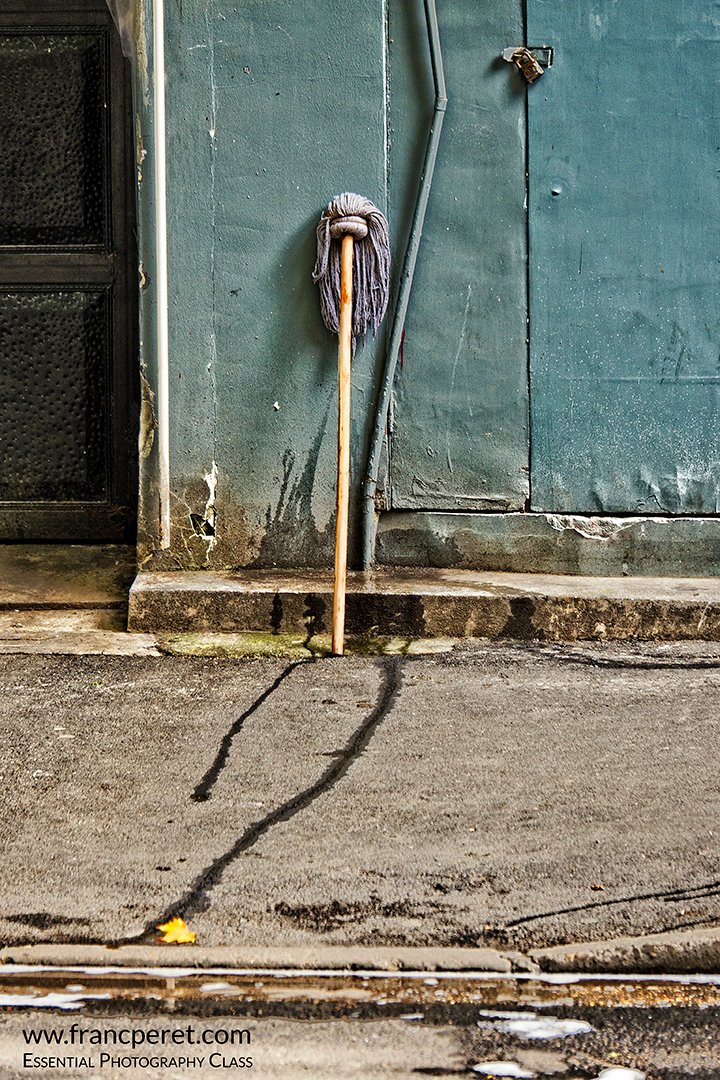
Sunny Hairs (GH4 and 12-135mm f2.8)Wet Broom
I am taking benefit of the class to demonstrate some ideas and to develop Student’s inspiration by just walking around the block close to our starting point, which is The Apartment on Yong fu lu.
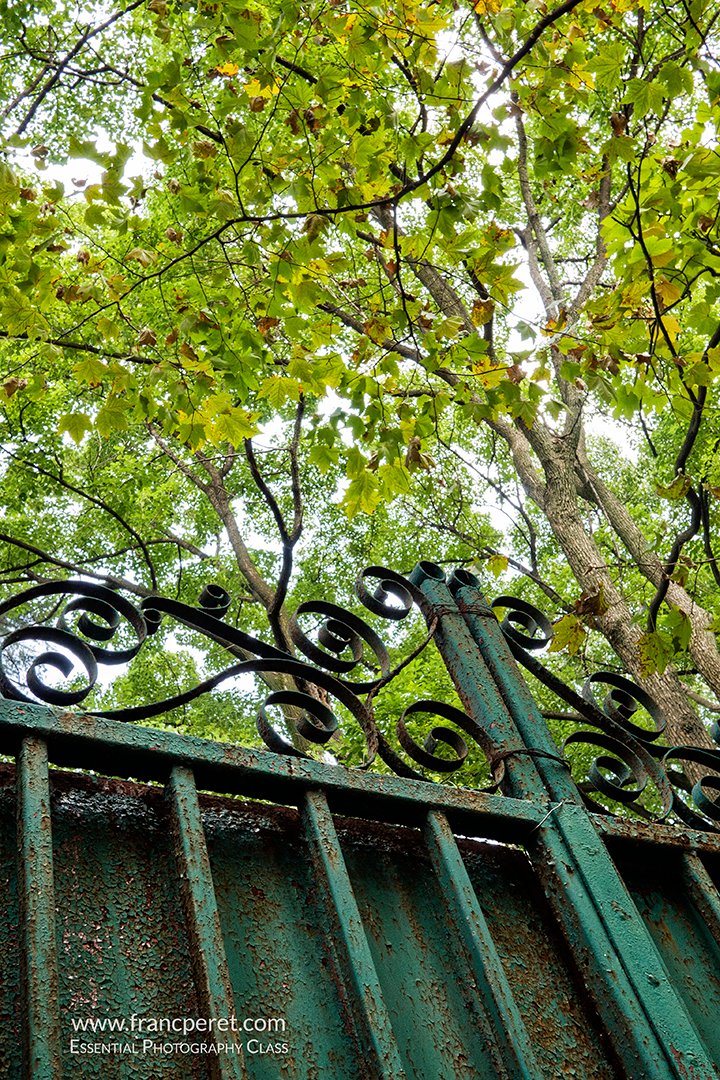
Splash of shadows on a Wall and a Rusty gate (GH4 and 12-135mm f2.8).
No need to walk long distance to get a wide collection of shots. Imagination is not calculated in meters.
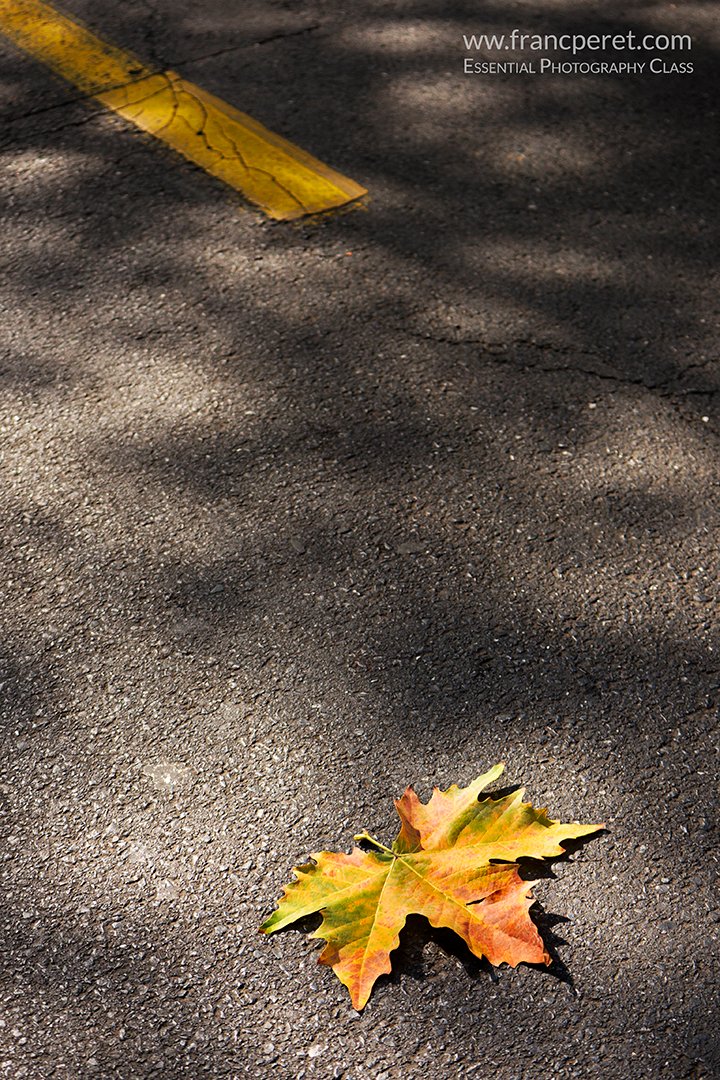
Side leavesCenter Leave
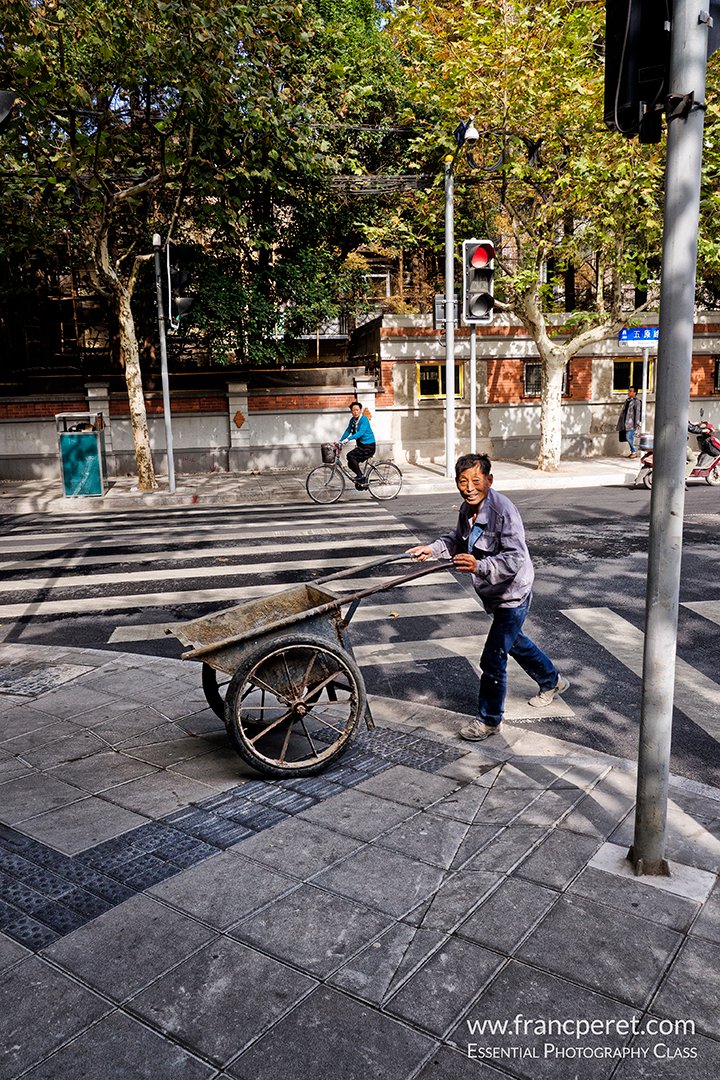
Shanghai former French Concession is a great place for shooting due to its historical background (trees and houses) and the traditional life local people are still enjoying there.
Checking the bill.
On this series of shots, I tried to extract structures out of the element of the environment.
Passing byGrey Cubism
Whatever I am shooting is not real anymore, it becomes my own interpretation in term of association (color, shape, texture) and balance (contrast or common point).
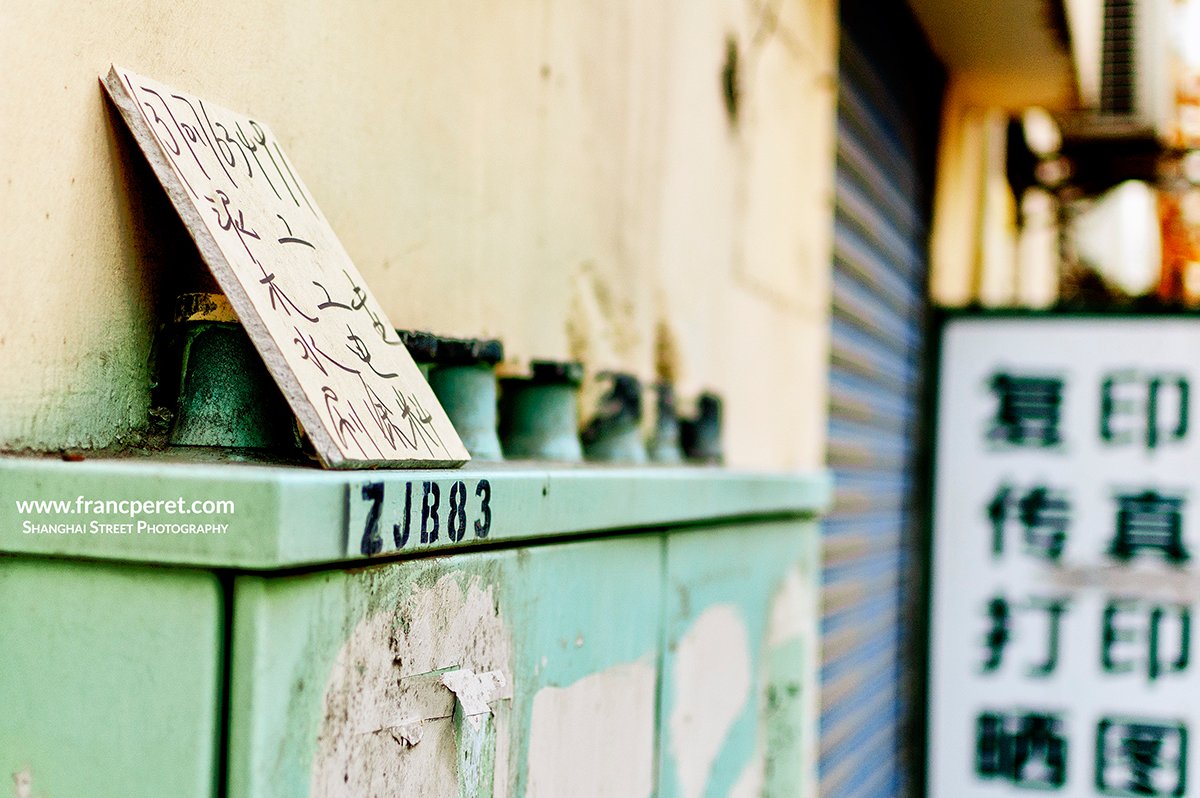
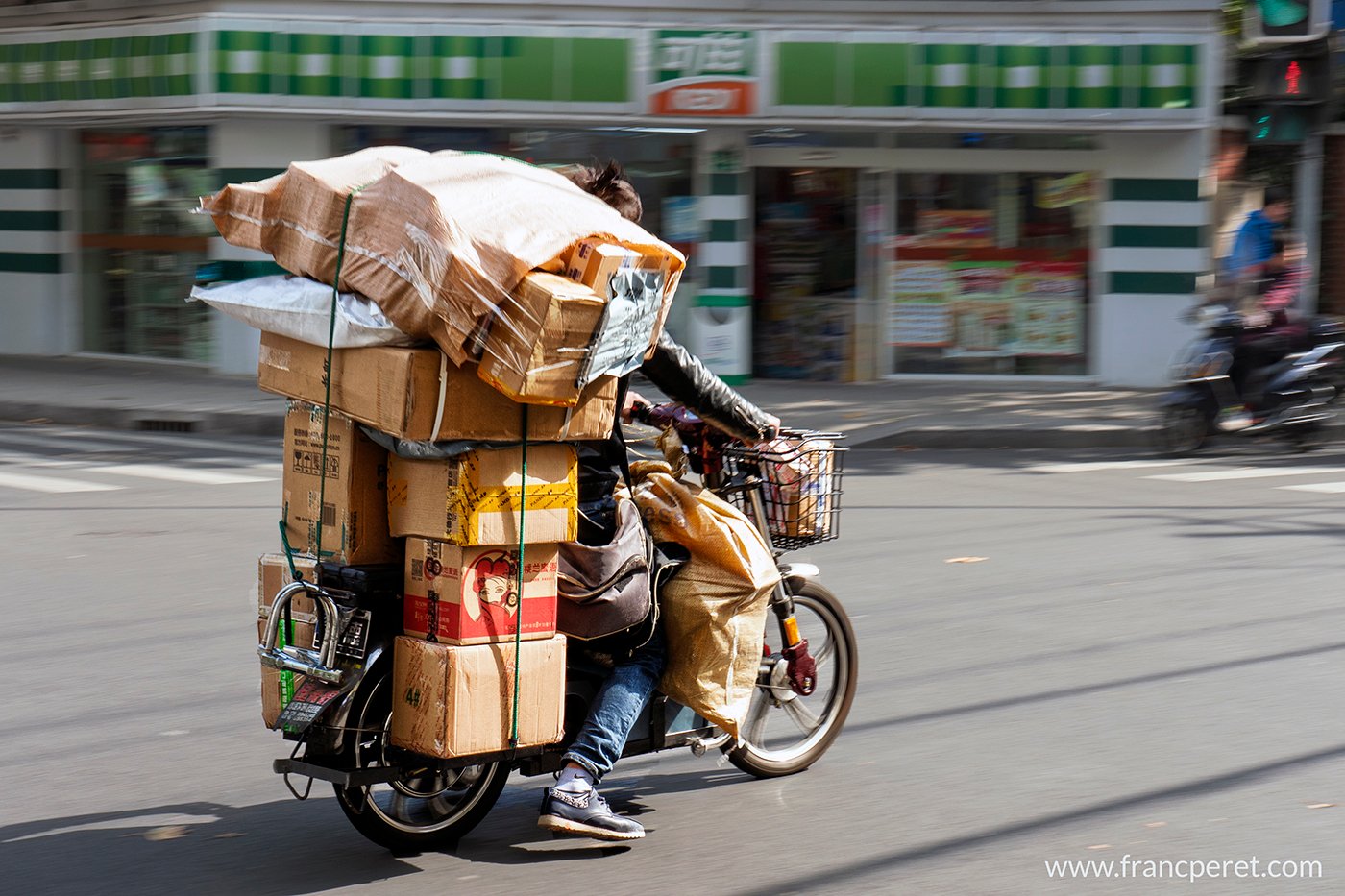
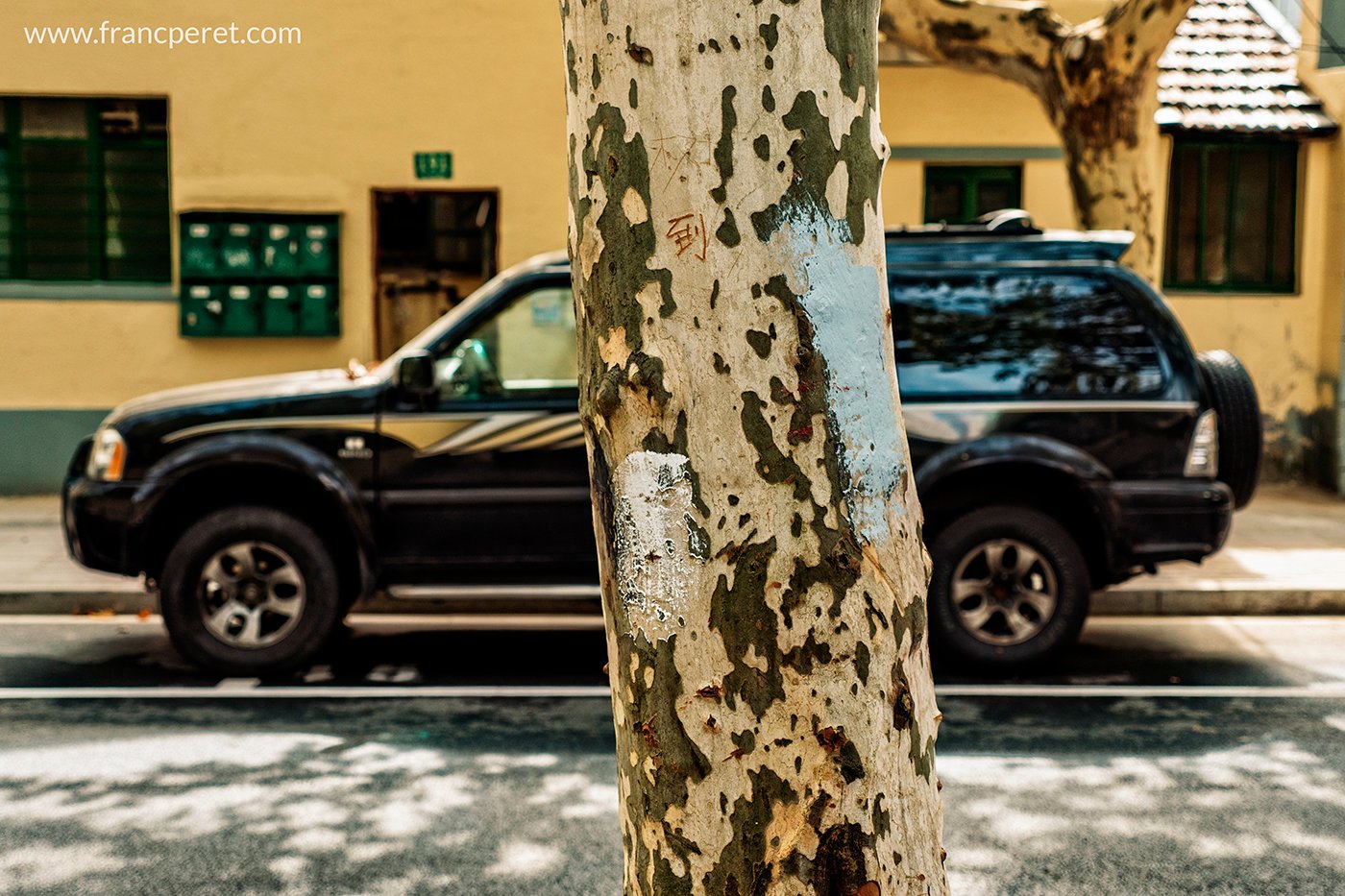
“Kuaidi” means Express delivery.
This is what I am calling “structuralism”.
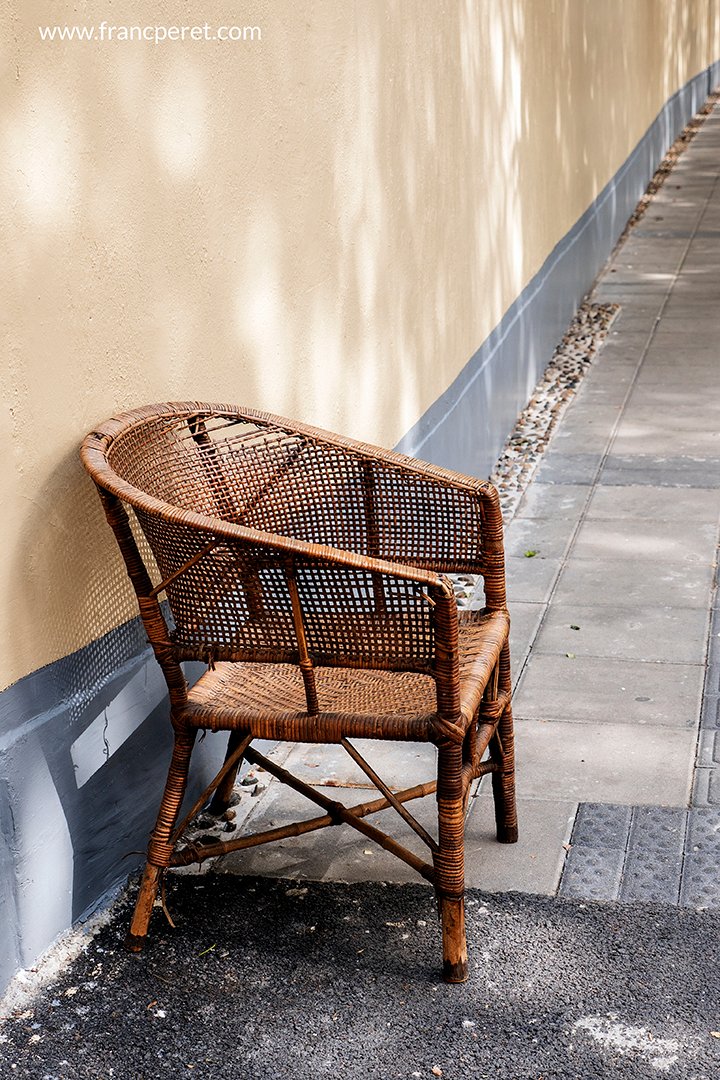
Having a seatEmpty Chair
Sometime it can be quit close to a reproduction of the real life, sometime, it is pure reformatting of the surrounding i am in.
Camouflage
light, Shadows, Lines, texture, colors and shape are directing my eyes and inspiring my brain.
And there is much more to come!
I am not turning my camera in the direction of real people, trees, car or building.
What are they shooting? My Saturday Essential Class students in action.
I am not choosing a specific subject or person according the way they look as is, I am assembling elements and collecting interesting reflection of light for reaching a personal feel of balance.
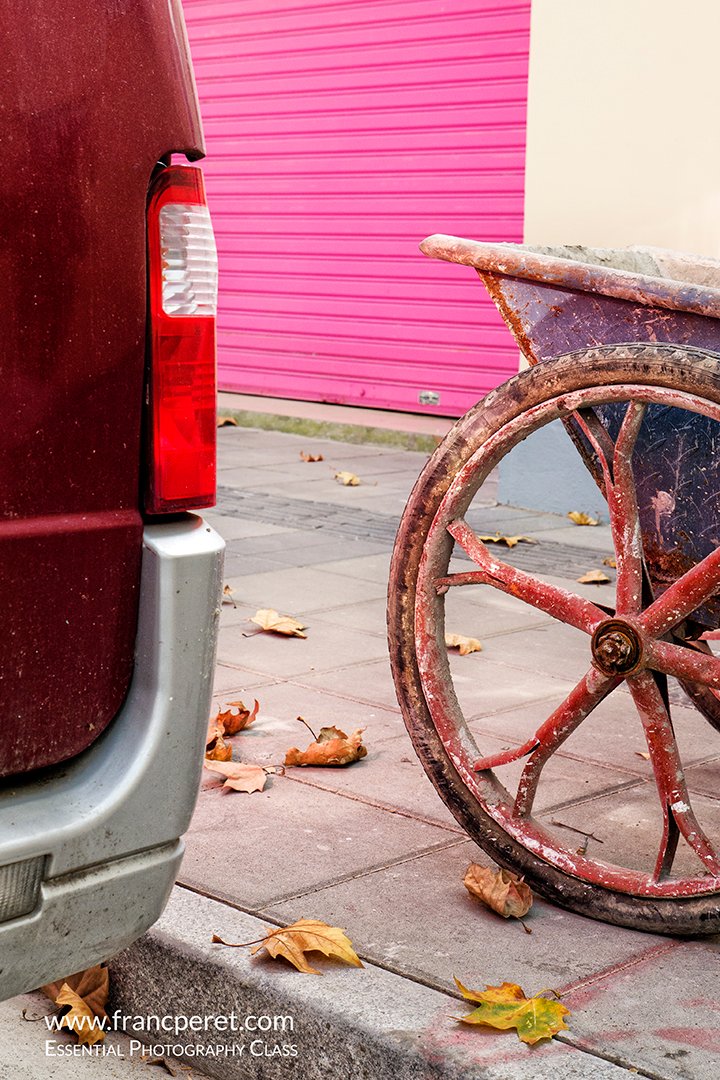
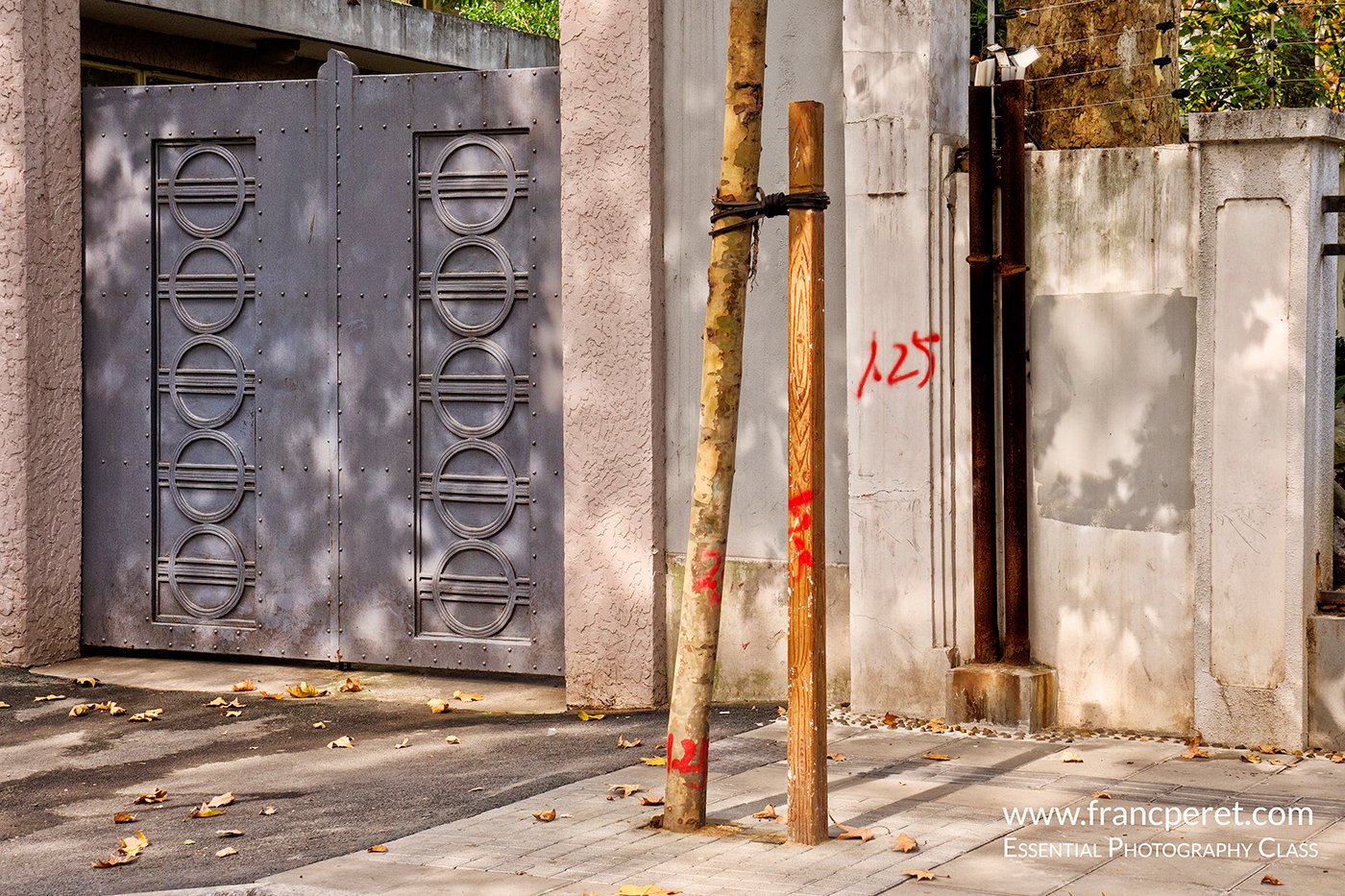
Shape and ColorsGate and WindowA red, pink and blue world
My pictures might not please or attract viewers, but this doesn’t matter much to me as I am using my own language to build up my images and I am not expecting that everyone is going to understand it or, even if they understand it, to agree with it.
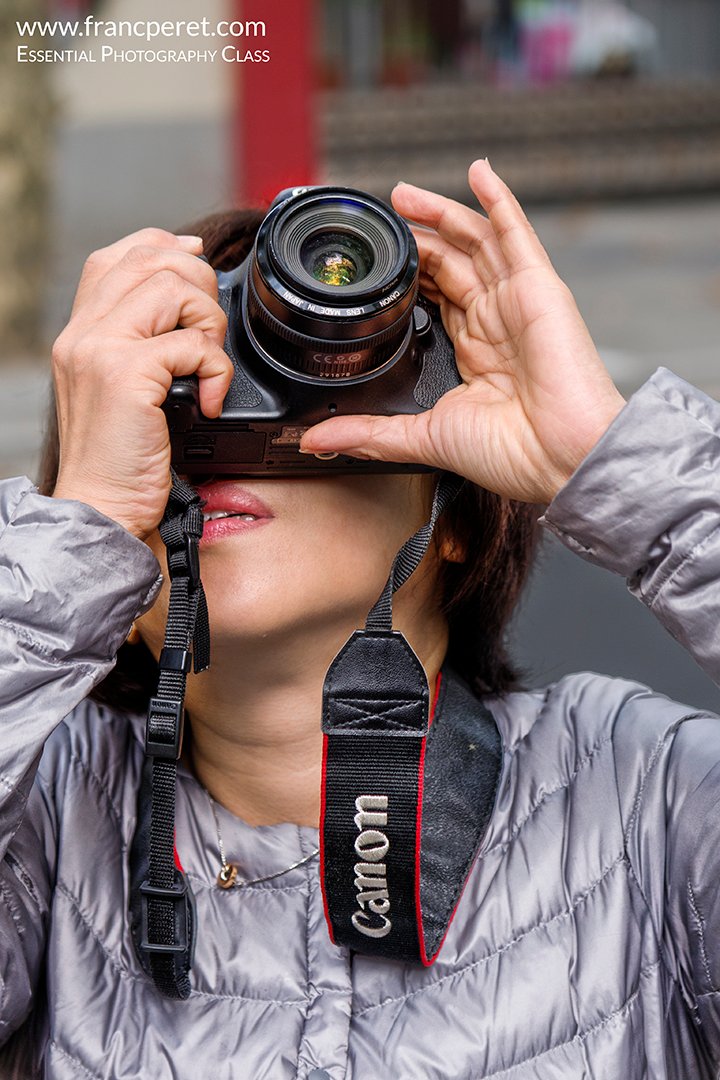
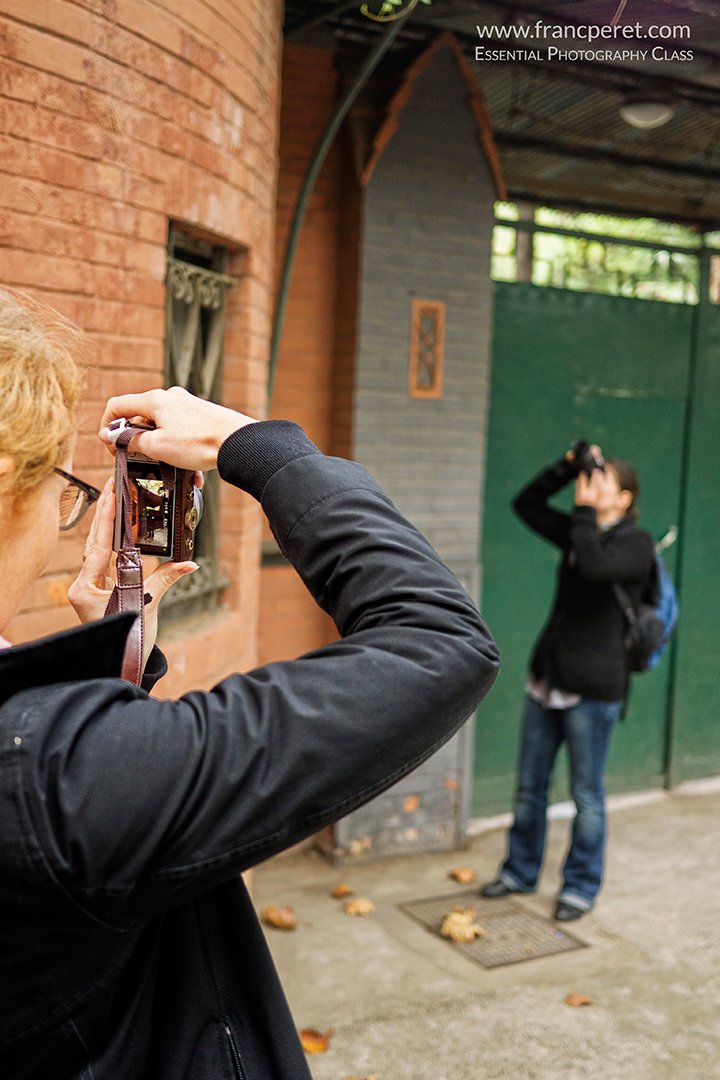
Wrong hand position! A lens is not a cup of tea!Shooting a shooter.Shooting Fever. My students at work…
Creation is something personal and as soon as I know what I am looking for, I guess that I know it better than outsider who might have a totally different sensitivity and approach to street photography.
Gate and leavesAnd more leaves!Texture and shape on Gate and wall
I am simply true to myself, building up my image according my need of structuring things visually and I am just trying my best to succeed to do so.
Pier knows how to use his camera with style.Antic on wheel
Even, when I am not carrying a camera, I am composing with things I am seeing, it is always useful, like a training, helping to detect interesting combination faster when I am having a camera in hands.
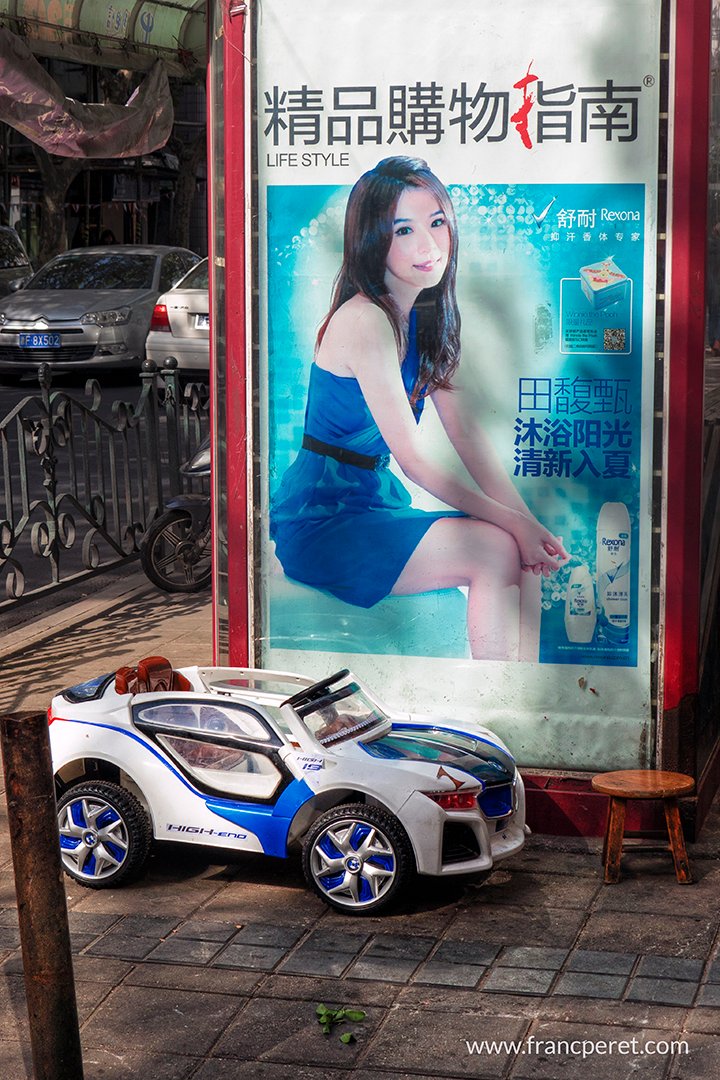
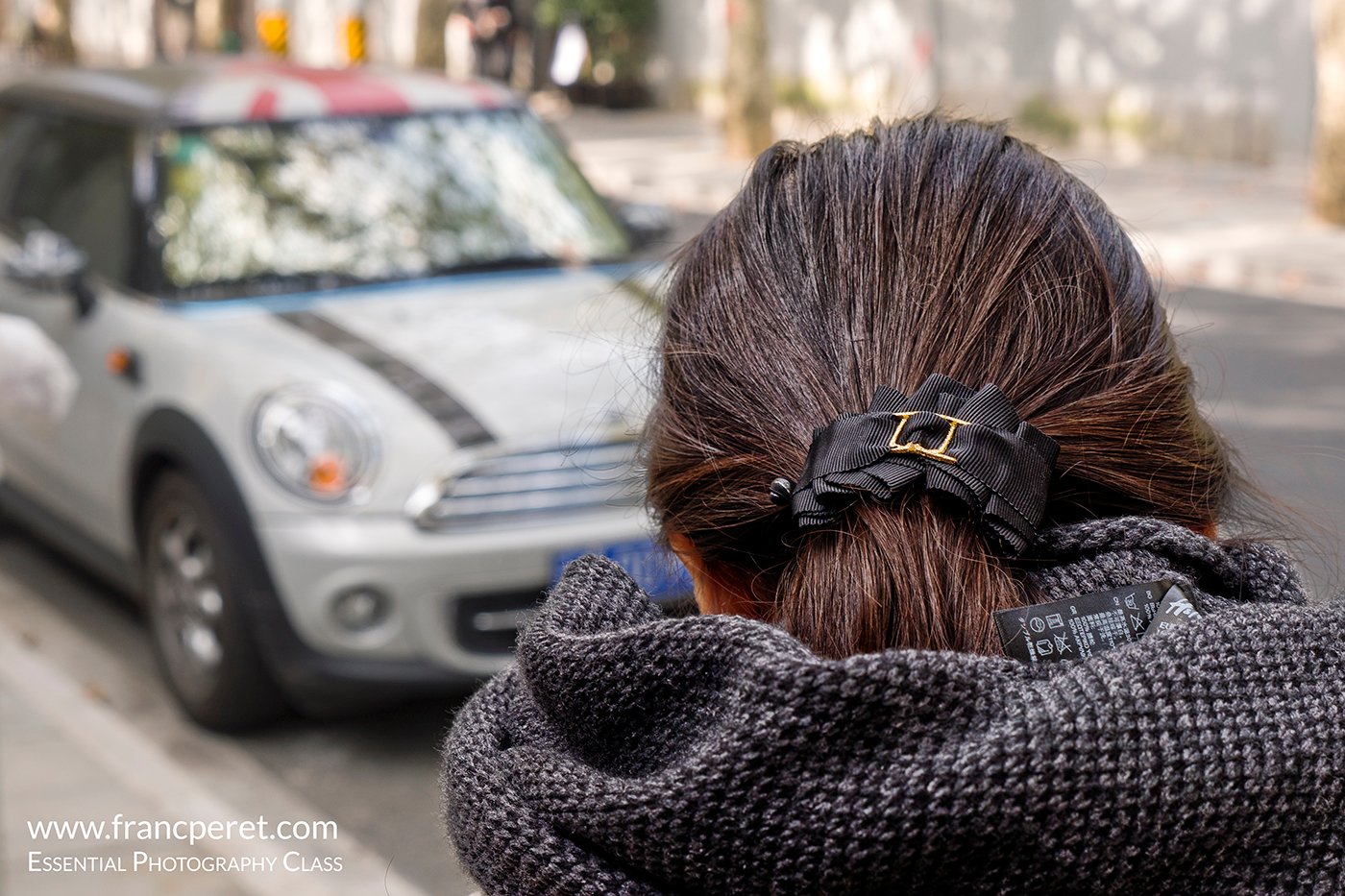
Mini Yukie loves Mini carMini Car
Composition is an extension of being sensitive to light, reflection of light and its character.
In China, dogs drink white paint…
I might say, in Photography, the light is the verb and the composition the adjective. They helps to build up the phrase we started by picking up a subject.
Yukie hides and…Philippe seeks
Actually, we often pick up a subject not for what it is but for what he/she is doing.
A couple of parrots shot by a couple of students
To get more information about my Essential Photography Course, check it here